
In my previous article, I wrote at length about why Chihiro knows her parents are not among the pigs at the end of Spirited Away(Studio Ghibli Official).
Read the full analysis: How Did Chihiro Know Her Parents Weren’t Pigs?
This time, I want to consider a different question: Why does Yubaba take people’s names? What is happening in that scene?
*This is a translated version. The original (Japanese) is available here.
- A New Nickname, Rather Than a Stolen Name?
When Yubaba says, “From today, you are Sen,” I see something like a ritual of acceptance into the bathhouse. Perhaps she is giving Chihiro a nickname rather than simply taking her name. - The Two Sides of a Nickname
A nickname given by someone in authority can shape how everyone else sees its bearer, regardless of that person’s wishes. Miyazaki’s nicknames for animators offer a comparison: giving a name and taking one away may be closer than they seem. - A Possible Message to Miyazaki’s Animators
Chihiro works under an overwhelming authority while remembering her own name. Her eventual freedom might be read as encouragement to animators: whatever you are called, hold on to what matters within you and, one day, become independent.
On this pageContents
Yubaba, Names, and the Benefits and Dangers of Nicknames
A name can connect someone to memory and identity, while a nickname can reshape how others see them. Yubaba’s contracts make that everyday tension threatening.
Does Yubaba Actually “Steal” Names?
To ask why Yubaba takes names, we first have to ask: is she really taking Chihiro’s name?
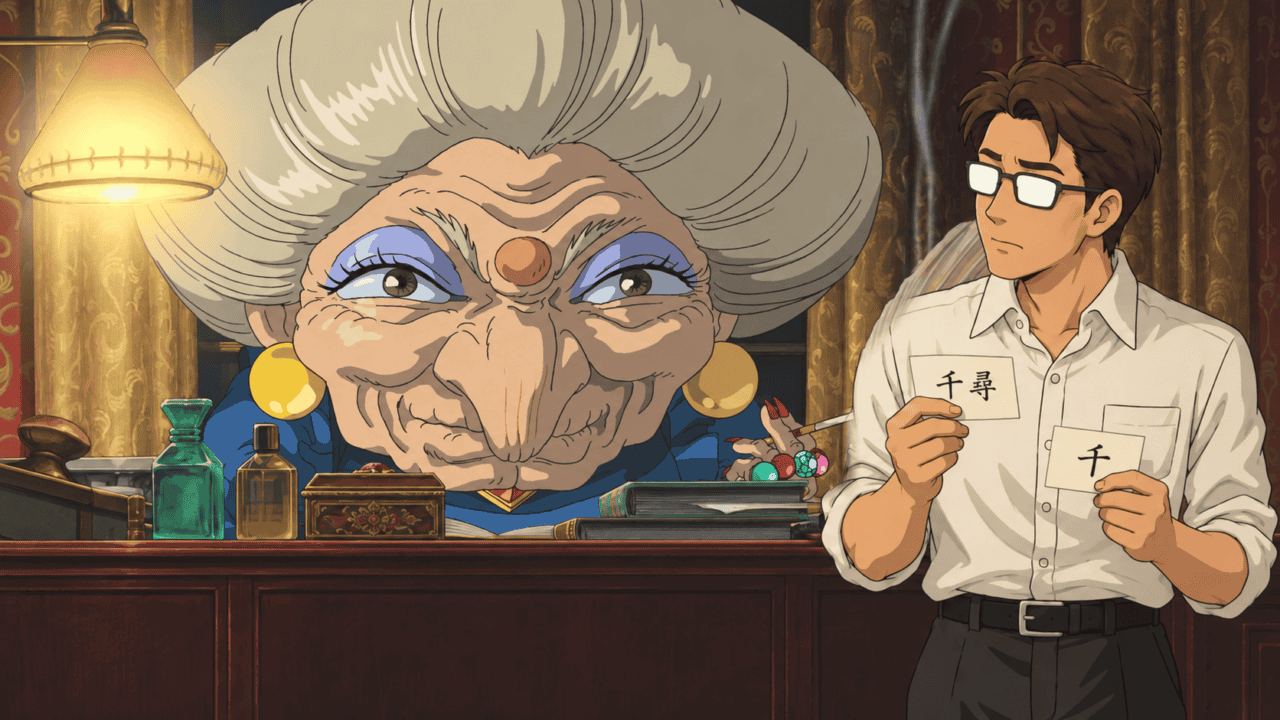
A frightening-looking witch makes the written characters of Chihiro’s name float off the page, leaving only 千, “Sen.” It certainly looks as if her name has been taken. But looked at another way, Yubaba is giving her the nickname “Sen.”
Why, then, do we tend to think only in terms of theft? I think the trailers and television advertisements have something to do with it. They described a ten-year-old girl whose name is taken and who ends up working in a mysterious town.
Information outside the film has helped shape our understanding of the scene.
Yubaba does say, “From today, you are Sen,” so I think we should consider the possibility that she is giving Chihiro a nickname. A superior calling a subordinate by a nickname can be an expression of affection. From that perspective, this could even be a good scene: despite everything, Yubaba has accepted Chihiro as a member of the organization.
The Benefits and Dangers of Nicknames
Even if we read the scene as Chihiro’s acceptance into the organization, whether giving her a nickname is a good thing remains a separate question.
Miyazaki gave Hiromasa Yonebayashi the nickname “Maro.” Yonebayashi directed Arrietty and When Marnie Was There at Ghibli, followed by Mary and the Witch’s Flower at Studio Ponoc, where he also directed a segment of Modest Heroes.
A Nickname and the Impression It Creates
Watching Yonebayashi on screen, “Maro” seems to suit him. He also seems as though he might not mind it—or might even like it. But that is only how he looks to me.
Whatever the associations of “Maro,” I do not hear it as a particularly respectful nickname.
Whether it happens to suit him does not settle the question. A name can sound affectionate without expressing respect.
Miyazaki can give him that name because of his position as the overriding authority within Studio Ghibli.
A nickname can determine a person’s place in a group, regardless of their own wishes.
For a more extreme example, imagine someone being told, “You’re like a dog, so I’ll call you ‘Pochi’!”
Calling Someone “Pochi”
“Pochi” is a familiar Japanese dog’s name, rather like “Fido” or “Spot” in English.
Applied to a person, it puts an animal’s name in place of their own. Whether they are happy with that is another matter.
The person might become much loved by everyone around them, including their colleagues. Yet we cannot assume they are comfortable being called “Pochi.”
That is the contradiction. Giving a nickname can also mean taking away a name, and the nickname may even begin to define the person’s humanity.
So why does the film include this scene in which Yubaba takes Chihiro’s name—or gives her a nickname?
A Little Self-Reflection—and a Message to the Animators?
One possible answer is that giving people nicknames is something Miyazaki does himself.
I know nothing about life inside Studio Ghibli. Still, I find it hard to imagine being able to refuse a nickname from Miyazaki. And I find it equally hard to imagine him being unaware of that situation.
Perhaps, in such a situation, he might think, “If you don’t like it, leave Ghibli and work somewhere else! In fact, that’s how you should live!”
An animator should be able to live by the strength of their own skills—that might be the idea.
Yet there may also be a little self-reflection here.
Early in the film, after Chihiro manages to get a job, Haku tells her that Yubaba takes people’s names to control them.
Haku’s warning about names is closely connected to another of his most important lines: “Without your real name, you’ll never find your way home.” For the Japanese original, romanization, subtitle, and translation notes, see our Spirited Away quotes in Japanese and English.
I can hear a little self-reflection in Haku’s warning about Yubaba taking names to control people, as though Miyazaki were saying, “I know people see me that way too.”
Seen this way, Chihiro’s effort to live as “Sen” without forgetting her own name—and her eventual escape from Yubaba’s hold—might be a message from Miyazaki to his animators. I imagine it something like this:
“Animators of Ghibli: yes, I give you nicknames without asking, and I do as I please from a position of authority. I understand if you resent that. But whatever name you are called, don’t lose what matters within you. One day, break free of the spell of Hayao Miyazaki, reclaim your own name, and fly!”
That, perhaps, is the message.
I have written all this without knowing the animation industry, Ghibli, or Miyazaki himself. Even so, I do not think this reading of Spirited Away is entirely off the mark.
Your Take
What is your view? Choose the answer that comes closest to your own response.
Poll results
What makes losing a name most unsettling to you in Spirited Away?
- Forgetting who you are.0%
- Losing the freedom to leave.0%
- Being defined by someone else.0%
- Several of these together.0%
- Something else.0%
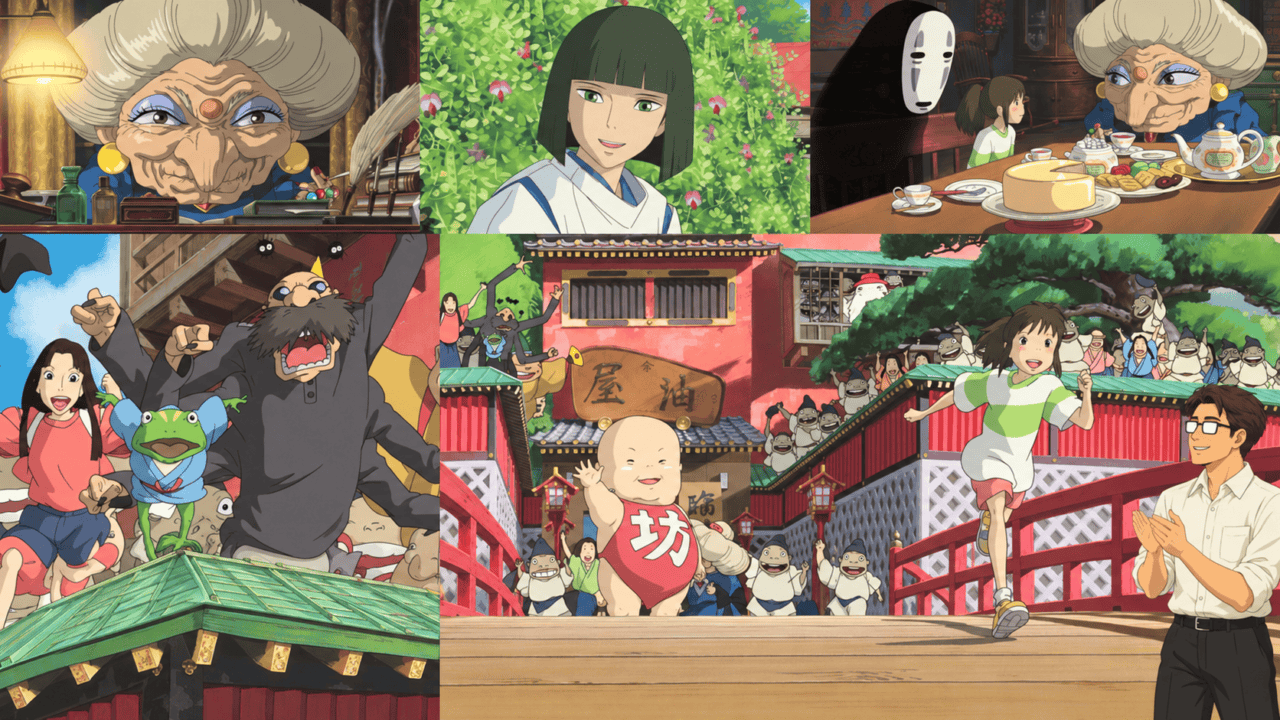
The images used in this article are from Studio Ghibli Works Still Images.
Can you name the movie before the scene comes into focus?
Put your visual memory to the test with a blurred Studio Ghibli scene.
Reader Comments
Have a thought or interpretation? Leave a comment