
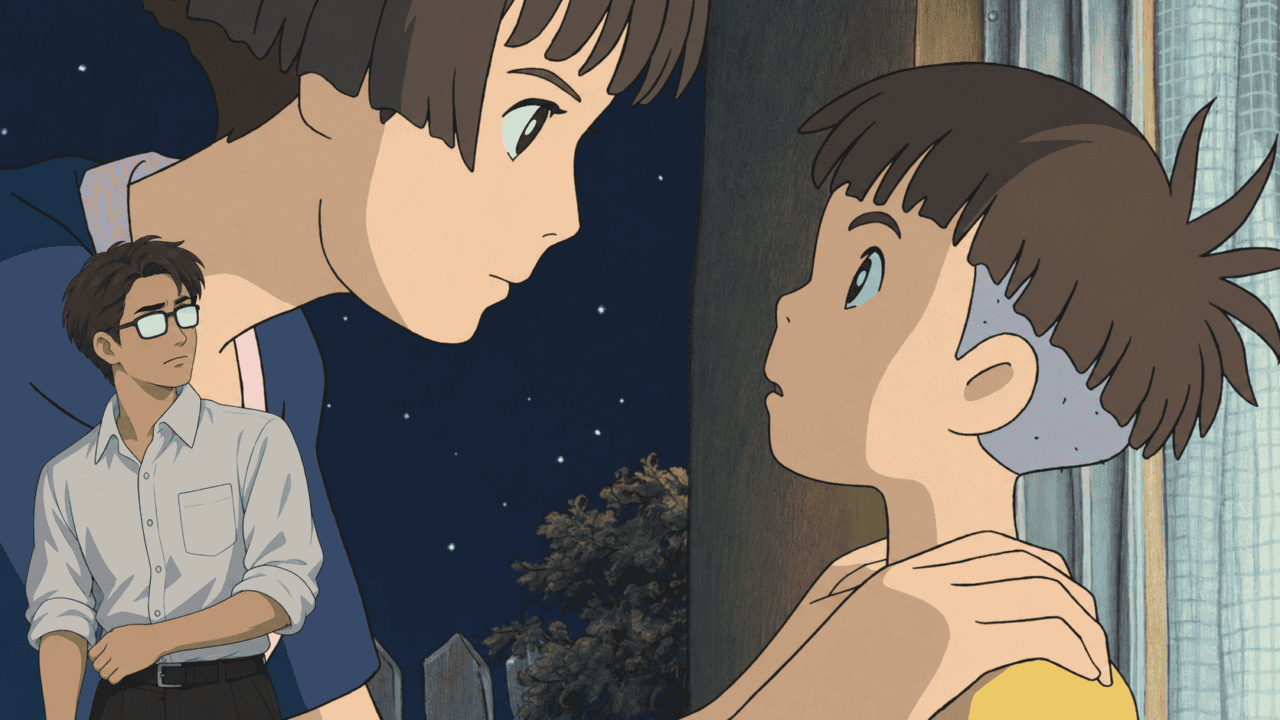
Ponyo (Official Studio Ghibli Website) is a 2008 animated feature film directed by Hayao Miyazaki.
I remember having little to say about it after my first viewing. One detail, though, was impossible to ignore: Sōsuke calls his mother “Lisa”—just her name, with no honorific. He calls his father “Kōichi” too.
Here, I want to consider why he addresses his mother that way.
First, I think we need to clear up a misunderstanding about Lisa. The unusual way her son addresses her seems to lead some viewers to see her as a flawed parent. I disagree: I see her as a fine parent and a capable adult. With that in mind, we can consider what calling her “Lisa” means.
*This is a translated version. The original (Japanese) is available here.
- Lisa: A Capable Working Mother
With Kōichi away, Lisa does most of the parenting while also working at Himawari House. Her judgment during the storm and her care for the children show a responsible adult. I see that example reflected in Sōsuke. - “Lisa” as a Sign of Sōsuke’s Independence
I read his use of her name as an expression of his independence. That quality matters to his role in protecting Ponyo, and it seems to have been nurtured at home. - A Sign of Lisa and Kōichi’s Close Relationship
Perhaps he uses their names because they have continued to use them with each other. Lisa calls her husband “Kōichi” in the film. I take that as a clue to the closeness of the couple whose love surrounds Sōsuke. - Shin-chan and Totoro
Like Shinnosuke in Crayon Shin-chan, Sōsuke addresses his parents by name and shows a strong independent streak. Like My Neighbor Totoro, Ponyo also suggests that children have important experiences beyond adults’ sight—and that those experiences can be dangerous.
On this pageContents
Ponyo (2008) Analysis: In Defense of Lisa’s Parenting
Lisa’s words and actions show several sides of her relationship with Sōsuke. Looking beyond the form of address helps put her parenting in perspective.
What Makes Lisa Such a Good Parent?
With her husband away from home, Lisa is effectively parenting on her own. On top of that, she works at Himawari House.
That alone leaves me with little inclination to criticize her. But she shows us still more to admire.
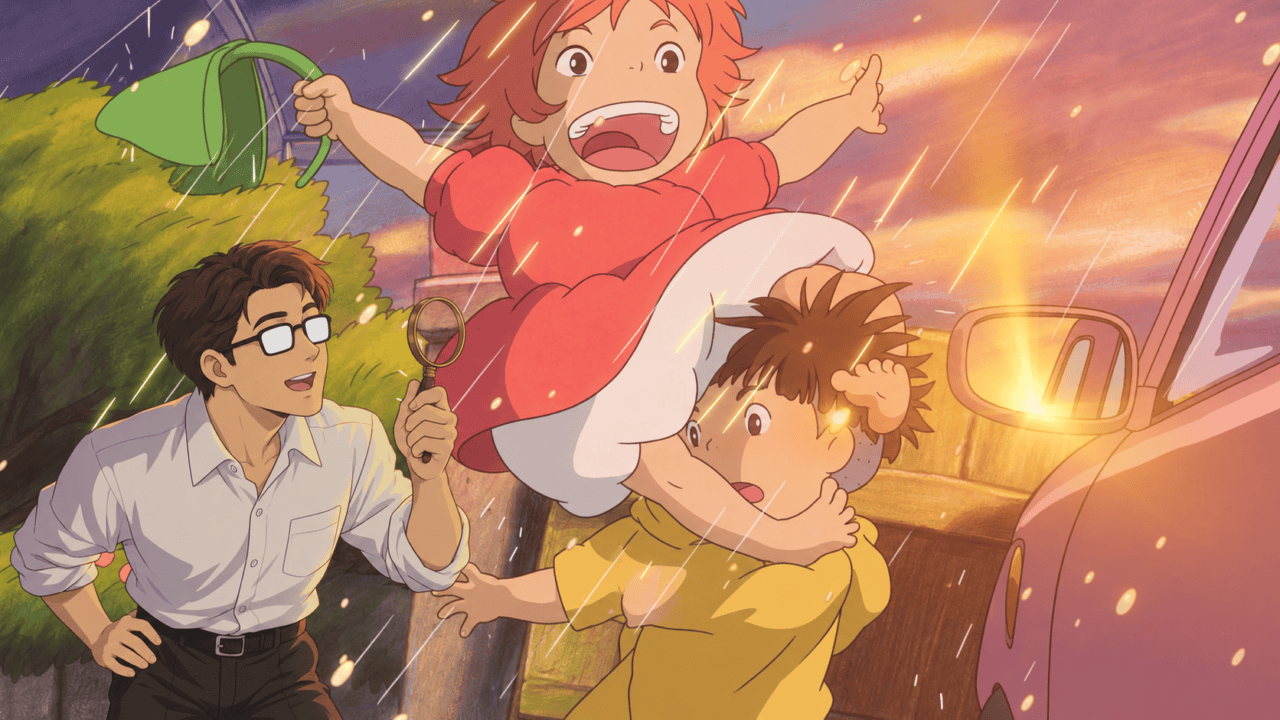
After Ponyo’s return brings the storm, Lisa briefly takes Sōsuke home from Himawari House. Look at what she does:
- She puts Sōsuke into the car through the driver’s door to shield him from the storm.
- When he says a girl has fallen, she gets out into the storm to try to rescue her.
- She takes Ponyo in, apparently seeing her as a lost child, without complaint.
- She puts her own needs aside and prepares food for the children.
- Once things have settled, she goes to check on Himawari House.
Her quick decision to return to the car after looking for Ponyo is impressive too. As a parent and an adult, she protects the children as a matter of course, while trying to fulfill her responsibilities at work. Kōichi’s presence might have helped—but men being little use is rather typical of Miyazaki’s films.
There may be objections. Early on, Sōsuke puts Ponyo, whom he found by the sea, in a bucket of tap water. Some people argue that a properly raised child would have used seawater instead.
I think that criticism comes either from a tiresome parent who imagines they have taught their child everything, or from a fool who does not yet have children and thinks they could. No parent can teach a child everything. Children also learn through experiences their parents have not prepared them for. Ordinarily, putting a sea fish in tap water could lead to its death and teach a child something—though I am sorry for the life lost.
There may also be objections to Lisa’s decision at the end. She allows the fate of the world to rest on her son. We do not know what Gran Mamare tells her in private, and it may seem cruel.
But I read it as a painful decision made precisely because Lisa is responsible.
Her son surely matters most to her, and I imagine she tried to refuse the offer. Yet protecting him also means protecting the world he lives in. After all, it was Sōsuke who brought Ponyo into the human world. Lisa may have wanted to take responsibility herself, but if only he can change the situation, she cannot.
Perhaps she chooses to live with the guilt of making her son bear that responsibility. To me, that is not something a parent who runs from responsibility could do. It is a decision she can make because she is a good person. You may disagree, but I hope her strength is clearer now.
Sōsuke: The Independent Boy Who Calls His Mother Lisa
Now to Sōsuke. One way to consider his use of “Lisa” is to imagine the opposite: what if he called her “Mom” or “Mama”?
That would be normal. In this story, though, I think it would suggest a child who depends strongly on the adult beside him. There is nothing wrong with that for a five-year-old.
But that is not the kind of character who could protect Ponyo.
To me, it is precisely this boy, who calls his parents Lisa and Kōichi, who can protect Ponyo and set out in a boat to look for Lisa after the flood.
The family’s circumstances may matter too. Kōichi is away throughout the story. Perhaps he is escaping family life, but his work as a sailor also makes his absence difficult to avoid. With mother and son spending much of the year together, how to raise Sōsuke would be an important question. I suspect independence was their priority.
That wish seems to have borne fruit. Sōsuke is remarkably independent for a five-year-old and tries wisely to protect what matters to him. He sometimes shows an especially clear, dignified gaze. I see that as the result of Lisa and Kōichi’s care—though, in practice, I think Lisa has done most of the raising.
That determination also comes through clearly in Sōsuke’s dialogue. Several of his most important lines are examined in Ponyo Quotes in Japanese and English.
A Clue to a Close Marriage
That is the main point I wanted to make. To finish, I’ll look at the names from another angle: the couple’s relationship.
Before children arrive, couples may address each other by name or by a nickname. Once a child is born, they often start calling each other “Mom” and “Dad.”
There may be several reasons. In a nuclear family, each parent is often the person who addresses the other most frequently. A baby who hears names or nicknames may learn those as the right way to address them. Parents who want to be called “Mom” and “Dad” may therefore use those terms themselves, at least in front of the child. They may keep doing so as the child grows because it makes their roles in the household clearer.
Seen the other way around, Sōsuke’s choice suggests that Lisa and Kōichi have kept calling each other by name since he was born.
Lisa does call him “Kōichi” in front of Sōsuke.
I read that as a sign that they were close and still are. She complains about his being too busy with work to come home, but that can be the other side of affection.
Perhaps it is growing up with the love of such a close couple that makes Sōsuke the boy who can be this story’s protagonist.
An Aside: Crayon Shin-chan and My Neighbor Totoro
Other animated families provide a useful comparison for how children name and relate to adults. These examples help separate a family’s behavior from a single word.
The “Crayon Shin-chan” Parallel
A boy addressing his parents by name inevitably makes me think of Shinnosuke in Crayon Shin-chan.
He calls his mother “Misae” and his father “Hiroshi.” I would read that, too, as a sign of the couple’s closeness.
Does that make him a bad child? Not at all. He is independent and deeply responsible about protecting his little sister. Whatever the original work intended, I see Crayon Shin-chan as a counterargument to negative views of the nuclear family—a work that affirms it.
From that perspective, Sōsuke might be called Miyazaki’s version of Shinnosuke.
He is not as silly or mischievous, but he is just as independent. It is an unusual comparison, yet I think Ponyo can be seen as a counterpart to Shin-chan—whether or not that was intended.
Ponyo and My Neighbor Totoro
Another film that comes to mind while watching Ponyo is My Neighbor Totoro.
Both films strongly convey a wish to show them to children. Lisa even sings “Watashi wa genki”—“I’m fine”—from Totoro in one scene.
But there are more important similarities:
- A child meets a mysterious being while alone.
- The child is in danger.
In Totoro, Mei goes missing. In Ponyo, Sōsuke is swept up by the waves.
I do not mean that Ponyo simply repeats the earlier film. Rather, I think both share this idea:
Children have strange and important experiences when adults are not watching, but danger always accompanies them.
Perhaps being close to danger is part of childhood.
I remember dangerous games from my own childhood. Sadly, I never met a Totoro or a Ponyo. If I was going to face the danger anyway, I would have liked a more mysterious experience.
Have you ever met a mysterious being?
Your Take
What is your view? Choose the answer that comes closest to your own response.
Poll results
How does Sōsuke calling his mother Lisa feel to you?
- Affectionate and familiar.0%
- A sign that she has an identity beyond motherhood.0%
- A little emotionally distant.0%
- A mixture of these.0%
- I see it differently.0%
- I’m not sure.0%
The images used in this article are from the Studio Ghibli Works Still Images collection.
Can you name the movie before the scene comes into focus?
Put your visual memory to the test with a blurred Studio Ghibli scene.

Reader Comments
Have a thought or interpretation? Leave a comment