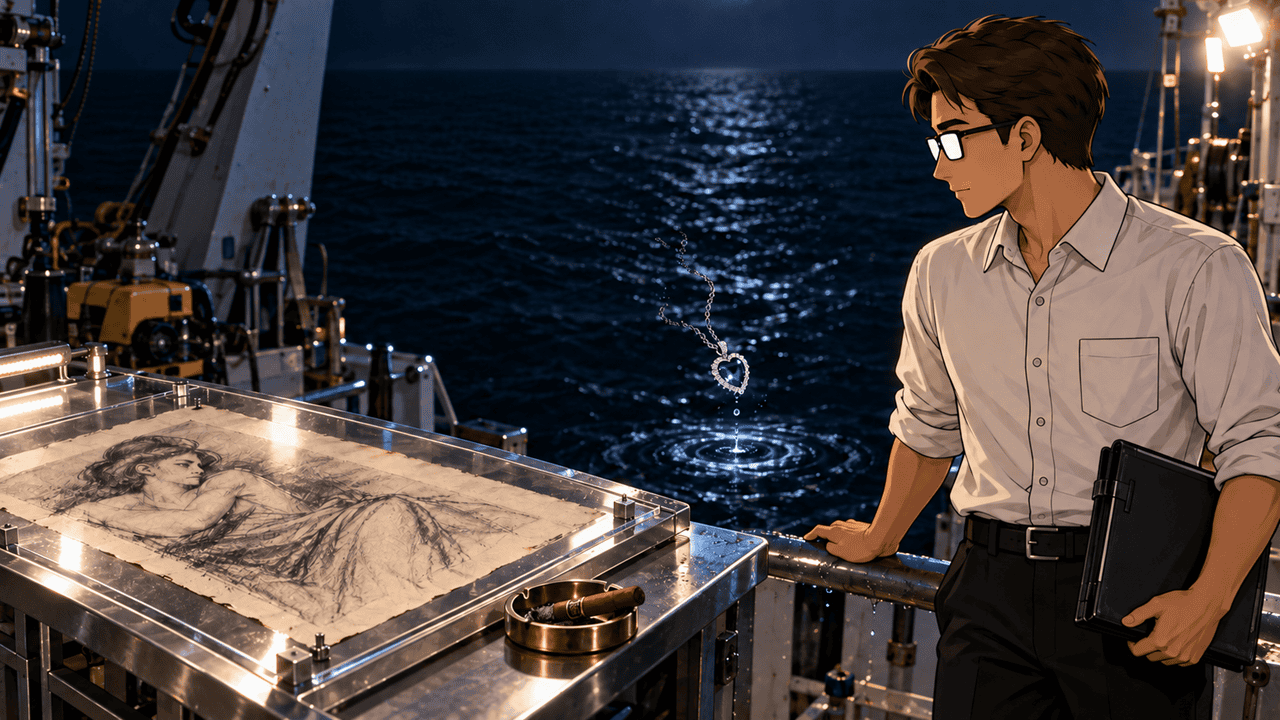
At the end of Titanic, the elderly Rose throws the Heart of the Ocean into the sea after keeping it for 84 years.
No matter how many times I watch that scene, part of me still thinks, “Wait—you’re throwing it away?” But why does Rose finally let the diamond go?
A familiar answer is that she is breaking with Cal. The Heart of the Ocean was a gift from her fiancé, and it seems to symbolize both his wealth and his desire to treat Rose as his possession. On that reading, she finally buries that past at sea.
I do not think that interpretation is wrong. Taken on its own, however, it leaves one substantial question unanswered.
If she simply wanted to break with Cal, why did she keep the Heart of the Ocean for 84 years?
After surviving Titanic, Rose does not return to Cal. Calling herself Rose Dawson, she begins a completely different life. Her break with him has already happened in 1912. Yet she keeps the jewel without selling it, throwing it away, or even telling her family it exists.
That suggests to me that the Heart of the Ocean did not remain merely a jewel Cal had given her.
- Why did Rose keep the diamond for 84 years?
- Why did she let it go after Jack’s drawing was found?
- Why did Brock Lovett throw his cigar into the sea just before she did?
Thinking about those three questions together, I believe we can begin to understand what the Heart of the Ocean means at the end. Here is my interpretation.
*This is a translated version. The original (Japanese) is available here.
- Why Rose kept the Heart of the Ocean for 84 years: I read the diamond as having become more than Cal’s gift: it was one of the few physical links between the present and her last night with Jack.
- Why she could let it go after 84 years: A drawing made by Jack himself returned from the seabed, and Rose told his story to other people. In this reading, she no longer needed the diamond alone to keep his existence present.
- Lovett’s cigar and Rose’s diamond form a pair: He lets go of his fixation on finding the jewel, while she is freed from entrusting her memories to it. On the same night, they each cease to need the Heart of the Ocean.
- Rose returns the diamond to Titanic rather than simply discarding it: As if in exchange for Jack’s drawing returning from the sea, the jewel she has kept for 84 years goes back into it.
- What Rose truly wanted to preserve was not the jewel: What ultimately remains, in my interpretation, is her memory of Jack and the life she went on to live.
On this pageContents
Why Did Rose Keep the Heart of the Ocean for 84 Years?
Cal gives Rose the Heart of the Ocean. But once we recall what it does within the story, it becomes difficult to keep calling it simply Cal’s diamond.
To separate Jack from Rose, Cal orders Lovejoy to slip the jewel into Jack’s pocket. It is then used as evidence to frame him for theft, leaving him handcuffed inside Titanic as the ship begins to sink.
Rose initially follows the movement toward the lifeboats, but cannot abandon Jack and goes back inside. Taking an axe herself, she frees him. The two then flee through the flooding ship before finally being thrown into the sea as it goes down.
By using the Heart of the Ocean to frame Jack, Cal helps bring about Rose’s decision to return and save him. Cal provided the jewel, but it has also come to carry the memory of her last night with Jack.
And, in a particularly bitter irony, that jewel does not go down with Titanic.
After being rescued, Rose reaches into the pocket of the coat Cal put around her and finds the Heart of the Ocean still there. Titanic has sunk and Jack has died, yet she is left holding an object connected to the night that transformed her life.
- Originally: a jewel Cal gave to Rose.
- Later: used to frame Jack.
- As a result: one of the circumstances that led Rose to return and rescue him.
- After the sinking: an object from that night that remained in her possession.
Seen that way, her reluctance to discard it for 84 years becomes much less surprising.
What matters most to me here is how little else remains of Jack.
He had not even planned to sail on Titanic. He wins a ticket at poker just before departure, boards the ship, and dies in the sinking. When the film’s present-day research team looks into Jack Dawson, it finds no record connecting it to the Jack Rose describes.
Rose herself says, in effect, that he now exists only in her memory. He changed her life completely, yet if she stays silent, no one else knows about him. Beyond Rose, nothing seems to remain of his presence aboard the ship, his rescue of her, or their love.
The Heart of the Ocean was not Jack’s possession. Even so, might it have become, for Rose, one of the few physical connections to that night when he had unquestionably existed?
Eighty-four years later, however, that situation changes.
Brock Lovett and his team raise a safe from Titanic while searching for the diamond. The jewel they hope to find is missing. In its place is a drawing of the young Rose wearing nothing but the Heart of the Ocean.
And Jack drew it.
However deeply the diamond has become entwined with her memories of Jack, it still originated with Cal. The drawing is different. Jack looked at Rose and made it with his own hands.
After 84 years in which Jack had lived only in Rose’s memory, something unique that he himself had made returns from the seabed.
I think that recovery matters enormously to her eventual decision to let the jewel go.
But saying that the drawing made the diamond unnecessary does not, by itself, explain the rest of the film.
After the drawing is found, Rose makes the journey to Lovett’s ship and tells the team what she experienced aboard Titanic. Jack is, of course, at the center of that story.
Until then, Rose alone had known him. Once she finishes, Lovett and the others know his story too. No official record has been discovered, but the story that had survived only within Rose now also survives in other people’s minds.
The film then shows, in a rather interesting way, that her story has truly reached Lovett.
Lovett Throws Away His Cigar; Then Rose Throws Away the Diamond
Shortly before Rose drops the Heart of the Ocean into the water, Brock Lovett also throws something into the sea.
A cigar.
And not just any cigar. He has been saving this particular one to smoke when he finds the Heart of the Ocean. It is, in other words, a cigar intended to celebrate himself as the man who finally found the diamond.
Yet after hearing Rose’s entire story, he throws it overboard even though he has still not found the jewel.
The diamond he has pursued for years is still missing. From the perspective of a treasure hunt alone, there is no reason to discard that cigar. His doing so suggests that the very aim of finding the Heart of the Ocean has changed its meaning for him.
Until then, Titanic was a place where an immensely valuable jewel lay waiting. Learning from Rose what actually happened there changes the way he sees it.
There may be a diamond on the seabed. But a diamond is not all that went down there. People lived and died there. Stories like Rose and Jack’s unfolded there.
I think that realization is why he discards the cigar meant to celebrate his own great discovery.
Then, almost immediately afterward, Rose drops into the sea the actual Heart of the Ocean that Lovett has devoted his life to finding.
- For Lovett: the Heart of the Ocean was treasure to be found.
- For Rose: it was a keepsake connecting her to that night with Jack.
They wanted entirely different things from the same jewel. Yet once Rose has finished telling her story, they cease to need it at almost the same time.
Lovett gives up his fixation on finding the diamond and throws away the cigar that embodied it. Rose, too, lets go of the jewel that has carried her memories of Jack through those 84 years.
Lovett discards the cigar, and then Rose discards the diamond. I read these two gestures as a pair.
Their order matters too.
If Jack’s drawing had merely been found, something might have come full circle only within Rose herself. But she also tells his story to Lovett and the others, and Lovett changes because he hears it.
In this reading, his act of throwing away the cigar makes it possible for Rose to recognize that her story has truly reached at least one other person.
That suggests two things may have been necessary before she could let the Heart of the Ocean go.
- Finding a drawing Jack himself had made.
- Jack’s story reaching someone other than Rose.
Together, they could explain both why she kept the jewel for 84 years and why she suddenly released it on that particular day.
Jack’s drawing has returned. There are now other people who know about him. The Heart of the Ocean no longer has to bear the whole weight of keeping her memories present.
That is how I understand her decision.
Where she lets it go matters as well. She does not put it in a rubbish bin, sell it, or give it to her children or granddaughter. She drops it into the sea where Titanic lies.
At the beginning of the film, Jack’s drawing is brought up from the seabed. At the end, the Heart of the Ocean leaves Rose’s hand and returns to that same sea.
Something Jack left behind comes back from the sea; almost in exchange, something Rose has kept for 84 years goes home to it.
Seen this way, perhaps Rose is returning to Titanic something she has long been keeping, rather than merely throwing it away.
From Lovett’s point of view, though, there is something deliciously cruel about the ending.
The jewel he has spent his life chasing has been practically under his nose. Just after he finally gives up his obsession with it, the real thing goes straight overboard with a splash.
Imagine how he would feel if he knew.
For the film, however, that may be exactly right. The treasure-hunting Lovett would surely have lunged at the diamond had it appeared in front of him. The man who has finished listening to Rose is no longer quite the same person.
What he finally gains from Titanic is the story of the people who lived there, rather than a jewel worth hundreds of millions of dollars.
The same is true of Rose. What she has treasured for 84 years is not simply an enormously valuable blue diamond. It is the memory that Jack really existed and spent that time with her.
At the end, photographs beside Rose’s bed show the life she went on to lead. Then the young Rose returns to Titanic’s Grand Staircase and makes her way toward Jack.
The Heart of the Ocean is not there.
It is no longer needed.
What Rose has truly kept for 84 years is her memory of Jack. I think returning the diamond alone to the sea finally makes that distinction clear.
That brings my interpretation of Rose’s decision to an end. Now, let us consider something a little less serious.
I suspect many viewers watched that ending and thought, “Why not just sell the thing?” But could she actually have done so?
An Aside: Could Rose Have Sold the Heart of the Ocean?
There is one more question about the Heart of the Ocean: could Rose have sold it?
She kept it for 84 years. If money ever became tight at some point in her life, wouldn’t selling it have seemed an obvious option?
After all, it is fantastically valuable. We do not know Rose’s financial circumstances throughout her later life, but it is hard to imagine a more reassuring secret nest egg.
Trying to sell it, however, could have become rather complicated.
- Ownership: was Rose free to dispose of a diamond given to her by her fiancé Cal?
- Insurance: had it been treated as an insured jewel lost with Titanic?
- Provenance: how would she explain selling a diamond that had been missing for 84 years?
The first question is ownership.
Cal gives Rose the Heart of the Ocean, so the straightforward reading is that it becomes hers as a gift. But they are engaged, and the jewel is closely associated with that engagement and their intended marriage.
Would the matter end with the fact that he had given it to her, or might the broken engagement have raised a question about returning it? That is less clear.
The film does not resolve such legal questions, so I cannot decide the answer here. It may not be as simple as assuming that a gift from Cal was automatically hers to sell without any further issue.
Another complication would be how Cal and his family had dealt with the missing diamond.
Rose discovers it after being rescued, then adopts the name Rose Dawson and disappears from Cal’s life. From his perspective, it would be understandable to think that the jewel had gone down with Titanic.
Which raises another question: what about insurance? This is an extraordinarily expensive diamond. If it had been insured, and a claim had been paid for its loss in the sinking, the original suddenly reappearing decades later could have complicated matters further.
The film does not settle those practical consequences, so this part is speculation. Still, once you start imagining them, it is rather fun.
The biggest difficulty, to my mind, is simpler than the legal questions.
How would she actually go about selling it?
A jewel like the Heart of the Ocean is hardly something to take to the local secondhand shop and casually ask to have valued. If an elderly woman suddenly produced a legendary blue diamond that had been missing for decades, someone would surely ask:
“Where did you get this?”
An honest answer would run something like: “I brought it away from Titanic in 1912, and I’ve had it for the past 84 years.”
The next question would probably have little to do with the asking price.
“Who exactly are you?”
That seems the likelier response.
Rose would then find herself explaining that she had sailed on Titanic as Rose DeWitt Bukater, called herself Rose Dawson after the sinking, and gone on to live an entirely different life.
Why did she have a jewel thought to have been lost with the ship? Why had she stayed silent for 84 years? Did Cal know? Would his family have anything to say? What had happened with the insurance?
She might find herself having to explain her whole life since 1912 just to sell one diamond.
Could she simply sell it quietly while keeping her identity secret?
That would be difficult too.
Producing an enormous blue diamond missing for 84 years and saying that it had always been lying around at home would be asking rather a lot of anyone’s credulity.
The Heart of the Ocean would also be valuable not just as a large blue diamond, but because of its connection to Titanic.
To benefit from that history, however, she would need to establish that it really was the Heart of the Ocean. In doing so, she could hardly escape the question of how she had acquired it.
Concealing her identity would make the diamond’s history harder to establish; establishing that history would make concealing her identity harder.
Quite an awkward secret fortune.
None of this proves that selling the Heart of the Ocean would have been impossible. Had the ownership, insurance, and other issues been properly resolved, a sale might have been possible.
It probably would not have been the casual matter suggested by the thought that she should simply have sold such an expensive jewel whenever she needed money.
And after entertaining all these rather silly practicalities, I find myself back where I started.
For 84 years, Rose never turns the Heart of the Ocean into money. In the end, she does not leave it to her children or granddaughter either. She returns it to the sea.
Perhaps, for her, it was never principally a diamond with an astronomical price tag.
That is why she could keep it for 84 years—and why, in the end, she could let it go.
Seen that way, it is a remarkably well-conceived jewel.




Reader Comments