
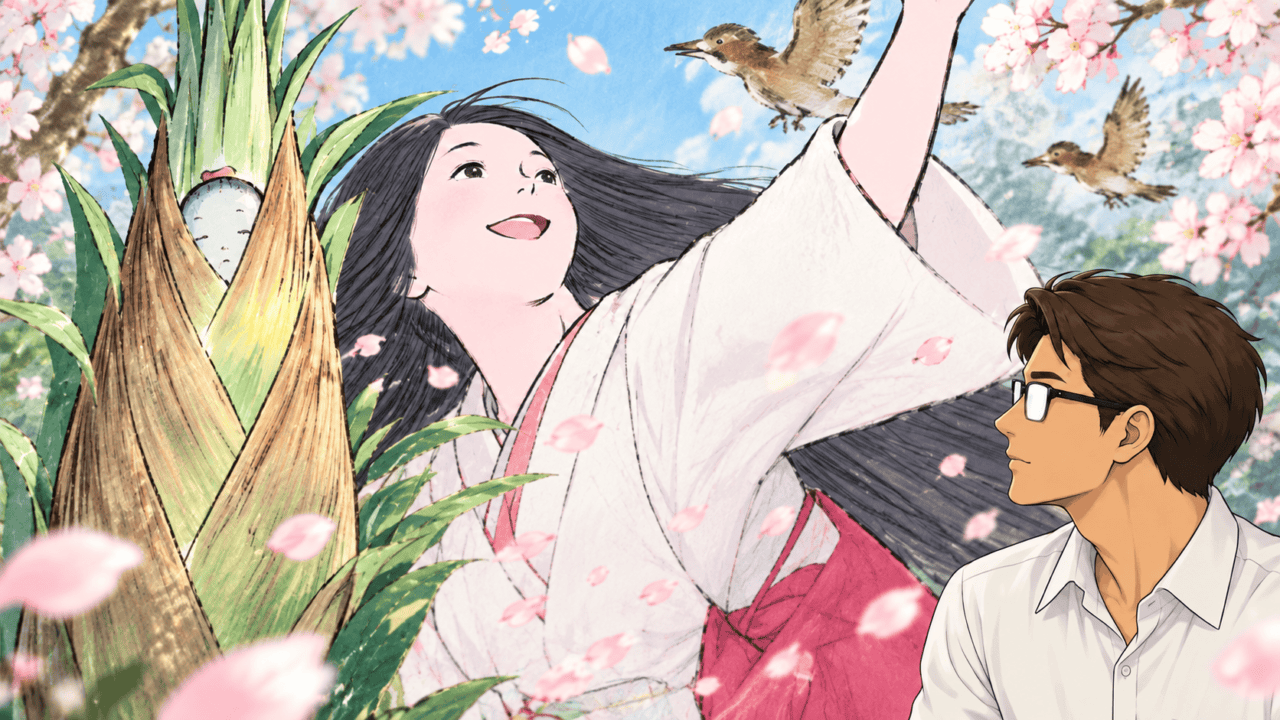
Isao Takahata’s The Tale of the Princess Kaguya (Official) is a theatrical animated film released in 2013. Its tagline was “The crime and punishment of the princess.” It turned out to be Takahata’s final film, but its box-office return of 2.1 billion yen was a disappointing commercial result.
Plenty of people around me went to see Hayao Miyazaki’s The Wind Rises that year, but few saw The Tale of the Princess Kaguya. Actually, none did. I wrote about my frustration with that in the article below:
Here, I summarize The Tale of the Princess Kaguya and compare it with its source, The Tale of the Bamboo Cutter. A warning: although this is a synopsis, I cover the entire story. If you want to avoid spoilers, stop partway through and watch the film.
*This is a translated version. The original (Japanese) is available here.
- Detailed Synopsis and Character Map
Kaguya is born from bamboo and grows up happily in the mountains. At the Old Man’s insistence, she moves to the capital, where nobles and the Emperor seek her hand. She rejects them, but must eventually return to the moon, still longing for Earth. Below are a detailed synopsis, a character map, and commentary on the story. - A Greater Focus on Everyday Life
The film greatly shortens the five noble suitors’ episodes in The Tale of the Bamboo Cutter, while carefully depicting Kaguya’s life in the mountains and the capital. This change suggests Takahata’s interest in human lives and feelings over aristocratic pretensions. - A Different Relationship with the Emperor—and a Shorter Timeline
The original tale presents Kaguya’s exchanges with the Emperor positively, over an extended period. In the film, she clearly rejects his advances, and her time on Earth is considerably shorter. This heightens the sadness of a life whose brief span is largely spent in a capital where she does not want to be.
On this pageContents
The Tale of the Princess Kaguya (2013): Synopsis (Spoilers)
The synopsis follows Kaguya from her childhood in the mountains to her return to the Moon.
Story Highlights and Character Relationships
Here is a brief outline of The Tale of the Princess Kaguya:
-
The Princess Born from Bamboo
The protagonist, Kaguya, is born from bamboo. The Old Man (Okina) discovers her in a bamboo grove, takes her home, and raises her with the Old Woman (Ouna) as their own child, calling her “Princess.” -
The Princess Called “Takenoko”
Her remarkable growth earns her the nickname “Takenoko,” or “bamboo shoot,” among the local children. -
Life in the Mountains with Sutemaru
Kaguya runs through the mountains and fields with the other children, led by Sutemaru, and enjoys her life there. -
The Old Man Plans a Life in the Capital
The Old Man finds fine clothes and gold in the bamboo grove where he found Kaguya. Determined to raise her as a fine princess, he uses this wealth to acquire a residence in the capital. -
Leaving the Mountains for the Capital
Still longing for her life in the mountains, Kaguya begins a new life in the capital with the Old Man and Old Woman. -
Aristocratic Education and Her First Period
Kaguya receives various lessons intended to make her a “proper princess.” During this time, she has her first period. -
The Naming of Nayotake no Kaguya-hime
While Kaguya is bewildered by the changes in her body, the Old Man is delighted. He asks the prominent nobleman Inbe no Akita to name her. Akita praises her beauty and names her Nayotake no Kaguya-hime—Princess Kaguya of the Supple Bamboo. -
The Coming-of-Age Ceremony and Despair
At her coming-of-age ceremony, Kaguya despairs at being treated as an object. She dreams of fleeing somewhere else, but cannot escape. -
Five Nobles Seek Her Hand
Despite her wishes, Kaguya’s beauty becomes the talk of the aristocracy, and five noblemen propose marriage. -
Kaguya Sets Impossible Tasks
Kaguya rejects their proposals by setting them impossible tasks. -
The Nobles Fail
The noblemen try all kinds of fabrications to fulfill these impossible demands, but every attempt is defeated. -
The Emperor Takes an Interest
The Emperor hears that Kaguya has rejected the prominent nobles and decides to act. -
The Emperor’s Assumption—and Rejection
The Emperor is convinced she rejected the others because she wanted him. Kaguya rejects him too. -
Kaguya Wishes to Return to the Moon
Unable to escape the advances of the most powerful man in the land, Kaguya desperately wishes to return to the moon. -
Her Longing for Earth
Although Kaguya still longs for Earth, the people of the moon come to take her back. -
Resistance Fails
The Old Man, the Old Woman, and others try to protect Kaguya, but are helpless against the moon people’s mysterious power. She is taken away. -
The Robe of Feathers and Lost Memories
Wearing the lunar robe of feathers, Kaguya loses her memories. Yet an inexplicable feeling for Earth remains somewhere within her.
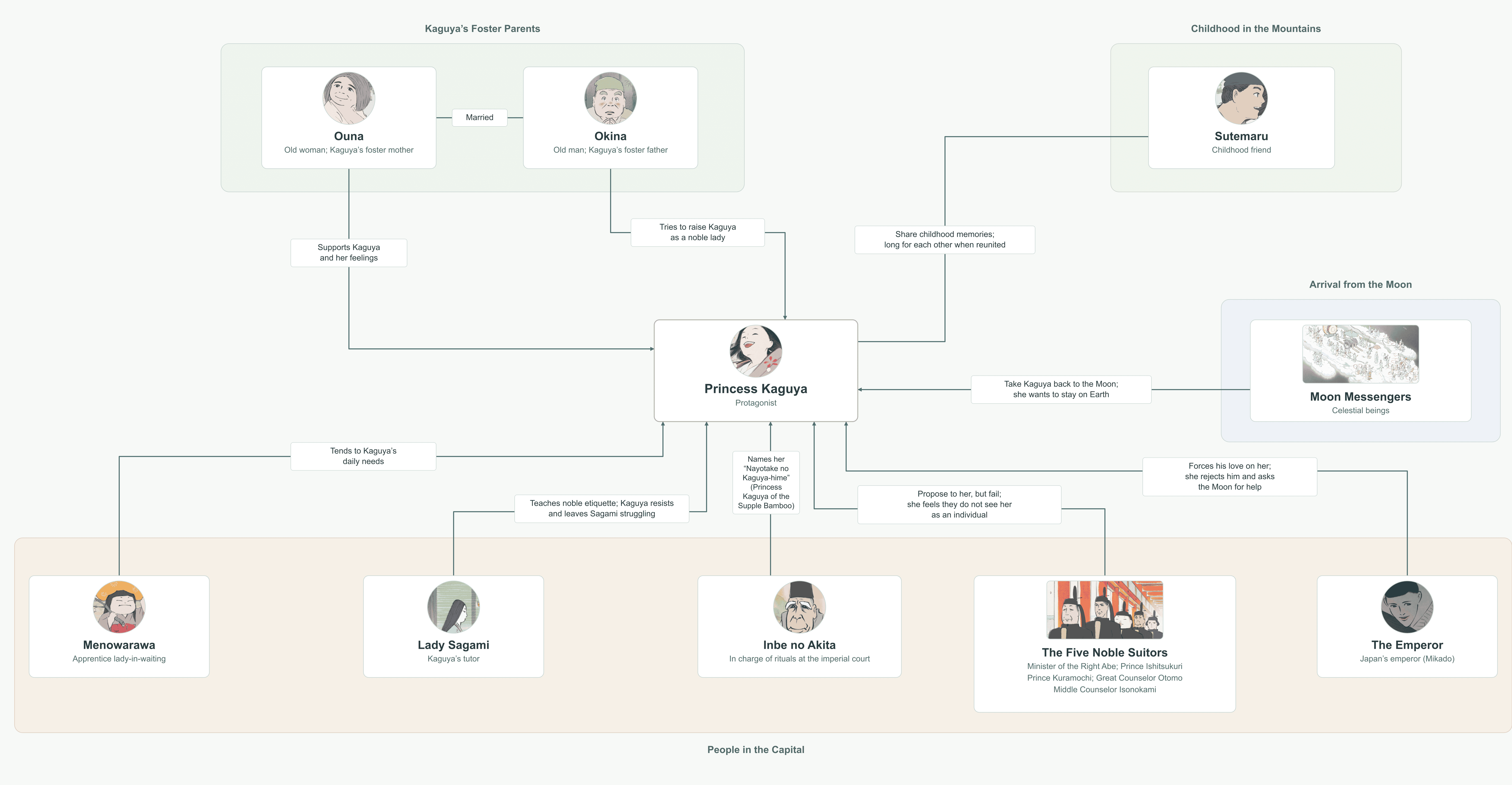
Character Map
Commentary on the Story
The basic course of The Tale of the Princess Kaguya follows The Tale of the Bamboo Cutter, but there are clear differences.
The greatest difference is how closely the film depicts Kaguya’s daily life after she comes to Earth. What emerges from those details is her forced adaptation to circumstances she does not want.
And there is something we should not forget: none of us knows Kaguya’s real name.
The Old Man and Old Woman call her “Princess,” the children call her “Takenoko,” and the aristocrats call her “Princess Kaguya” for her graceful beauty.
But none of us knows what she was called on the moon.
In that sense, you could see The Tale of the Princess Kaguya as “a story in which the person at its center is absent.” Well… that is a painful way to look at it.
Perhaps I am the only one who sees it that way, though. To maintain some “objectivity,” I will now look more closely at the story itself.
Detailed Synopsis: Through to the Ending
Here is the story in detail, from Kaguya’s bright childhood in the mountains to her caged existence in the capital and the unavoidable farewell of the final scene.
A Child Born from Bamboo
The story begins when an Old Man discovers a bamboo stalk glowing at its base. As he approaches, a bamboo shoot grows from the ground, and an extraordinarily beautiful little princess appears inside.
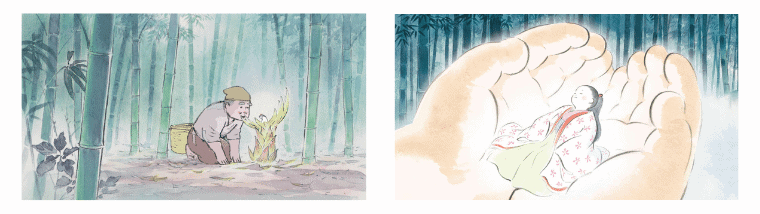
Believing that heaven must have given him this child, the Old Man takes her home.
She is still small enough to fit in his hand when he arrives. But when the Old Woman receives her, she quickly grows to the size of a human baby.
The couple sets out to ask a nearby household to nurse the baby. On the way, the Old Woman’s body changes, and she begins producing milk herself.
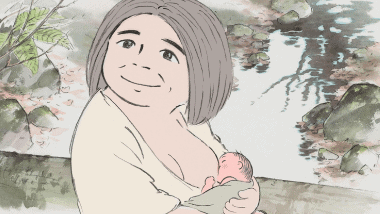
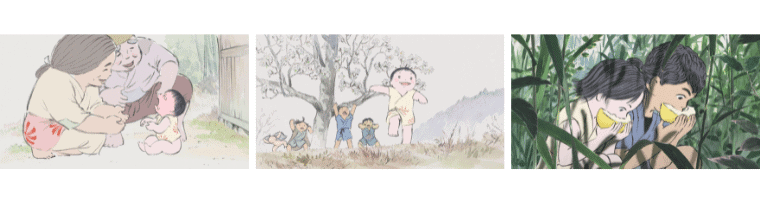
The Old Man calls the child “Princess” and raises her with great care. The local children call her “Takenoko,” or “bamboo shoot,” because of her sudden growth spurts. She spends happy days running through the mountains and fields.
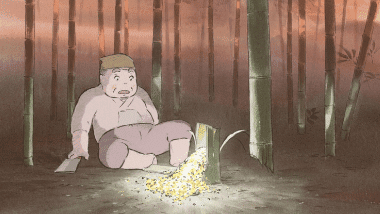
Meanwhile, in the course of cutting bamboo, the Old Man finds gold and fine clothes in the grove.
Moving to the Capital: The Beginning of Her Troubles
The Princess is content with life in the mountains. The Old Man, however, thinks she should not remain as she is. Using the money he found in the bamboo grove, he plans a life in the capital.
The day arrives suddenly. When she returns from playing with the other children, he tells her they are moving. She leaves for the capital without even being able to say goodbye.
The change from mountain life is enormous, but she does find some pleasure in the luxury of her new surroundings.
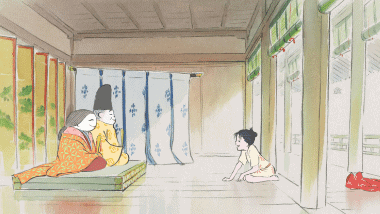
The Old Man hires a tutor to make her a “proper lady” and has her taught all kinds of things. Though bored by these days, she continues her lessons for his sake.
Then she has her first period.
The Princess is bewildered by the changes in her body, but the Old Man is delighted that she has grown up. He asks Inbe no Akita to give her a name.
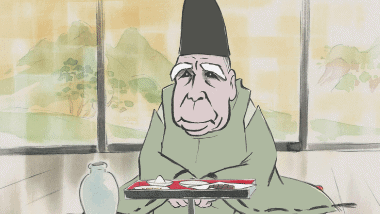
When Akita meets her, he is astonished by her otherworldly beauty. In praise of her radiance, he names her Nayotake no Kaguya-hime—Princess Kaguya of the Supple Bamboo.
After the naming, a grand banquet is held for her hair-raising ceremony, marking her coming of age. Kaguya, waiting in an inner room, finds it tedious. Some guests insist that the Old Man let them see her. He invokes custom and desperately refuses, only to be showered with abuse. Hearing their words, Kaguya despairs at being treated as an object and runs off, seeking “somewhere other than here.”
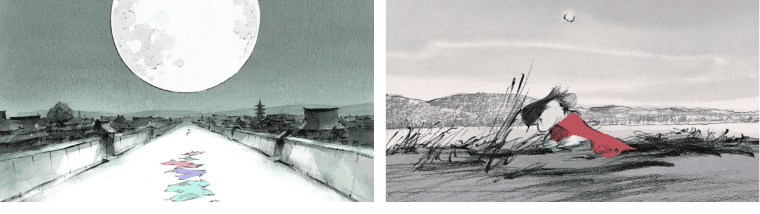
Battered and exhausted, she reaches the mountains of her childhood, but collapses there.
Then she finds herself back at the banquet. She has finally let her feelings burst out, yet nothing has changed.
From then on, she becomes a quiet young woman who listens to her tutor—as if she has given up on something.
The Five Nobles
Five noblemen who have heard directly from Inbe no Akita about Kaguya’s beauty come to visit her.
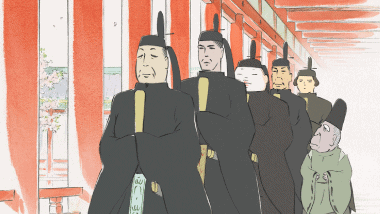
They make all kinds of extravagant claims to attract her attention. Kaguya tells them she will go to the man who can make his claim a reality. Feeling mocked, they hurry away.
Three years pass.
Although they initially withdrew, the nobles now try every possible means to make good on their boasts. One even loses his life in the attempt. Ultimately, Kaguya and her household repel them all. None wins her, despite the three years spent trying.
The Emperor’s Advances and the Return to the Moon
News that Kaguya has rejected the five nobles reaches the Emperor. Convinced that she has done so because she wants him, he visits her.
Never imagining that she might reject him, the Emperor forces his attentions on her.
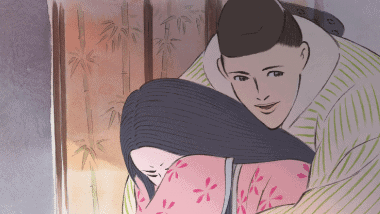
Faced with this unfamiliar aggression, Kaguya wishes with all her heart to escape. The next moment, she vanishes. The Emperor seems somewhat chastened by this strange occurrence and begs her to reappear. She does, but now she seems different, with an otherworldly air.
The Emperor, having acted too hastily, leaves her residence. For Kaguya, however, the encounter has brought back an important memory.
She was originally a resident of the moon, though she had forgotten it. When the Emperor approached her, she asked the moon for help. She repeatedly begs it not to come and rescue her, but cannot change her fate.
Kaguya’s refusal to leave Earth includes one of the film’s most important lines. I discuss its Japanese wording, English subtitle, and meaning in my collection of memorable quotes from The Tale of the Princess Kaguya.
On learning this, the Old Man and Old Woman decide to enlist the Emperor’s help to protect Kaguya from the people of the moon.
With the appointed time approaching, Kaguya visits the mountains she remembers and happens to meet Sutemaru again. He already has a family, but she attempts one final escape with him.
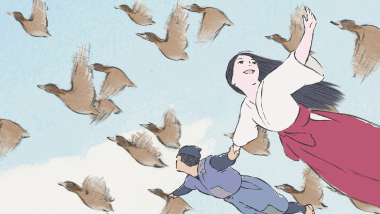
She shares an unforgettable time with Sutemaru, but cannot escape the moon.
Then comes the fateful night.
Many people have been mobilized to defend her residence, but they are helpless before the mysterious power of the visitors from the moon.
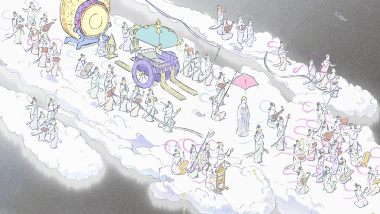
Even Kaguya, hidden deep inside the house, is summoned to them by that power.
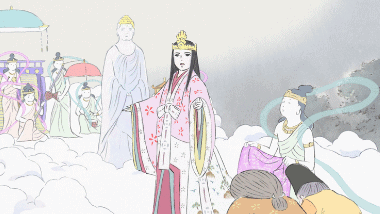
She still tries to say a final goodbye to the Old Man and Old Woman. In the end, however, she is made to wear the lunar robe of feathers and departs for the moon.
The robe takes away her memories of Earth. Yet something within her is still drawn to the blue planet.
As she looks back at Earth, that feeling remains.
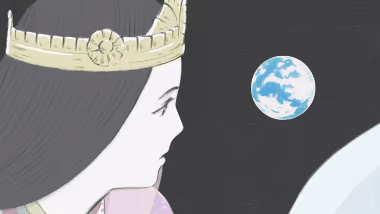
But she cannot remember it.
What did her days on Earth mean to her? That is something we have to consider.
That is my synopsis of The Tale of the Princess Kaguya. Since it follows The Tale of the Bamboo Cutter, you might expect little that is new in the story. Even so, I urge you to watch the film. Reading a summary and seeing the work itself are absolutely different experiences.
Next, I will compare the film with The Tale of the Bamboo Cutter. There may well be differences beyond those I cover here.
The Tale of the Princess Kaguya and The Tale of the Bamboo Cutter: The Differences
On the surface, it is a story in which an old couple raises a girl found in bamboo, becomes wealthy through treasure from the bamboo, and watches her reject five nobles and the Emperor before returning to the moon. That much matches the original tale. But there are decisive differences.
I would identify the following differences:
- The careful depiction of life in the mountains.
- The considerable shortening of the five nobles’ courtship episodes.
- The different reason for rejecting the Emperor’s affection.
- The passage of time.
Mountain Life—and the Five Suitors Given Short Shrift
Depicting life in the mountains seems to be one of the film’s important concerns. It also carefully shows life in the capital. That interest in everyday living feels characteristic of Takahata.
The shortening of the five nobles’ courtship episodes is particularly striking. To my mind, they are plainly the highlight of The Tale of the Bamboo Cutter.
Readers who studied the tale at school may remember that these episodes emphasize Kaguya’s otherness while also explaining the origins of various Japanese expressions. In other words, they are told as comedy.
The five nobles who court Kaguya are:
- Prince Ishitsukuri
- Prince Kuramochi
- Minister of the Right Abe no Miushi
- Major Counselor Otomo no Miyuki
- Middle Counselor Isonokami no Maro
Each is asked to retrieve one of the following items, respectively:
- The Stone Begging Bowl of the Buddha
- The Jeweled Branch of Hourai
- The Robe of Fire Rat Skins
- The Colored Jewel from a Dragon’s Neck
- The Cowry Shell Born of Swallows
Naturally, they cannot obtain them, so they try to deceive Kaguya with lies. The original tale has Kaguya set these demands herself; the film has her respond to the nobles’ own claims. That is another difference from the source.
Their lies are exposed, and the outcomes of their attempts are presented as the origins of these expressions:
- Haji wo sutsu (“discarding shame,” with a pun on “bowl”)—shameless behavior.
- Tamasakaru—losing one’s senses and becoming dazed.
- Aenai—something unrewarding.
- Anatagegata—something not worth the effort.
- Kainashi (“no worth,” with a pun on “shell”)—an outcome contrary to one’s hopes.
The five nobles’ episodes are told in such detail that I almost wonder whether they were what the author really wanted to write. In the film, however, the men are treated so dismissively that it is as if Takahata were saying, “I couldn’t care less about you.” In their place, Kaguya’s daily life is depicted at length.
The Relationship with the Emperor
Kaguya’s relationship with the Emperor is also reversed. In The Tale of the Bamboo Cutter, she initially refuses his proposal because she is a being from another world, destined eventually to leave Earth. They ultimately exchange letters, however; his advances are not presented as unwelcome to her.
In the film, by contrast, she openly, completely, unmistakably rejects an Emperor whose very design seems full of the filmmakers’ malice.
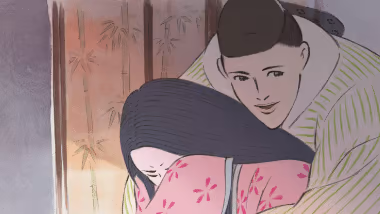
Why change the story this way? One possibility is that it feels more natural. In a tale from the Heian period, becoming close to the Emperor might justify having rejected the nobles. Seen as a modern drama, though, she would surely dislike the match even if he were the Emperor. Were she an ordinary human, perhaps it would be different; as a resident of the moon, her unconditional acceptance of becoming his consort would seem strange.
The Passage of Time
The original tale contains a decisive statement about the time that passes:
We have had the honor of raising Princess Kaguya for more than twenty years.
(Original Japanese and its meaning)
かぐや姫を養ひ奉ること廿余年に成りぬ
Meaning: More than twenty years have passed since we began raising Princess Kaguya.
There are other indications of elapsed time, but this passage puts her stay on Earth at roughly twenty years in the original tale. Longer than you might expect, isn’t it?
The film provides no equally decisive statement, so we have to assemble circumstantial clues:
- When Kaguya flees from the capital to the mountains, the charcoal burner tells her that Sutemaru’s group will not return for ten years. I take this to suggest that roughly ten years have passed by the ending.
- In the same scene, she sees the winter landscape and thinks it has died. She does not seem to understand the cycle of the seasons, suggesting that less than a year has passed since she came to the Old Man’s home.
Her growth into a young girl is also described as taking just over six months. Putting these clues together, I would estimate that she spends a little over ten years on Earth in the film.
She loves the ever-changing Earth and the mountains of her childhood. Yet, on this estimate, less than a tenth of her time here is spent in the place she loves. That alone makes her story poignant.
The Princess’s Crime and Punishment
The film’s memorable tagline is “The crime and punishment of the princess.” I saw it repeatedly in theatrical teasers.
What were that crime and punishment? I explore them in the article below, taking the phrase as seriously as I can. But one part never quite satisfied me: the “punishment.”

The original tale also says Kaguya was punished. Yet the moon seems to be a world without worries. Would the concept of punishment exist in such a world? This never quite clicked for me, so I thought it through a little further in the following article:
Did Kaguya really commit a crime and receive a punishment?
Your Take: Kaguya’s Life on Earth
Kaguya’s days on Earth bring joy as well as suffering. What do they mean to you?
Reader poll
Can you name the movie before the scene comes into focus?
Put your visual memory to the test with a blurred Studio Ghibli scene.

Reader Comments
Have a thought or interpretation? Leave a comment