
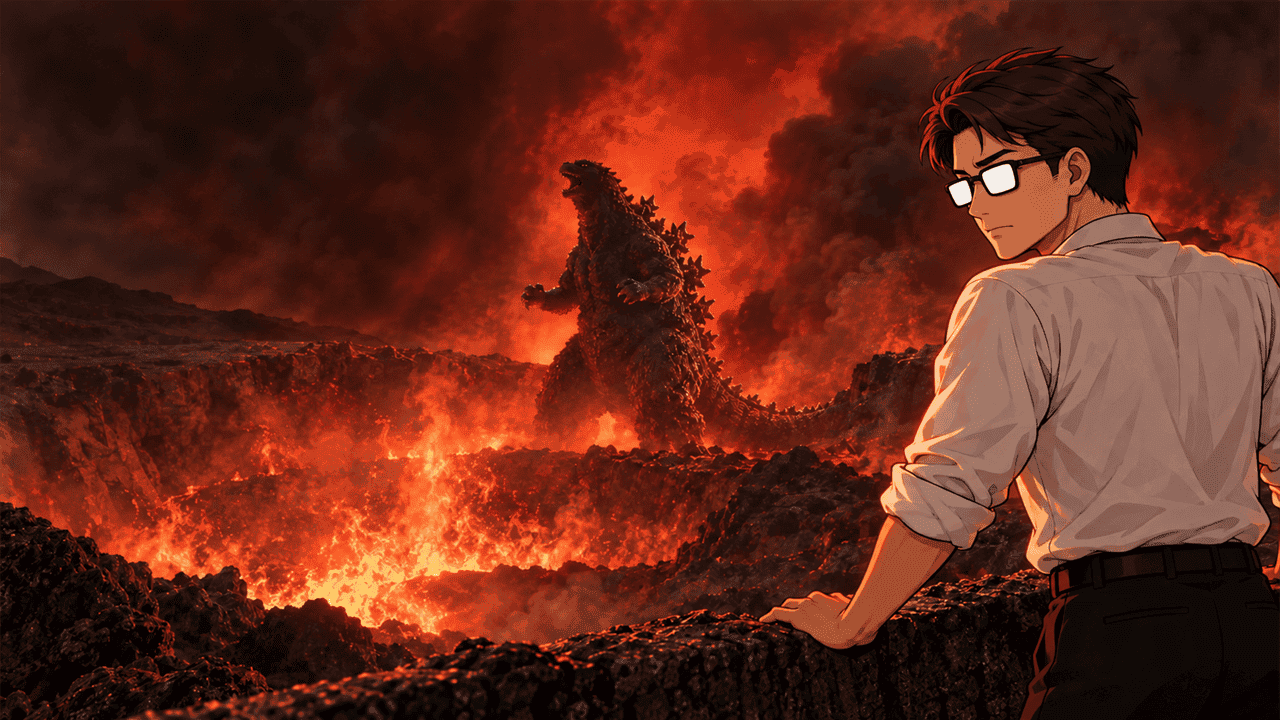
Kōji Hashimoto’s The Return of Godzilla opened in Japan on December 15, 1984. It had been nearly ten years since Terror of Mechagodzilla (1975), and you can feel how much the filmmakers wanted to bring Godzilla back. In Japan they even called the film simply Godzilla, just like the original.
In the story, thirty years have passed since the events of the original. Dr. Hayashida lost his parents in that first attack. Even so, when Godzilla returns, he comes up with a way to send it home. That gets me every time.
I know a lot of people love this movie. It’s my second-favorite Godzilla film by a mile. The original is still first, of course. Before getting into what I love about the 1984 film, let’s revisit the story.
*This is a translated version. The original (Japanese) is available here.
On this pageContents
The Return of Godzilla (1984) Plot Without Spoilers
The fishing boat Dai-Go Hachiman Maru goes missing off the Izu Islands. The account of its sole survivor, Hiroshi Okumura, and an investigation by the biologist Dr. Hayashida confirm that Godzilla has returned thirty years after its first attack on Tokyo. Prime Minister Mitamura’s government keeps the discovery quiet at first for fear of causing a panic.
When a Soviet nuclear submarine is sunk and Godzilla turns out to be responsible, Japan goes public. Godzilla attacks the Ihama Nuclear Power Plant in Shizuoka Prefecture to feed, then disappears into the sea. Hayashida notices that it responds to ultrasound from migrating birds. He devises a plan to lure it to the volcano on Mount Mihara.
As the United States and Soviet Union press Japan to let them use nuclear weapons, Godzilla comes ashore in Tokyo. The city suffers devastating damage, and the Self-Defense Forces send in their new weapon, the Super X. Can Hayashida lure Godzilla away? And can Japan get through the crisis without a nuclear strike?
The Return of Godzilla (1984) Plot With Spoilers
Hiroshi Okumura’s testimony convinces Hayashida that Godzilla is back. The government has to confront both the monster that attacked a nuclear plant and the nuclear powers that want to strike it. The Super X brings Godzilla down, only for it to wake after an intercepted missile explodes. Hayashida’s signal finally draws it to Mount Mihara, where Mitamura watches it fall into the crater.
Plot at a Glance
- Godzilla returns. When the missing fishing boat is found, its only survivor tells Hayashida about a giant creature. The biologist identifies it as Godzilla and reports the discovery. Mitamura suppresses the news to avoid panic.
- Godzilla attacks a nuclear plant. Tensions rise when a Soviet nuclear submarine sinks. The Self-Defense Forces trace the attack to Godzilla, which raids the Ihama plant, absorbs radiation from the reactor core, then seems to follow migrating birds back out to sea. Hayashida proposes using their calls to lure it into the crater of Mount Mihara.
- Tokyo comes under attack. The Super X stops Godzilla temporarily. In Tokyo Bay, equipment aboard a Soviet freighter triggers an accidental nuclear missile launch. The Americans intercept the missile, but the blast revives Godzilla. Hayashida’s lure draws Godzilla away from Tokyo and into the volcano.
Character Map
Hayashida wants to send Godzilla to Mount Mihara while the United States and the Soviet Union push for a nuclear strike. The map also shows where Maki and the Okumura siblings fit into the story.
Full Plot Summary
A Mysterious Giant Creature
Newspaper reporter Gorō Maki is sailing on holiday when he comes across the missing Dai-Go Hachiman Maru. He boards and finds most of the crew dead, their bodies shriveled like mummies. One man, Hiroshi Okumura, is still alive. As Maki tries to identify the unconscious man, a giant sea louse attacks him. Okumura comes to and kills it.
On the way back, Okumura tells Maki something hard to believe. He saw a giant creature emerge from Daikoku Island. Maki tries to pitch it as a scoop, but his editor won’t hear it. Even Maki isn’t sure he believes the story.
While Okumura is in the hospital, his former teacher, biologist Makoto Hayashida, visits him. His account convinces Hayashida that the creature is the Godzilla that attacked Japan years ago. The news reaches Prime Minister Mitamura, who decides to keep it quiet. Maki’s story is killed before it goes to press, and he gets permission to interview Hayashida exclusively in return.
While interviewing Hayashida, Maki meets Okumura’s sister, Naoko. When he learns the government has kept her in the dark about her brother, he arranges a reunion. The siblings are crushed when they realize he wanted to turn their reunion into a story.
Godzilla Comes Ashore
While the Okumuras are reunited, a Soviet nuclear submarine is sunk at sea. The Soviets assume the Americans are responsible, but footage from a Japanese patrol aircraft shows that it was Godzilla. Japan informs both ambassadors and at last makes Godzilla’s return and the fishing boat incident public.
While the Self-Defense Forces mobilize, Godzilla appears at the Ihama Nuclear Power Plant in Shizuoka. It destroys the plant and absorbs the radiation from the reactor core, then disappears into the sea as if led by the migrating birds overhead. Hayashida and the others see it happen from a Self-Defense Forces helicopter.
Hayashida thinks the birds’ ultrasound acts on magnetic material inside Godzilla and triggers a homing instinct. He proposes synthesizing that signal from the birds’ calls to lead Godzilla into the crater of Mount Mihara. Mitamura strengthens the Self-Defense Forces’ response and lets Hayashida prepare his plan. When the Americans and Soviets ask for permission to kill Godzilla with nuclear weapons, Mitamura refuses, citing Japan’s Three Non-Nuclear Principles.
The Attack on Tokyo
Despite the watch kept by the Self-Defense Forces, Godzilla comes ashore in Tokyo. A malfunction in the nuclear missile control equipment aboard a Soviet freighter in Tokyo Bay starts a launch countdown. Hayashida is still racing to finish his ultrasonic signal.
The Self-Defense Forces deploy the Super X, a flying fortress secretly built to defend the capital. Godzilla has shrugged off every attack so far. The Super X’s cadmium shells finally bring it down.
Meanwhile, a Soviet military satellite launches a nuclear missile toward Godzilla. Mitamura asks the United States to shoot it down. There are only thirty minutes until impact. The Americans fire immediately and intercept it. Then Godzilla wakes up. The Super X has used up its cadmium ammunition and can no longer stop it.
Sayonara
With the signal finally ready, Hayashida switches on the lure. The creature that had been tearing through Tokyo calms down and follows the sound all the way to Mount Mihara. His plan works, and Godzilla falls into the crater.
Godzilla is gone. What lingers, strangely enough, is a feeling of remorse.
What Stays With Me About The Return of Godzilla
What stays with me most is Keiju Kobayashi’s face at the end. Mitamura has spent the film refusing a nuclear strike and backing a plan to lead Godzilla away. When Godzilla falls, his tears leave room for relief, grief, and the guilt of having to bury a threat that people created in the first place.
That’s the balance I keep coming back to. This Godzilla still looks more cute or cool than frightening to me, but the fear of nuclear weapons is back at the center of the story. And when Godzilla slips past the Self-Defense Forces, the film makes it feel closer to a ghost or a wrathful god than to an animal anybody knows how to track.
Godzilla Is Still Cute
By 1984, what a Godzilla movie could be had drifted a long way from the original. I think this film really did get back to it. The design was the one thing it couldn’t shake. I can imagine that being one of the hardest calls the filmmakers had to make.
To get back to the first film, you need the audience to look at Godzilla and feel scared. But look at that face. You can still see the Godzilla of all those earlier movies, and to me it’s downright cute. That curse stuck around for years. If “cute” doesn’t work for you, call it “cool.”
For me, it took until Shin Godzilla for Godzilla to look frightening again. That’s more than sixty years between the 1954 design and another that really scared me. Maybe that tells you how much nerve it takes to put a genuinely scary Godzilla on screen. People have to want to buy tickets, after all. Maybe cute was as far as the filmmakers felt they could go. It’s a tough business.
The 1984 movie brought Godzilla back all the same. It put nuclear weapons right in the middle of the story.
Why Prime Minister Mitamura Cries
If a 1984 film was going to make Godzilla feel like a real threat, it had to ask whether someone would use a nuclear weapon against it. And as soon as Japan, a country without nuclear weapons, faces that question, it has to contend with the logic of countries that have them.
In the film, the Soviet Union and the United States decide on a nuclear strike and ask Japan to allow it. Prime Minister Mitamura, played by Keiju Kobayashi, refuses. You want to cheer him for holding his ground. Somewhere in the back of your mind, though, you’re wondering if a strike really would be the better option. Maybe that’s what fiction is for. You get to feel both things at once.
When the Soviet missile is launched by mistake, the Americans shoot it down. I love little details like that. Here’s a world where the U.S.–Japan Security Treaty works exactly as Japan might hope. Maybe that reflects a fear of the Soviet Union, or an uncritical admiration for America. I can also hear Japan asking America, “You’d do that for us, right?” Either way, the film gets at just how much Japan depends on the United States.
That’s the sort of thing I think about as an adult. But come on. Kobayashi’s Mitamura did pretty well, didn’t he? He covered up Godzilla’s return at first, but he stood up to the two superpowers and gave Hayashida’s plan a chance.
Mitamura’s face has barely moved all film. Then he watches Godzilla fall into the crater and cries. The red of the volcano looks so much like the red sky when the Soviet missile was shot down. Maybe he’s relieved that he did his duty. Maybe he feels the need to atone for what people have done, creating Godzilla and then burying it themselves. When I think about those two red skies, I see a man feeling responsible as a human being for something he never did himself.
I doubt people in Japan will ever agree about nuclear weapons. Even so, I wonder if we can feel the same thing when we see Kobayashi cry in that red light. There’s some small comfort in being able to share what we feel when Mitamura cries. I believe that.
It’s hard to talk about Godzilla without talking about Japan and nuclear weapons. I love this film for taking that on. Now I want to get into a few lighter things.
How Does Godzilla Keep Getting Ashore?
Did that first landing look a little strange to you? The Self-Defense Forces are already tracking Godzilla, and somehow it comes straight out of the fog and gets ashore without anyone noticing. The second time, they’re on alert and still don’t see it until the last possible moment.
Hayashida calls Godzilla a warning that humanity could destroy itself. Today I also think of things like typhoons and earthquakes, or any threat we still don’t know how to control. We can try to deal with the damage as it happens. Mostly we’re left hoping it’ll pass.
When Godzilla comes ashore through the fog, it feels like a ghost, a yōkai, or a wrathful god. Size and a knack for smashing buildings can only explain so much. There’s something terrifying about Godzilla all on its own. The 1984 film finds a way to put that on screen.
Cadmium Shells, Hayashida, and the Problem With the Sequel
Think of the 1984 Godzilla and you think of the Super X. Think of the Super X and you think of cadmium shells. The film says cadmium is used to control nuclear reactors, and it can indeed be used in control rods.
Few weapons in a Godzilla movie have ever worked quite that well. Which leaves me with two questions. Why didn’t they use them in the sequel? And why did Hayashida sound so upset when they worked?
I get the first one. If you’ve got a whole sequel to make, those shells would end it pretty quickly. Still, didn’t we all watch Godzilla vs. Biollante and think, “Why don’t they just use the cadmium shells?”
There’s also a way to make sense of it within the story. It’s cadmium, of all things. When many of us in Japan first heard the word, it was right alongside “itai-itai disease.” Many people in Toyama suffered severely after cadmium pollution contaminated their water and food. The Super X was developed in secret, but imagine the public argument over using those shells. Maybe that’s why the Super X2 didn’t carry them.
- Itai-itai disease and cadmium pollution (Japan’s Ministry of the Environment)
- What is itai-itai disease? (Toyama Prefecture)
Hayashida’s reaction matters more to me. When Godzilla collapses, he says, “It’s still alive. It can’t die.” You can hear how badly he wants it to live. The words just come out. Why does he care that much?
It’s messy, so let’s start with the easy part. Maybe it’s a scientist’s pride. If Godzilla dies there, nobody ever needed Hayashida’s plan. His life’s work is to understand Godzilla better than anyone else does. How is he supposed to accept that someone else can simply show up and get rid of it?
There’s another possibility. Hayashida may speak for those of us who grew up loving Godzilla. He lost his parents in the first attack. Losing your parents is hard enough today. Think what it must have been like then. He still went on to make a name for himself as a scientist, and somewhere in all those years he grew to love Godzilla. Those of us raised on movies like Destroy All Monsters know that feeling.
The more Hayashida learns about Godzilla, the more he sees human beings at the root of what happened. That sits alongside the affection we feel for Godzilla. I love that the film lets him be that complicated.
Gorō Maki, Newspaper Reporter
If the 1984 film has a main character, it’s probably Gorō Maki. He’s a newspaper reporter, and he’s a piece of work.
When Maki finds Okumura alive aboard the Dai-Go Hachiman Maru, he goes through his wallet. He checks his ID, pockets a photo of him with his sister, and photographs the unconscious man instead of helping him. Later, when Maki spots Naoko at Hayashida’s lab, he calmly shows Hayashida the stolen photo and asks how the two are related. He has no qualms about photographing their reunion either. He even claims the chief cabinet secretary gave him permission. All he was allowed to do was interview Hayashida.
Maki never grows out of this. Somehow he and Naoko hit it off toward the end. I can only put that down to the suspension-bridge effect, where the rush of danger gets mistaken for attraction.
So why give a guy like this the lead? Maybe the filmmakers wanted someone who could be a witness. A Godzilla movie has things happening all over the place. To see them, your lead has to have a reason to turn up wherever the story goes. Sending a newspaper reporter may have been the most natural way to do it.
Whatever the reason, Maki is as nosy and aggravating as a real reporter can be. That choice feels of a piece with the effort to make Godzilla’s return feel real.
The Godzilla Love Theme I’ll Always Love
The 1984 film made Godzilla and nuclear weapons feel like part of the same world again. That meant Godzilla had to be stopped. But for those of us who had grown to love Godzilla through the Shōwa films, seeing it go was complicated. I’m too young to have seen those films when they came out, but I grew up watching them all the same.
Then the Star Sisters gave us a song to say goodbye with. Their song, “Godzilla: Love Theme,” is so good. I can’t be the only one who gets a little choked up when they sing “Goodbye now Godzilla” and “Sayonara till we meet again.” I envy anyone who got to hear that ending in a theater when the film came out.
What About Tetsuya Takeda and Monsieur Kamayatsu?
Realism is the word I keep coming back to with this film. Which makes Tetsuya Takeda and Monsieur Kamayatsu seem a little out of place. Takeda plays a homeless man who takes the chance to loot during a fire. Kamayatsu smiles up at Godzilla from inside a train it’s just lifted off the tracks. At first glance, they seem to be there for a laugh.
But it always rings false when a movie shows only one side of a situation. Everyone grieves when they’re supposed to grieve. Everyone suffers when they’re supposed to suffer. Everyone panics on cue. Real life always has somebody who laughs at the wrong moment, has the time of their life while someone next to them suffers, or enjoys the chaos.
Takeda and Kamayatsu make the disaster feel more real because they react in ways nobody else does. They give us a moment to catch our breath, and they still feel like people who might actually be there.
Reader poll
One Last Thing I Keep Hearing in the Russian Dialogue
This last bit really doesn’t matter. I’ve been hearing it ever since I first saw the film as a kid. Midway through, the Soviet Union and the United States ask Japan to let them launch a nuclear strike. Once Mitamura refuses, a Soviet colonel takes the missile controls off standby. A man comes up to him and says something in Russian.
I still hear Dō suru ki desu? every single time. That’s Japanese for “What are you going to do?” It fits the moment perfectly. I still have no idea what the man actually says in Russian. Did anyone else hear it? Can you hear it now?
Anyway, there you have it. It really doesn’t matter.
The Return of Godzilla (1984) Cast and Crew
Kōji Hashimoto directed the film, and Teruyoshi Nakano directed the special effects. Keiju Kobayashi plays Prime Minister Mitamura. The cast also includes Yōsuke Natsuki as Dr. Hayashida and Ken Tanaka as the reporter Gorō Maki.
| Direction | Kōji Hashimoto (film), Teruyoshi Nakano (special effects) |
|---|---|
| Screenplay | Shūichi Nagahara |
| Original story | Tomoyuki Tanaka |
| Music | Reijirō Koroku |
| Theme song | The Star Sisters |
| Gorō Maki | Ken Tanaka |
|---|---|
| Naoko Okumura | Yasuko Sawaguchi |
| Hiroshi Okumura | Shin Takuma |
| Dr. Makoto Hayashida | Yōsuke Natsuki |
| Dr. Minami | Hiroshi Koizumi |
| Prime Minister Mitamura | Keiju Kobayashi |
| Finance Minister Kanzaki | Eitarō Ozawa |
| Chief Cabinet Secretary Takegami | Taketoshi Naitō |
| Home Affairs Minister Isomura | Nobuo Kaneko |
| Trade and Industry Minister Kasaoka | Takeshi Katō |
| Foreign Minister Emori | Mizuho Suzuki |
| Defense Official Mōri | Junkichi Orimoto |
| Joint Staff Council Chairman Kakurai | Shinsuke Mikimoto |
| National Land Agency Director Ōkōchi | Kanta Mori |
| Environment Agency Director Hidaka | Yoshifumi Tajima |
| Science and Technology Agency Director Kajita | Kiyoshi Yamamoto |
| Cabinet Intelligence Director Henmi | Kunio Murai |
| Bullet train passenger | Hiroshi “Monsieur” Kamayatsu |
| Nuclear plant employee | Kōji Ishizaka |
| Homeless man | Tetsuya Takeda |

Reader Comments
Have a thought or interpretation? Leave a comment