
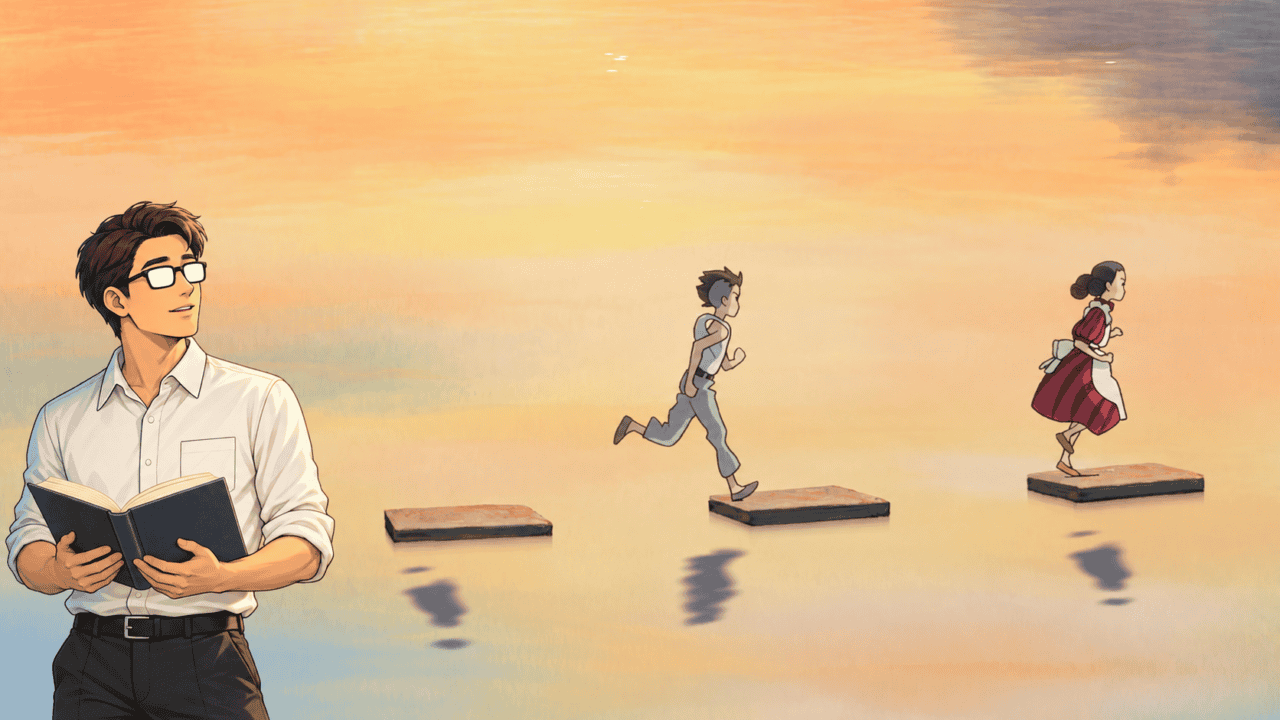
After announcing his retirement following The Wind Rises, Miyazaki returned with The Boy and the Heron (Official Studio Ghibli Website). Released in Japan on July 14, 2023, it earned 9.4 billion yen at the Japanese box office (Reference: Motion Picture Producers Association of Japan, Inc., 2023 National Film Industry Overview, in Japanese).
The Japanese title comes from Genzaburō Yoshino’s novel How Do You Live?, but the film is not an adaptation. The book appears as something Mahito’s mother left for him, and his encounter with it marks an important turning point in the story.
I had fallen for Miyazaki’s retirement announcement and assumed that The Wind Rises would be his last film. News of a new one made me very happy.
Naturally, I also wondered why he had decided to make another film. One important feature is that it begins with Mahito’s monologue and ends with Mahito’s monologue.
In other words, I read this as a story the grown-up Mahito is remembering—a story told from his own perspective.
Here, I will revisit the story of The Boy and the Heron and consider its meanings. What kind of film was it?
*The synopsis below tells the whole story, including spoilers. If you would rather avoid them, read only part of it and then watch the film.
*This is a translated version. The original (Japanese) is available here.
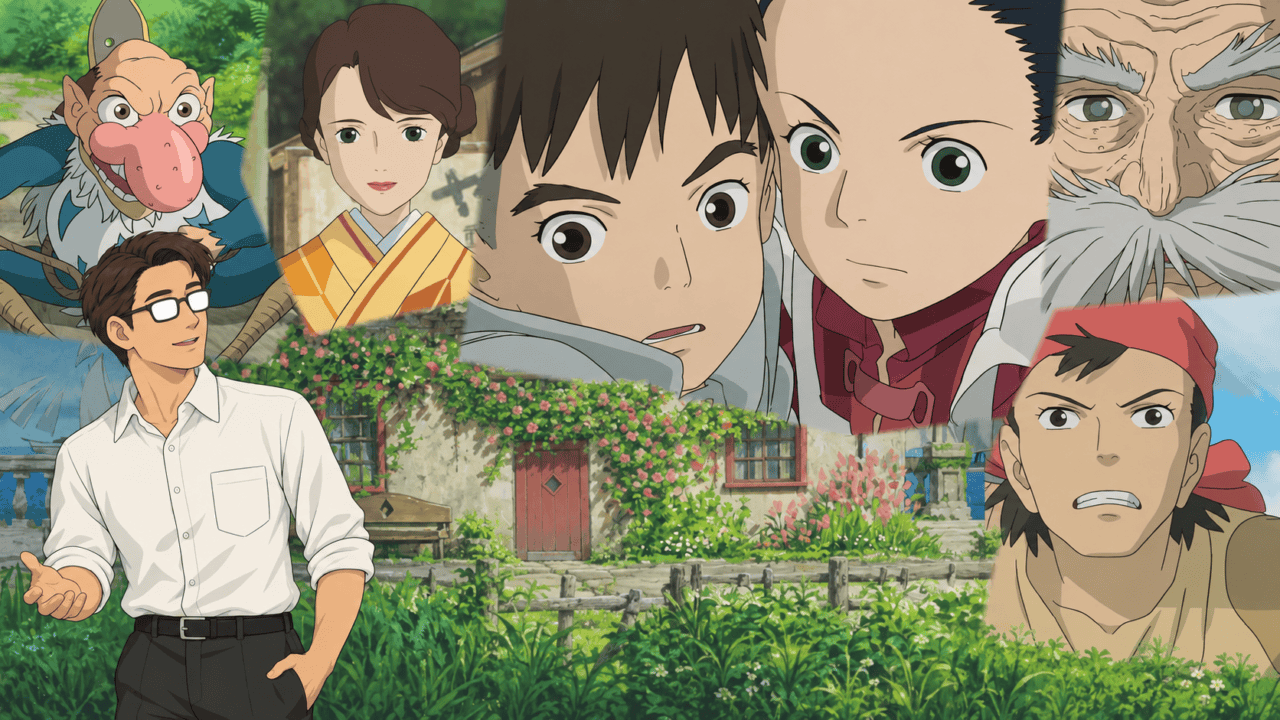
- Detailed Synopsis and Character Map
Eleven-year-old Mahito Maki loses his mother and begins a new life after moving to the countryside. Drawn into a mysterious tower by a gray heron, he confronts his lost family and the past. His adventure leads him to reconsider his family ties and make a choice across time and space, before beginning a new life after the war. Below are a detailed synopsis, a character map, and an explanation of the story. - Questions for Analysis
We will consider the loving father, the mother who wields fire, the mysterious meteorite, Mahito running toward the fire, the parakeets and pelicans, the numbers eight and thirteen associated with the cold stones, and Suzuki as the model for the Gray Heron. Links below lead to more detailed articles on these questions.
On this pageContents
The Boy and the Heron: Synopsis and Character Guide (Spoilers)
The synopsis follows Mahito from the loss of his mother to his journey through the tower and his return to his own world.
The Story at a Glance
Here are the main events in The Boy and the Heron:
-
Mahito Moves to the Countryside
Eleven-year-old Mahito loses his mother in a fire. During the Pacific War, he moves with his father to his mother’s family home in the countryside. -
Life with His Father’s New Wife
His father has remarried Natsuko, his late mother’s younger sister. Still struggling with his mother’s death, Mahito does not know how to relate to her. -
The Tower and the Gray Heron
Unable to settle into his new surroundings, Mahito is drawn to a strange tower on the estate. A gray heron nesting there tells him that his mother is waiting. -
Natsuko Disappears
When the pregnant Natsuko goes missing, Mahito, who saw her enter the forest, heads toward the tower with the maid Kiriko. -
An Encounter with a Mysterious Old Man
Inside the tower, Mahito and his companions encounter a strange old man and are drawn into the “world below.” -
The World Ruled by Parakeets
The world below differs from the world above. It is a strange realm ruled by parakeets that behave like humans. -
The Heron and Himi
Mahito works with the Heron and a girl called Himi to rescue Natsuko. He discovers that Himi is his own mother as a child, from the time when she too disappeared inside the tower. -
The Granduncle, Master of the Tower
The old man is the granduncle of Mahito’s mother and Natsuko. He rules the world below from inside the tower. -
The Request to Take His Place
The Granduncle asks Mahito to succeed him. Mahito refuses and returns to his own world. -
A New Beginning
Two years after the war ends, Mahito returns to Tokyo with his family.
Character Map
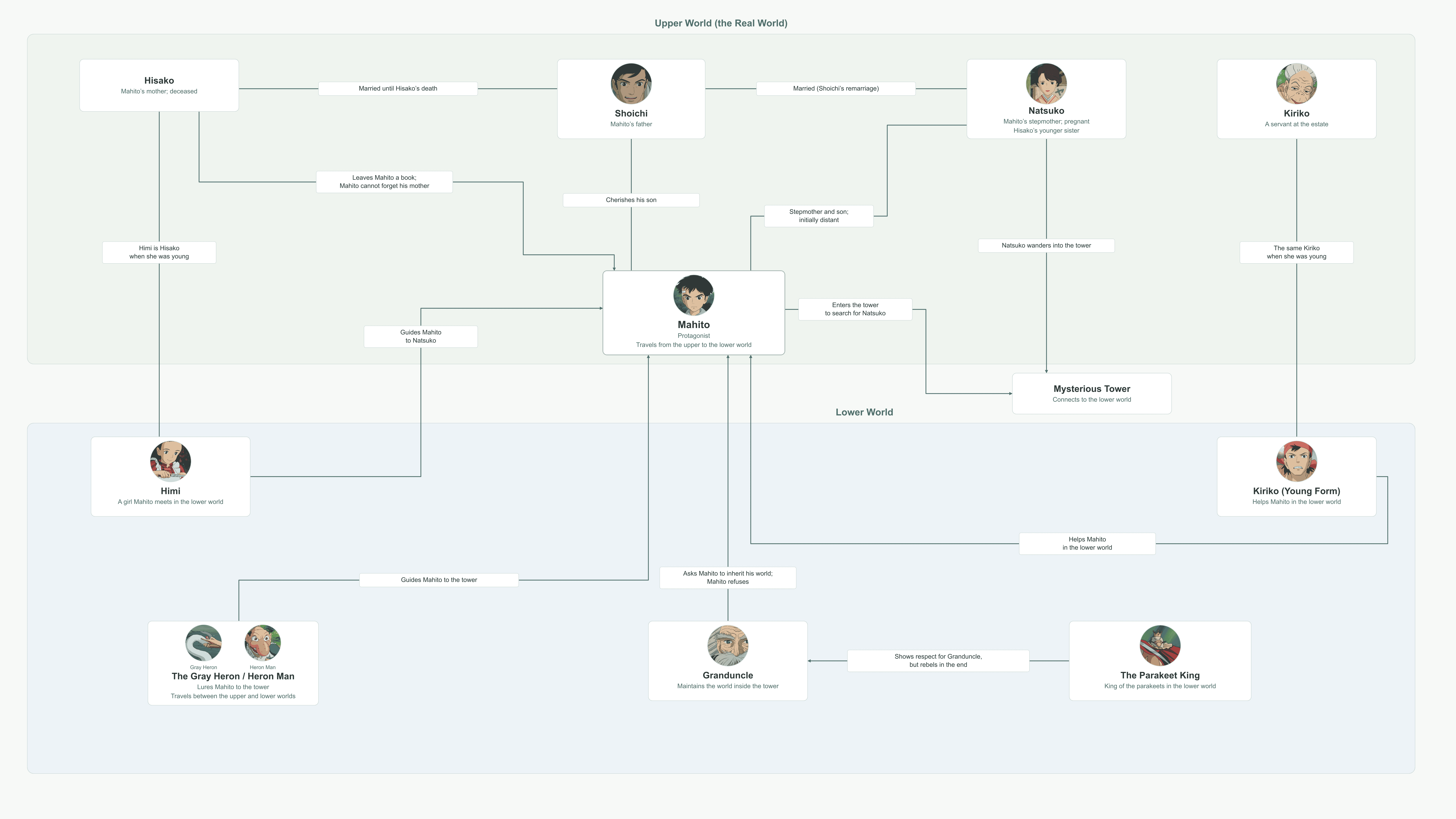
Family, Loss, and the World Below
Mahito’s mother, Hisako, left him Yoshino’s How Do You Live?. Reading it helps him come to terms with her death.
Hisako and Natsuko’s granduncle was captivated by a fallen meteorite. He built a tower around it and then disappeared inside. Mahito and Natsuko find their way into the “world below” that he created.
Hisako had also disappeared into the tower as a child. The young Himi whom Mahito meets is his mother from that period, and he encounters a younger Kiriko there too.
In my reading, Miyazaki himself is reflected in Mahito, his father, and the Granduncle. Family memories and the world of filmmaking seem to overlap here. The story invites us to think about those connections rather than giving each character just one meaning.
Detailed Synopsis: Through to the Ending
His Mother’s Death and the Mysterious Tower
Eleven-year-old Mahito Maki loses his hospitalized mother in a fire one night during the Pacific War. The following year, still carrying that grief, he moves with his father, Shoichi, to his mother’s family home in the countryside.
Natsuko, his mother’s younger sister and his father’s new wife, welcomes him. She is expecting Shoichi’s child. Mahito begins this new life with complicated feelings about the situation.
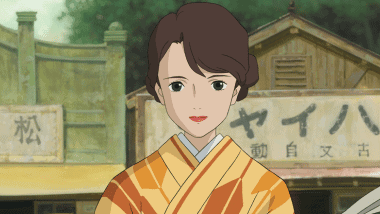
Still mourning his mother, Mahito follows a gray heron living in the grounds of the large estate to an old tower. The bird seems to nest there. He tries to enter, but the strange layout inside blocks his way.
Natsuko tells him that the tower was built by the granduncle she shared with his mother. According to her, he became “strange” after reading too many books and then disappeared.
Natsuko and the household’s servants treat Mahito kindly, but he cannot accept his situation. He becomes increasingly drawn to the mysterious tower.
“Your Mother Is Waiting”: The Heron and Mahito’s Self-Inflicted Injury
On Mahito’s first morning at the local school, Shoichi, who runs a munitions factory, insists on driving him there in his Datsun. As expected, this attracts the attention of his classmates, and he gets into a fight on the way home.
Muddy from the fight, Mahito picks up a roadside stone and strikes the right side of his own head. He returns bleeding and stays home from school to recover. Natsuko and the others are kind to him; Shoichi even threatens to go and shout at the school.
While Mahito is resting in bed, the heron appears at his window and cries in an eerie voice, “Mahito, help me,” before leaving. It later appears again, offering to take him to his mother and saying that she is waiting for help.
Suspicious of the heron, Mahito begins making a bow and an arrow with one of its feathers, preparing to confront it.
Natsuko Disappears, and Mahito Enters the World Below
Mahito finds the copy of How Do You Live? that his mother left for him. Moved by its contents, he comes to understand her love more deeply and begins to accept her death.
Around the same time, the household is thrown into confusion when Natsuko disappears.
Having seen Natsuko enter the forest, Mahito sets out through the woods with Kiriko, one of the maids, and reaches the tower.
Unlike on his first visit, its huge doors stand open, almost inviting him in. The heron’s voice calls, “I have been waiting for you.” Mahito enters, and Kiriko, worried about him, follows.
The heron leads them to the center of the tower, where Mahito sees his mother lying down, just as the bird had promised. But when he approaches, she dissolves into a puddle. “What a shame,” says the heron. “It was such a good likeness.”
Angry, Mahito fires an arrow that hits the heron’s beak. The bird loses its power and turns into a little man with an enormous nose.
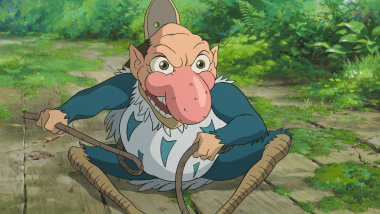
Mahito presses the Heron Man to take him to Natsuko.
As the Heron hesitates, a mysterious old man above them says, “Foolish bird. You shall be their guide.” “Can’t be helped,” the Heron replies. Mahito, Kiriko, and the Heron are drawn into the floor.
Warawara, Pelicans, and Himi, the Girl Who Wields Fire
Mahito slowly descends to the shore of a strange sea. Many sailing ships are visible on the horizon.
He meets a middle-aged fisherwoman with seemingly magical powers and, having nowhere else to go, helps with her work. Watching her closely, he begins to think she is Kiriko. She denies it, but he feels sure.
That night, Mahito sees round, white beings called Warawara floating into the sky. Kiriko tells him they go to the world above to become human.
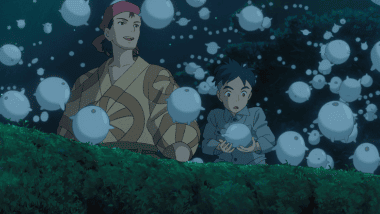
As he marvels at the sight, pelicans fly in from across the sea to eat the Warawara. Lady Himi appears and drives them off with her power over fire, though a few Warawara are killed by the flames too.
Mahito then encounters an injured pelican. At first, he feels hostility toward it, but their conversation helps him understand the necessity of the cycle that makes the birds eat the Warawara. When it dies, he buries it with care.
The Heron reappears and offers to guide him to Natsuko. Mahito refuses at first, but follows Kiriko’s advice and agrees to go with it. Before leaving, he receives a small protective doll that resembles the elderly Kiriko.
Meanwhile, Shoichi is searching desperately for Natsuko, Mahito, and Kiriko. A servant tells him that the tower began as a meteorite that fell before the Meiji Restoration, and that Hisako had also disappeared mysteriously as a child.
Natsuko’s Rejection in the Delivery Room
Mahito and the Heron approach the place where Natsuko is being held, in a territory ruled by humanlike parakeets. The Heron acts as a decoy while Mahito encounters Himi again.
When Mahito says he is looking for a woman named Natsuko, Himi replies, “My sister!” She leads him onward, apparently understanding the situation. She is Hisako, Mahito’s mother, as a young girl.
Himi takes Mahito to a room lined with doors and shows him one leading to the world he came from. She hints that he should go home, but he wants to bring Natsuko back.
Himi tells him that Natsuko does not want to return. It seems she has chosen the world below as the place to give birth.
Himi nevertheless takes him to Natsuko, who rejects him fiercely. At last, Mahito realizes that Natsuko, an adult, has been struggling with the situation too. He cries, “Mother, let’s go home!”
But a mysterious force separates them again.
The Granduncle’s Request and Mahito’s Choice
Mahito wakes hanging in the parakeets’ kitchen. They appear ready to eat him, but the Heron rescues him. Together, they set off to find Himi.
The parakeets seem ready to rebel against the Granduncle. They use Mahito and Himi’s forbidden entry into the delivery room, and their family connection to him, to challenge his authority: he will let only a blood relative succeed him. They have taken Himi hostage, but release her at his request. Their king remains ready for what comes next.
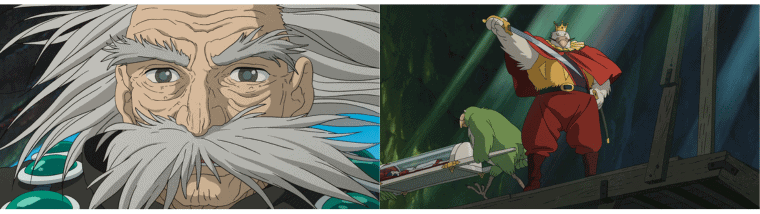
Mahito and the Heron reach the Granduncle by another route and reunite with Himi. Mahito finally meets the ruler of this strange world.
The World Collapses, and Himi Returns to Her Own Time
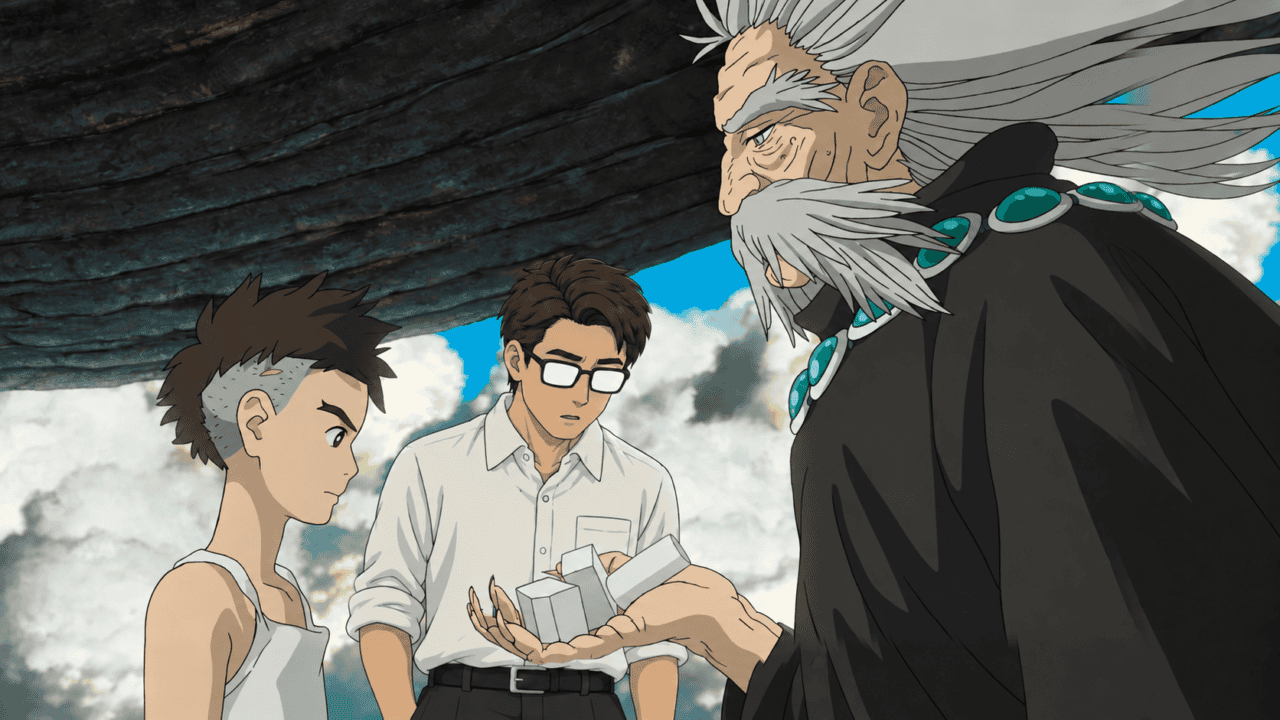
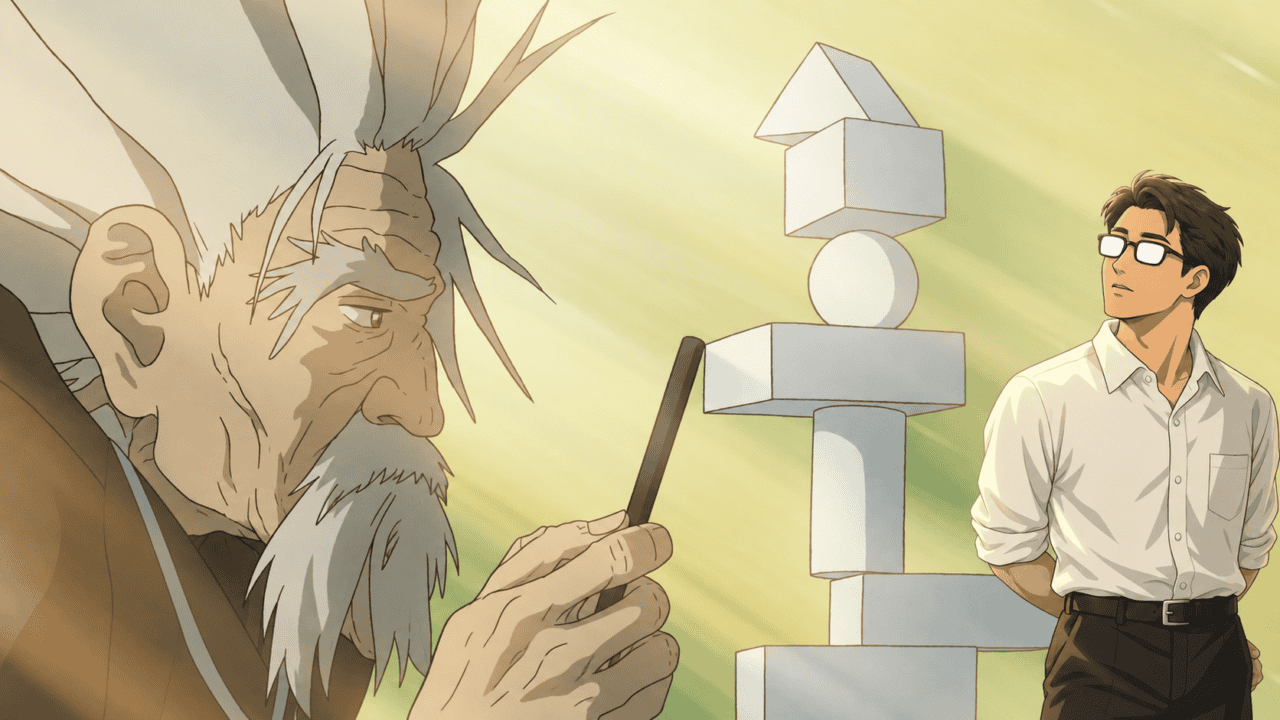
The Granduncle asks Mahito to take over the world he has built, saying that only a blood relative can do so and that it is near collapse. Mahito objects to the malice in the stones supporting it. The Granduncle offers him thirteen replacement stones free of malice with which to build a better world.
Mahito points to his own self-inflicted scar as evidence of his malice and refuses. He wants to return to his own world and make friends, like the Heron.
Mahito expresses both sides of this choice directly in the film’s dialogue: he acknowledges his own “malice,” then chooses to make friends instead. I examine those lines in The Boy and the Heron quotes in Japanese and English.
The Parakeet King declares that he should take over and tries to stack the stones himself. When they will not balance, he swings his sword. His reckless actions bring the already fragile world crashing down.
Accepting even this unwanted outcome, the Granduncle tells Mahito and Himi to go to the Corridor of Time—the room full of doors—and return to their own time.
As the world collapses, Kiriko brings Natsuko to the doors. Mahito hesitates to let Himi return to her own time, knowing that she will become his mother and die in the fire.
Himi answers, “Isn’t it wonderful? To give birth to you, Mahito.”
Mahito, Kiriko, Natsuko, and Himi each return to their own time.
Two years after the war ends, Mahito returns to Tokyo with his father, his mother Natsuko, and his younger brother.
The Boy and the Heron: Analysis and Interpretation
The family relationships, the tower’s inhabitants, and the Granduncle’s stones invite several approaches to the film’s meaning.
The Father, the Mothers, the Granduncle, and the Meteorite
As noted above, the film begins with Mahito’s monologue, a device that struck me as new for Miyazaki. Another distinctive feature is its portrayal of a father showing love for his son at close quarters.
Sosuke’s father appears in Ponyo, but we do not see him spending time with his son. Shoichi’s closeness to Mahito in The Boy and the Heron stands out by comparison. Why did Miyazaki portray this relationship?
The film also gives extraordinary prominence to the mother. I think Miyazaki’s own mother is reflected in his earlier work, but I cannot recall her presence being brought so clearly to the center.
We can distinguish four versions of the mother figure: the dead biological mother, the imitation created by the Heron, the mother as a child, Himi, and the stepmother, Natsuko. This feels purposeful—but what might that purpose be?
Then there are the Granduncle and the mysterious meteorite that seems to have driven him mad. What are we to make of them?
The production documentary identifies Takahata as the model for the Granduncle. Yet watching the film, I could not quite see him that way. The character seemed to reflect more than Takahata alone.
So, what might the Granduncle and the meteorite symbolize?
I explore my own reading more fully in this article, written while my impressions of the film were still fresh: The Three Miyazakis: The Granduncle and the Meteorite. How do you read them?
What Might the Parakeets and Pelicans Represent?
A remarkable number of birds appear in The Boy and the Heron.
You can watch without questioning their presence, but with so many of them, it is natural to ask why. I cannot explain why Miyazaki chose parakeets and pelicans specifically, though we can consider how they are portrayed.
The starting point for my reading is the Granduncle’s connection to Takahata, alongside the impression that Miyazaki himself is reflected in him. Both kinds of bird are depicted as creatures that devour.
Putting these ideas together, I read the pelicans as Miyazaki’s confession to devouring the talent of younger animators. The Parakeet King could also reflect Miyazaki, while the flock might suggest animators or us as consumers of his films. I develop that reading here: What Might the Parakeets and Pelicans Mean?. What did they suggest to you?
What Might the Eight and Thirteen Stones Mean?
Near the end, the Granduncle asks Mahito to succeed him and entrusts him with stones that will keep the world in balance. One reading treats the stones as a metaphor for Miyazaki’s work. But why eight in the Granduncle’s stack and thirteen in the set he offers Mahito? The visible number in the stack actually varies between scenes; for this interpretation, I use eight.
I think a possible key lies in Miyazaki’s relationship with Takahata. If the Granduncle reflects both men, the eight stones could stand for early works on which they were closely involved, in a relationship that might be called collaboration.
Under this reading, the thirteen stones would correspond to later works with less direct involvement from Takahata. Mahito’s refusal might then express Miyazaki’s self-criticism of his past filmmaking, especially the work and working methods of that later period.
The proposed correspondences and their interpretation are discussed here: The Meaning of the Eight and Thirteen Stones. This is a reading of the numbers, not a confirmed code. What do you think they mean?
Toshio Suzuki: The Real-Life Gray Heron
Production documentaries and related books identify Toshio Suzuki as the model for the Gray Heron, or Heron Man. But why a gray heron in particular? The choice seems to carry humor and meaning beyond simply giving the producer an animal counterpart.
The Japanese word sagi means both “heron” and “fraud.” Looking back at Suzuki’s career, his sometimes forceful bluffs seem to make the name a fitting joke: his skill helped bring Miyazaki and Takahata’s work to audiences and Ghibli to success.
The Heron draws Mahito toward the tower with suspicious words and sometimes lies, yet ultimately guides and protects him. I see Suzuki in that combination: a companion who sometimes deceived Miyazaki and sometimes encouraged him. Perhaps the pun expresses Miyazaki’s complicated mixture of affection and resentment toward his longtime colleague.
For the specific stories behind this reading, see: Toshio Suzuki’s “Sagi” Stories and the History of Ghibli.
Still, perhaps the reasons do not matter all that much.
Your Take: Mahito’s Choice
Mahito turns down the Granduncle’s offer and returns to his own world. What does that choice mean to you?
Poll results
What does Mahito’s choice to return home mean to you?
- Accepting an imperfect world.0%
- Choosing the people he wants to live with.0%
- Choosing his own path beyond the Granduncle’s world.0%
- Several of these meanings at once.0%
- I see it differently.0%
- I’m not sure.0%
Can you name the movie before the scene comes into focus?
Put your visual memory to the test with a blurred Studio Ghibli scene.

Reader Comments
Have a thought or interpretation? Leave a comment