
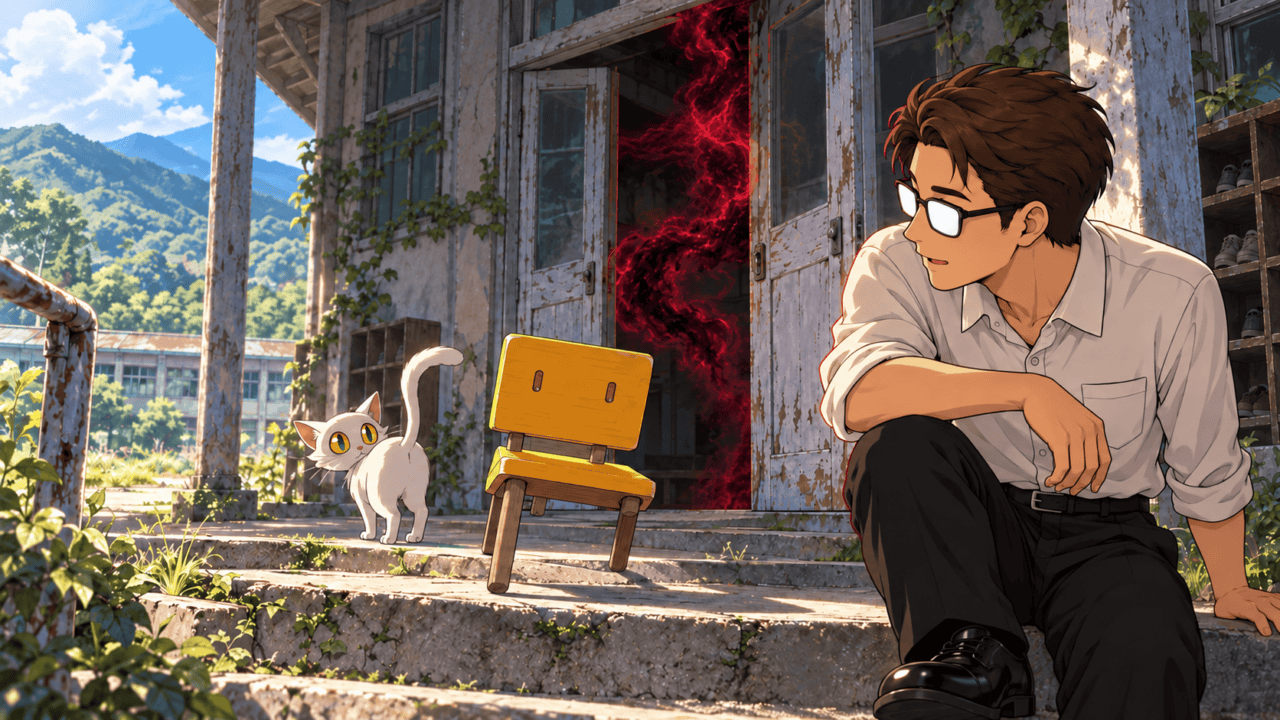
Suzume(Official) is Makoto Shinkai’s theatrical animated film, released on November 11, 2022. It was his first new film in three years, following Weathering with You.
I have been a Shinkai fan since The Place Promised in Our Early Days, but this time I felt a little uneasy: perhaps I was getting tired of his films. The high-school-girl protagonist was probably the main reason. More than anything, I feared becoming that painfully embarrassing old guy who makes the effort to see a new film only to mutter, ‘Makoto Shinkai is finished.’
As it turned out, I had no reason to worry. I left the cinema thinking, ‘Ah, that was a good film.’
Here I will revisit Suzume‘s story and consider what makes it interesting. But when I say ‘synopsis,’ I mean the whole story, ending included—so please beware of spoilers.
*This is a translated version. The original (Japanese) is available here.
- Ideal Parents, Real Parents, and a Necessary Quarrel
Suzume shows its heroine meeting adults who support her without interfering, unlike the aunt who has actually raised her. I read their painful confrontation as a way for parent and child to understand one another. - The End of My ‘Secrets of the World’ Trilogy
For me, Suzume concludes a trilogy with Your Name. and Weathering with You. By confronting the Great East Japan Earthquake directly, it seems to mark a turning point for Shinkai and a full stop for these stories. - Earlier Films and the Role of Music
‘Rouge no Dengon’ and the music of RADWIMPS bring earlier Ghibli and Shinkai films to mind. I find the restrained use of music an important part of the film’s balance. - An Absent Father and What the Film Leaves Out
Suzume’s father never appears. I see this as a choice to focus on a woman’s story of recovering her mother, mirroring the mother’s absence in Castle in the Sky.
On this pageContents
Suzume: Full Synopsis Through the Ending (Spoilers)
The synopsis follows Suzume’s journey from the first door in Kyushu to her return to her childhood home and the people who help her along the way.
Story Highlights and Character Map
-
A Door in the Ruins
Suzume Iwato, a 17-year-old living in a rural Kyushu town, follows a young man she meets on her way to school. In an abandoned hot-spring resort, she discovers a lone door, and a strange story begins. -
Meeting Souta, a ‘Closer’
Souta Munakata travels across Japan closing doors that let disasters into the world. Suzume is drawn to him and learns about the world on the other side. -
Daijin and the Chair
A keystone used to seal the door takes the form of the white cat Daijin. Daijin turns Souta into a small chair, and his mysterious behavior brings further confusion. -
Closing Doors Across Japan
Suzume and Souta, now a chair, pursue Daijin while closing doors in ruins across the country. The help and warmth of the people they meet sustain Suzume along the way. -
Facing What Suzume Has Lost
Suzume confronts memories of the mother she lost as a child and her feelings for Tamaki, the aunt who raised her. She eventually reaffirms her ties to those she loves and returns to everyday life.
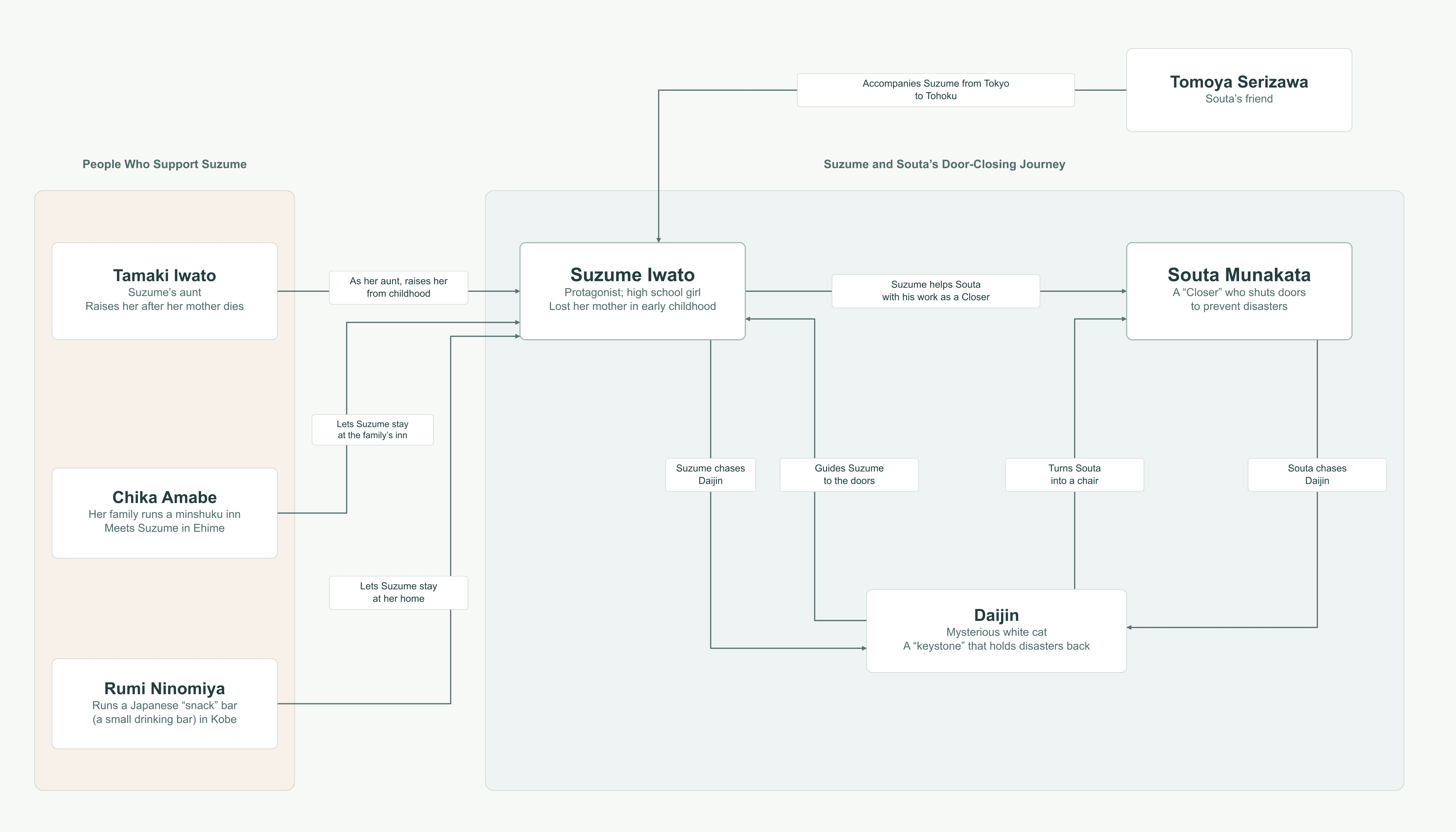
Character Map
About the Story
Suzume is Shinkai’s first road movie. Its journey begins in Miyazaki, Kyushu, crosses Shikoku, then travels up Honshu as far as Iwate Prefecture.
Like Your Name. and Weathering with You, it takes disaster as its subject against the backdrop of the earthquake of March 11, 2011.
Within that framework, its exploration of parents and children gives it a new dimension compared with his earlier films.
Let us now look more closely at Suzume‘s story.
Detailed Synopsis Through the Ending
The following account runs from the door in the ruins, through the journey across Japan, to Suzume’s confrontation with memories of the earthquake and the opening of a door to her future in the final scenes.
The Beginning: Suzume Meets Souta
Seventeen-year-old Suzume Iwato lives with her aunt in a quiet port town in Miyazaki Prefecture.
On what should be an ordinary morning, she meets a beautiful young man, Souta Munakata, on her way to school.
He asks a strange question: are there any ruins nearby? Suzume tells him about an abandoned hot-spring town beyond the mountain.
They part, but her curiosity about Souta draws her after him to the ruins. She cannot find him. Instead, she discovers a mysterious door and pulls up an odd stone planted in the ground as though watching over it. The stone changes into a white creature and runs away.
Bewildered, Suzume opens the door as though something is guiding her. Another world lies beyond it, but she cannot enter. Uneasy, she leaves for school.
The Worm Appears and Souta Becomes a Chair
At school, Suzume has a strange premonition. An earthquake follows, and she sees something ominous emerging near the abandoned hot-spring town.
Only Suzume seems able to see it.
Thinking the beautiful young man might be there, she returns to the ruins.
The ominous presence is pouring from the door she left open. This is where it came from.
The young man is there, desperately trying to close the door.
After a struggle, Suzume helps him close it. He is injured, so she invites him home…
As she treats his wounds, she learns that his name is Souta Munakata and that he works as a ‘Closer’ while attending university. Closers check the ‘rear doors’ around Japan and close them when necessary. In this story’s world, the creature emerging from them—the Worm—causes earthquakes. When it grows to its full size and falls to the ground, a major earthquake follows. The keystone that should have sealed the door has somehow disappeared.
Just then, an emaciated white creature appears outside the window.
When Suzume calls it cute, it quickly recovers its vitality and becomes a healthy white cat.
Souta is immediately suspicious. Finding him a nuisance, the cat uses its power to trap him in a chair—the three-legged chair Suzume’s mother made for her when she was little.
The cat runs off, and Souta chases it, still a chair. He tries to go alone, but Suzume cannot leave him like this and decides to join him.
Suzume calls the cat Daijin because of the impression he gives her.
Chasing Daijin and Closing Doors in Ehime and Kobe
Tracking sightings of the white cat on social media, the two take a ferry to Ehime.
On a mountain road, Suzume meets Chika Amabe, a high school student her own age. They quickly become friends. But Suzume notices another Worm emerging from the mountains, where Chika says an abandoned school stands.
At the school, the entrance has become a rear door, with the Worm pouring out. Daijin is there too.
They finally catch up with him, but first they must close the door.
Unable to do it as a chair, Souta entrusts the task to Suzume. What matters most is the accumulated thoughts and memories of the people who lived there. Suzume listens to them and succeeds in closing the door.
The task is done, but Daijin escapes.
They left home without a plan, but that night Chika’s parents let them stay at their guesthouse. Chika and her family seem to sense that something is going on, yet support Suzume without asking questions.
The next morning, the two resume their pursuit and happen to get a lift to Kobe. Their driver is Rumi Ninomiya, who runs the Haabaa bar and is returning home with her son and daughter.
Rumi lets Suzume stay at her home in exchange for helping out at the bar. Here too, she offers support without interrogating her.
That night, a Worm appears at an abandoned amusement park. Suzume and Souta head there.
Shinkai has described the park as fictional. Viewers comparing locations have suggested that it may combine features of Washuzan Highland, Otoginokuni Amusement Park, Roadside Station Fruit Flower Park, and Nasukawa Highland Park.
This time, the rear door is the door of a Ferris wheel carriage.
Leaving the door to Suzume, Souta pursues Daijin. He struggles to catch up and begs the cat to become a keystone again. Daijin gives a strange reply: he has passed that role to Souta.
Meanwhile, Suzume is not only struggling with the door; she is nearly swallowed by the world beyond it. Souta has to abandon the pursuit to save her, and they somehow manage to close the door.
Once again, Daijin gets away.
Tokyo: The Giant Worm and Souta’s Sacrifice
They travel to Tokyo to pursue Daijin, protect the second keystone that should be there, and see Souta’s hospitalized grandfather, who is also his teacher.
Before visiting him, they examine documents in Souta’s apartment. They learn that a keystone exists in Tokyo, but cannot locate it.
Then Souta’s friend Tomoya Serizawa comes to the apartment. Souta cannot exactly answer the door as a chair, so Suzume deals with him.
Serizawa looks a little flashy, but he studies education like Souta and wants to become a teacher. He has come because Souta failed to turn up for the teacher recruitment exam.
His language is a little rough, but he seems trustworthy.
After he leaves, Suzume and Souta set off to see the grandfather. On the way, they encounter Daijin again.
Determined to catch him this time, they give chase, but he escapes into a railway tunnel beneath a bridge.
At last, a Worm emerges from Tokyo’s rear door. Far larger than any they have seen, it suggests that the eastern keystone has also been removed.
They try to seal it using Daijin as the keystone, but that role has already passed to Souta. The only way to seal the Worm is for Souta to become the keystone. Faced with this desperate choice, they have no alternative.
The Worm covering Tokyo disappears, at the cost of Souta. Devastated, Suzume nevertheless finds the city’s rear door.
Souta is visible as a keystone in the world beyond it, but she cannot get inside.
Daijin appears.
Believing he has simply been playing with Suzume, Daijin speaks affectionately. But she rejects him for causing her to lose Souta. He immediately grows thin again, returning to the state in which they first met.
Suzume does not know how to save Souta, but cannot give him up. She goes to see his grandfather.
Hitsujirou Munakata is gravely ill. When Suzume asks for help, he tells her that she should know where she needs to go.
She resolves to travel to her hometown in Tohoku, where her own story began.
Tohoku: The Road Trip with Serizawa and Tamaki
Suzume meets Serizawa again and insists that Souta’s life is at stake, persuading him to drive north. Just as they are about to set out, Tamaki finally catches up with her.
Tamaki wants to take her straight home. Suzume refuses, and her aunt eventually permits the journey on condition that she comes too.
The emaciated Daijin appears, and Suzume lets him join them without rejecting him.
Given no say in the matter, Serizawa drives toward Suzume’s hometown with two troublesome passengers and a cat.
In an awkward atmosphere, they arrive at a motorway service area.
They have argued along the way, but now their accumulated feelings explode. Tamaki in particular seems to lose control, shouting her frustrations with their life together at Suzume.
Suzume has suspected that her aunt feels this way, even if she never says it. Hearing the words aloud is still a terrible shock.
But a large black cat stands behind Tamaki. The outburst may reflect some of her real feelings, yet it may also be the mysterious cat’s doing.
Whatever the explanation, they must continue north. The tense journey resumes with three people and, now, two cats.
Just before their destination, Serizawa’s battered secondhand car rolls down an embankment. Having struggled north along the Tohoku Expressway, it has reached the end of its service.
Suzume tries to continue on foot, but Tamaki finds an old bicycle nearby and gives her a ride.
Their outburst at the service area seems, if anything, to have improved their relationship. It has cleared the resentment they avoided facing and allowed a fresh start as mother and daughter.
The Door to the Ever-After and Souta’s Rescue
Suzume returns to the site of the home she shared with her mother. After losing her mother in the earthquake, this was a place she could not bear to face. Now, to save Souta, she chooses to confront herself.
Daijin begins walking as though guiding her. He leads her to a rear door.
Suzume thought he was opening doors across Japan. Now she realizes he was guiding them to the next door that would open.
This is also, for Suzume, a door into her own heart. She passes through it to the other world to bring Souta back.
In a landscape like a volcanic region, she finds Souta. Knowing that freeing him may release the Worm again, she rescues him from his role as keystone.
The giant Worm begins to move.
It tries to crawl into the present world through the door Suzume used.
Suzume and Souta seal it with Daijin and the black cat as keystones. The black cat was, in fact, Tokyo’s keystone.
With the Worm sealed, Suzume encounters her younger self, searching for her mother among the earthquake’s rubble. As a child, she had wandered into this world.
Suzume embraces the child, just as the person she mistook for her mother once embraced her. She hands her younger self the three-legged chair, repeating what that person did for her…
The Ending: Facing the Past and Returning to Everyday Life
Their task complete, Suzume and Souta return to the present world.
Souta says he will set off again to check rear doors across Japan.
Reluctantly parting from him, Suzume returns to Miyazaki with Tamaki. Along the way, they visit those who helped her and thank them as mother and daughter.
Back in Miyazaki, Suzume has resumed everyday life. Then the beautiful young man looking for ruins appears again.
That is my account of Suzume‘s story. I wrote it from the memory of a single cinema viewing, so there are probably inaccuracies, but I think that is broadly how it went.
What, then, did I find so interesting about Suzume?
Suzume: Interpretation and Analysis
Suzume’s relationships, the film’s treatment of the past, and its connections with Shinkai’s earlier work offer several ways to consider the journey.
Parents, Children, and a Head-On Quarrel
As a road movie, Suzume portrays the kindness of the people she meets. Chika in Ehime and Rumi in Kobe do not pry into her circumstances. They seem like ideal adults: something must be going on, but let us support her first.
Perhaps this is precisely the kind of parent an adolescent wishes for. When the desire to decide for oneself emerges, parental interference can look like a lack of trust.
But a real parent has watched the child from the beginning. The wish to respect their independence mingles with ‘not again’ suspicions and the desire to be needed, bringing the parent into conflict with the child’s growth.
Tamaki takes the role of that real parent here.
Suzume’s trip to Tokyo happens somewhat by accident. For me, her real road movie begins when she leaves Tokyo for Tohoku, having lost Souta, to confront her past. It also becomes a journey in which Tamaki, who raised her, must face herself.
Tamaki’s terrifying monologue at the service area brings out feelings that have smoldered within her, and that Suzume has dimly sensed.
This fierce parent-child quarrel painfully confirms Suzume’s suspicions. I see it as essential to clearing their unspoken resentment and repairing their relationship. At that moment, Suzume becomes an adult in a deeper sense, while Tamaki can finally become a true parent.
I do not think this is necessary only because an aunt raised her niece. It probably applies to parent-child relationships generally.
The only solution humanity has discovered to the conflict between parents and children: a parent-child quarrel.
If Suzume has a clear message, might it be this? Have at least one head-on quarrel with your parent or child in your life.
The End of My ‘Secrets of the World’ Trilogy and the Earthquake
I think Suzume will be discussed as a Shinkai trilogy with Your Name. and Weathering with You.
One reason is that these three fantasies use unknown ‘secrets of the world’ to drive their stories. There are subtle science-fiction elements, but I think they are fundamentally fantasies.
In that sense, for me, they make up ‘Makoto Shinkai’s Secrets of the World Trilogy.’
Why a trilogy rather than four films? It does sound better, of course, but I think the decisive reason is the Great East Japan Earthquake.
Suzume is explicitly a story about that earthquake. I see Your Name. and Weathering with You as such stories too, approaching it indirectly through their disasters.
This time, nothing conceals the subject: Shinkai confronts the Great East Japan Earthquake directly.
I recall Shinkai saying after Weathering with You that its ending would divide opinion. But Suzume seems far more likely to do so.
Perhaps confronting the earthquake directly means that Shinkai feels he has crossed a ridge of some kind. In the ‘Makoto Shinkai Book’ handed out at cinemas, he says:
With Your Name., all I could do was approach it through dreams. But I increasingly felt that perhaps I could now touch it directly—that I should. Somewhere, too, I felt that I could not put it off any longer.
Original Text in Japanese
「君の名は。」のときは、夢を媒介にして触れていくみたいなことしかできなかったんです。でも、今なら直に手で触れることができるんじゃないか、直に触れるべきなんじゃないかという気持ちが強くなっていった。あるいは、これ以上、そこに触れるのが遅くなってはいけないという気持ちもどこかにありました。
For me, Your Name., Weathering with You, and Suzume are a ‘Secrets of the World Trilogy.’ Yet, as people recognized, they are also a trilogy about the Great East Japan Earthquake. The words above suggest that Suzume marks a major break between chapters.
Perhaps the scene in which Suzume and Souta drive the keystones down at the end is the full stop that concludes the series.
Thinking this way, I expect Shinkai’s next film to be entirely different from this trilogy that began with Your Name.. I do not expect the COVID-19 pandemic to be its subject either: I think Suzume has already addressed that.
What, then, will his next film be like?
Well, let us wait patiently. It is all we can do.
Connections with Kiki’s Delivery Service and Castle in the Sky
During the journey from Tokyo to Tohoku in the second half of Suzume, Yumi Arai’s ‘Rouge no Dengon’ plays. For many viewers, it must have brought Kiki’s Delivery Service vividly to mind.
The film mentions a journey beginning and a cat as reasons for playing it, but perhaps there is more. Kiki’s Delivery Service also surrounds its heroine with ideal people who ask no questions. This film follows that pattern. With a woman, a cat, and a departure, perhaps ‘Rouge no Dengon’ was the necessary choice for a story supported so conveniently by such people.
At its simplest, I read Suzume as a woman’s story: she says goodbye to her birth mother and recovers the woman who raised her as her mother. Notice that Suzume’s father never appears.
We have seen something similar: the mother’s absence in Castle in the Sky.
Castle in the Sky talks about Pazu’s father but says nothing about his mother. Perhaps that is because Castle in the Sky is a story of recovering his father.
A film has roughly two hours; it cannot show everything. Choosing what to leave out may matter more than choosing what to include.
Likewise, I read the father’s absence in Suzume as a deliberate narrative choice that focuses the film on her growth and her recovery of a mother. It mirrors the mother’s absence in Castle in the Sky.
The Role of RADWIMPS’ Music
Since Your Name., RADWIMPS—or Yojiro Noda—has been impossible to ignore in Shinkai’s films.
Comparing Your Name., Weathering with You, and Suzume, I think Your Name. produced the strongest chemistry between music and images. Surely you got goosebumps when ‘Sparkle’ played too?
Personally, Weathering with You had too much music. The songs were wonderful, and I like them individually, but as a film, it served up almost enough sound to make me burp.
Suzume sits at the opposite extreme.
The songs are as wonderful as ever, but used with great restraint. Some may find that insufficient; personally, I think it is about right. Perhaps Your Name. simply worked too well, and that kind of success cannot easily be repeated.
I hope the Shinkai–RADWIMPS partnership continues, though I suspect the balance may resemble Suzume from now on.
Those are my personal thoughts on Suzume. There is surely more to consider, including its mythological elements, but for now I have kept to my reading of the story.
What did Suzume mean to you?
Your Take: Suzume’s Journey
Suzume’s journey brings her closer to strangers, loved ones, and her own past. Which part stays with you most?
Poll results
Which part of Suzume’s journey stays with you most?
- Her determination to save Souta.0%
- The kindness of the people she meets.0%
- Her confrontation and reconciliation with Tamaki.0%
- Her meeting with her younger self.0%
- Several of these equally.0%
- Another part of the journey.0%

Reader Comments
Have a thought or interpretation? Leave a comment