
Summer Wars (Official Website) is a feature-length animated film directed by Mamoru Hosoda, released in 2009.
I remember going to see it with a friend when I was a student. It is now my favorite Hosoda film, and one of my favorites by any director.
Yet one scene had bothered me ever since that first viewing. I now think it is a damn good scene, but it took about three viewings to get there. That I went back to it after its theatrical release tells you how much I liked the film.
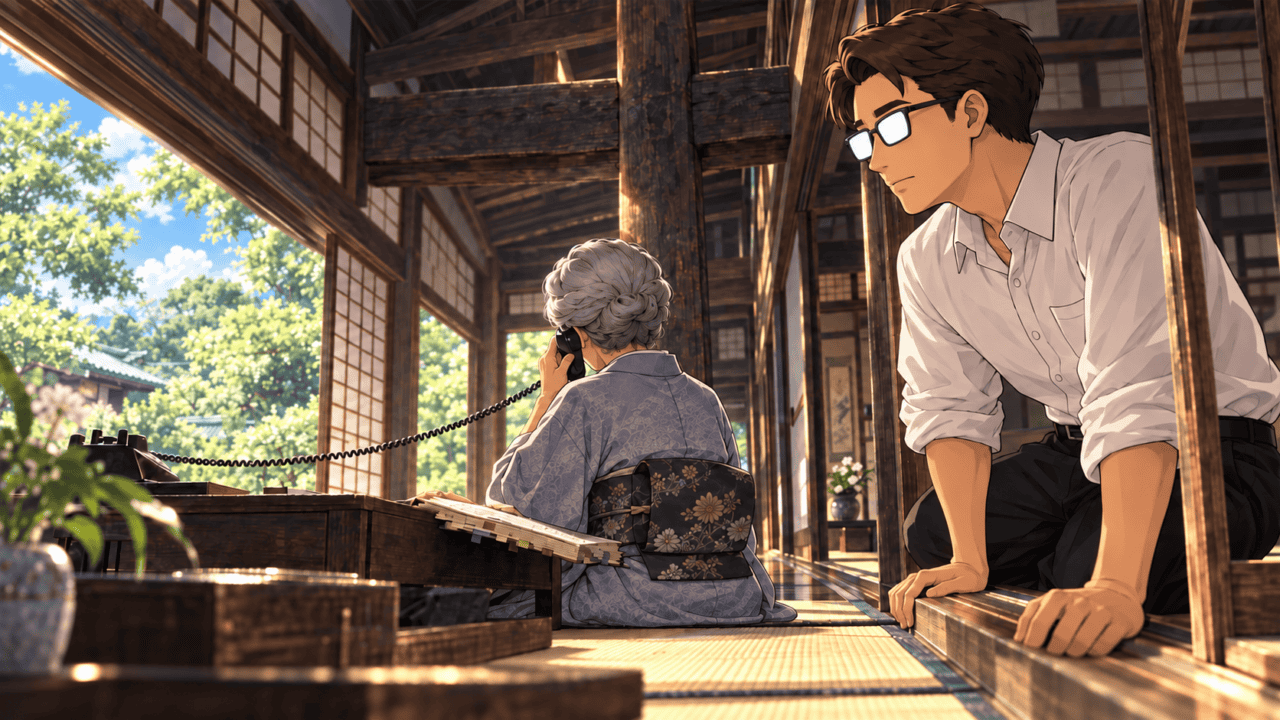
The scene was “Grandma calling everyone on the phone.”
*This is a translated version. The original (Japanese) is available here.
- The Phone Calls and the Weight of the Past
The crisis might have subsided without her calls. Yet the scene expresses the life she has built, and another future she might have had if she had been able to live differently. - Supporting Wabisuke as Liberation, Rather Than Exile
Some darker feelings may have been involved. Still, I think her essential wish was for Wabisuke to go somewhere else, free of the household that had bound her. The traditional “house” (ie) is central to this reading. - Kenji’s Growth in “Please Take Care of Us”
Kenji’s climactic “Please take care of us” (Yoroshiku onegaishimasu) is the response he could not give Grandma at their first meeting. It marks his growth and respect for her. He may be a mathematical stereotype, but he is a recognizable one. - Women Control the Food; Men Go to War
The Jinnouchi women command the dinner table, while the men seek a role in battles outside the home. Even the final victory comes from a woman. In this sense, the story leaves its men rather beside the point.
On this pageContents
Did Grandma Need to Make Those Phone Calls?
After Love Machine causes its first crisis in Summer Wars, Grandma starts calling relatives and people in high office, including the superintendent general of the Tokyo police. The situation settles down, and someone in the film says it is thanks to her. But is that really so?
This was exactly what bothered me. I could not shake the thought that “the situation would have settled down even without Grandma’s calls.”
People across Japan and the rest of the world were caught in the confusion, but they were still doing what they could. Surely things were already moving, little by little, in the right direction. When someone at the other end of Grandma’s call protests, “I was just about to do that!”, I suspect they really were. They may already have given the orders.
What troubled me was that the film presented this as such an uplifting scene despite all that. As I said, though, I now think it is wonderful. I see it less as a demonstration of Grandma’s competence than as a scene that uncovers the history of hardship she has carried.
Why, then, did the film need it?
To answer that, we must face what I take to be the greatest mystery in Summer Wars: “Why did Grandma Sakae support Wabisuke?” First, let us consider her past.
Before Summer Wars: Sakae’s History of Hardship
In Summer Wars, Grandma looks like an absolute monarch.
Yet piecing together what the film tells us, I suspect she became one only fairly recently, through her own ability.
Sakae belongs to the direct Jinnouchi line, while her husband married into the family—a mukodono. He seems to have lived as he pleased, taking another woman and having a child with her. Perhaps the strain of his position helped bring this about. Still, there is no denying that he was a fool.
But isn’t that odd? If women had always held power in the Jinnouchi family, things would not have gone this way. Under Sakae’s capable leadership, the household ought to have flourished—even after the upheavals of the postwar years.
Instead, her husband’s dissipation greatly reduced the Jinnouchi assets. Something does not add up.
Let me digress for a moment with a personal story.
My mother’s family were farmers. For two generations in succession, men married into the household: my grandfather and my uncle.
At my grandfather’s wake, my uncle, who had been drinking, said, “In the end, nobody ever poured me a beer—not once.”
Even though both had married into the family, there was still a hierarchy. I suspect my grandfather held the power—the position Sakae’s father would occupy in this analogy.
My grandmother and aunt belonged to the direct line. That did not necessarily mean they wielded real authority.
I know it is hardly fair to compare the prosperous Jinnouchi family with a rural farming household. Still, perhaps even Sakae had to submit to a traditional “house” (ie) with a man at its head.
Once the person standing over her husband was gone, he finally spread his wings and indulged himself.
It was probably only after her husband died that Sakae restored the household and built the “Sakae empire” we see. The important point is that her supremacy was probably not an inherited Jinnouchi tradition. It was something she had built through her own ability.
It was the product of her sweat and tears.
Why, then, did she secretly sell a mountain and send Wabisuke to America?
She had already taken in the child her husband had with another woman and raised him with love. Now she was supporting him even at the cost of a secret she could not share with the family.
Why Sakae Supported Wabisuke
Let us consider the reasons for this puzzling decision. I will start with the most negative interpretation.
The First Explanation: One I Would Rather Not Consider
One of the most memorable scenes in Summer Wars shows Sakae walking hand in hand with little Wabisuke.
She says she is glad to welcome him into the family. Oh, come on. Surely she ought to be furious.
Yet Sakae is not the sort of person who would take those feelings out on an innocent child arriving anxiously in an unfamiliar home. She is kind enough, and mature enough, to offer him words quite contrary to the ugliness she might feel inside.
By the time Wabisuke, isolated within the family, was old enough to leave, it would not be strange if darker feelings had surfaced in her.
Fortunately or unfortunately, Wabisuke was exceptionally talented, and he probably wanted to leave the Jinnouchi household himself. If Sakae secretly sold a mountain and handed him the money with “You can do it,” one could say she had “successfully sent him far away.”
Read this way, her near-tears when Wabisuke says “I worked hard” become “an atoning emotion born of guilt.” The thought might be: “I only wanted to keep you at a distance, yet, knowing nothing of that, you worked so hard.”
Sakae seems perfect. Even so, it is conceivable that deep down she wanted Wabisuke far away more than anyone else did.
Having written all that, I should confess that it is not the view I generally take. Perhaps some small part of her did feel this way. But I think the essential reason she supported him lay elsewhere.
The Second Explanation: What I Think Is More Likely
Perhaps her real wish was: “Wabisuke, at least you must go somewhere other than here.”
Sakae is a capable woman.
Had she been born a man, I think her life would have been quite different.
As a direct descendant of the Jinnouchi line, expected to bring a husband into the family, she was bound to the household. Perhaps she did not hate it. Still, I cannot imagine she never thought, “I could have had another life.”
What did she see in Wabisuke?
Perhaps she saw her former self in a gifted young man who, treated as an awkward outsider by the family, worked desperately at his studies—and perhaps other pursuits—to bring his abilities into the open.
It seems to me she sent him away with this encouragement: “I could not do it, but at least you must be free of this household. Go somewhere other than here.”
Yet she could not explain that to the others. Giving so much money to a child born outside the marriage would be a problem in itself. Her reason would be an even bigger one: it would reject the very household she was trying to build, shaking her kingdom at its foundations.
Being clever has its drawbacks.
Perhaps the only way to reconcile the new household she headed with her feelings for Wabisuke was to let him take the blame. This would also fit the darker side of the first interpretation.
I think these complicated feelings lay behind Sakae’s support for Wabisuke.
At last, we can return to the first question.
Why did the film need Grandma’s phone calls?
The Present She Might Have Had
The people she calls during the first crisis are people with considerable power.
These connections came partly from belonging to the Jinnouchi family; they were also people who listened precisely because it was Sakae calling. More than that, though, I think they represented another possibility for her life:
“The future she might have reached if she had been able to go somewhere else.”
On first viewing, I thought the crisis would surely have been resolved without those calls. Watching again, though, I began to see the scene differently.
It became a concise expression of the household sovereign’s history of struggle with the household itself. Her contacts were the result of a woman named Sakae living as hard as she could, and a reminder that, for all her ability, she had never been able to stand where they stood.
That is why the scene has become a favorite of mine.
Writing this might make me sound hopelessly enamored of progressive ideas. I do not, however, regard the traditional household as a villain. Then again, perhaps that is because I am a man.
An Aside
Kenji’s growth and the Jinnouchi family’s everyday roles offer a lighter way to revisit the film’s relationships.
Do People Like Kenji Koiso Really Exist?
The main part of this article has been Sakae and Wabisuke’s story. But we must not forget the protagonist, Kenji Koiso. His growth, and the Jinnouchi men’s battles beside women who command the dinner table, have their own kind of humor.
I graduated from a mathematics department, and yes, there were people like Kenji.
That goes for his mathematical ability, his build, and his personality.
I have someone quite specific in mind. Unfortunately, it is not me.
He is something of a “math enthusiast” stereotype, but people like him do exist, so I can hardly complain.
When I first watched Summer Wars, I did not understand the significance of Kenji’s final “Please take care of us!” (Yoroshiku onegaishimasu!).
Then I realized it was the response he had failed to give when, after the trouble with Wabisuke, Sakae told him to take care of Natsuki. That made me rather happy.
Someone usually quiet becoming dependable when it matters may be another familiar trait among mathematics or science students. Talented people do not always stay quiet, you know.
The Men’s War
The Jinnouchis are presented as a family in which women hold power. Yet it is still the women who prepare the meals.
You might take that to mean they are simply being made to do the housework. I suspect it is not quite so simple.
People have long said that “Anything is fine” is a bad answer when a man is asked what he wants to eat.
Of course it is. Asked to decide what to eat, he effectively says, “I have no idea.” No wonder that is irritating.
I suspect that never happens in the Jinnouchi household.
The women decide what is eaten, how it is cooked, and how it is seasoned. All of that is their domain.
The men have to eat what they are given. If asked what they want, they would probably have to recall the past week’s meals before cautiously suggesting something. Then they would be shot down anyway: “Wouldn’t this be better?”
In any case, they surely would not dare say, “Anything is fine.”
The women in Summer Wars are not being made to cook; they are cooking what they want to eat.
The men merely get to share in it. Even after its decline, the Jinnouchi household presumably has assets left. In this rather trivial respect too, the men have to give way.
Those men end up directing their frustrations into battles outside the home.
Might that be why only the men initially take on Love Machine in Summer Wars?
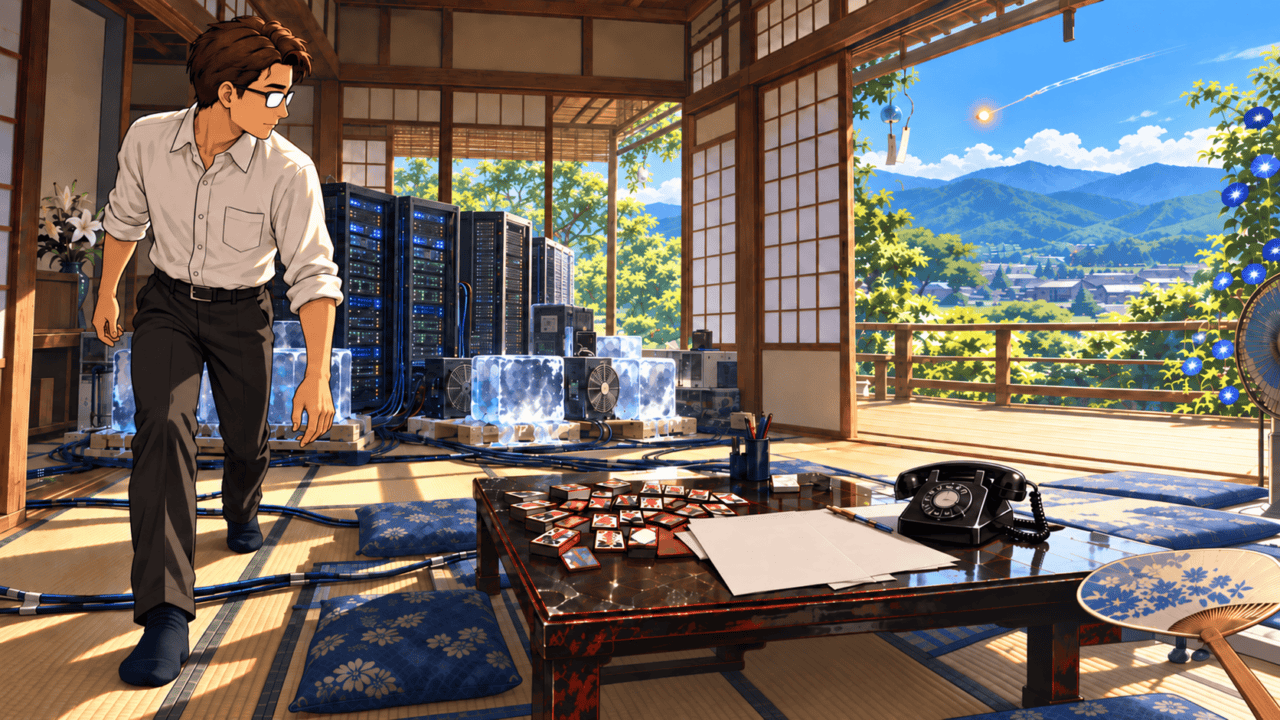
In the end, Natsuki settles things with hanafuda, a game Grandma taught her.
Summer Wars is quite a story of men being beside the point. That is fine by me.
Your Take: Sakae’s Support for Wabisuke
Sakae secretly provides the support that allows Wabisuke to go to America. What do you think motivates her?
Poll results
Why do you think Sakae secretly supported Wabisuke?
- She wanted him to have the freedom she never had.0%
- She believed in his talent and wanted him to succeed.0%
- She wanted some distance from him.0%
- Several of these reasons together.0%
- I have another explanation.0%
- I’m not sure.0%

Reader Comments
Have a thought or interpretation? Leave a comment