
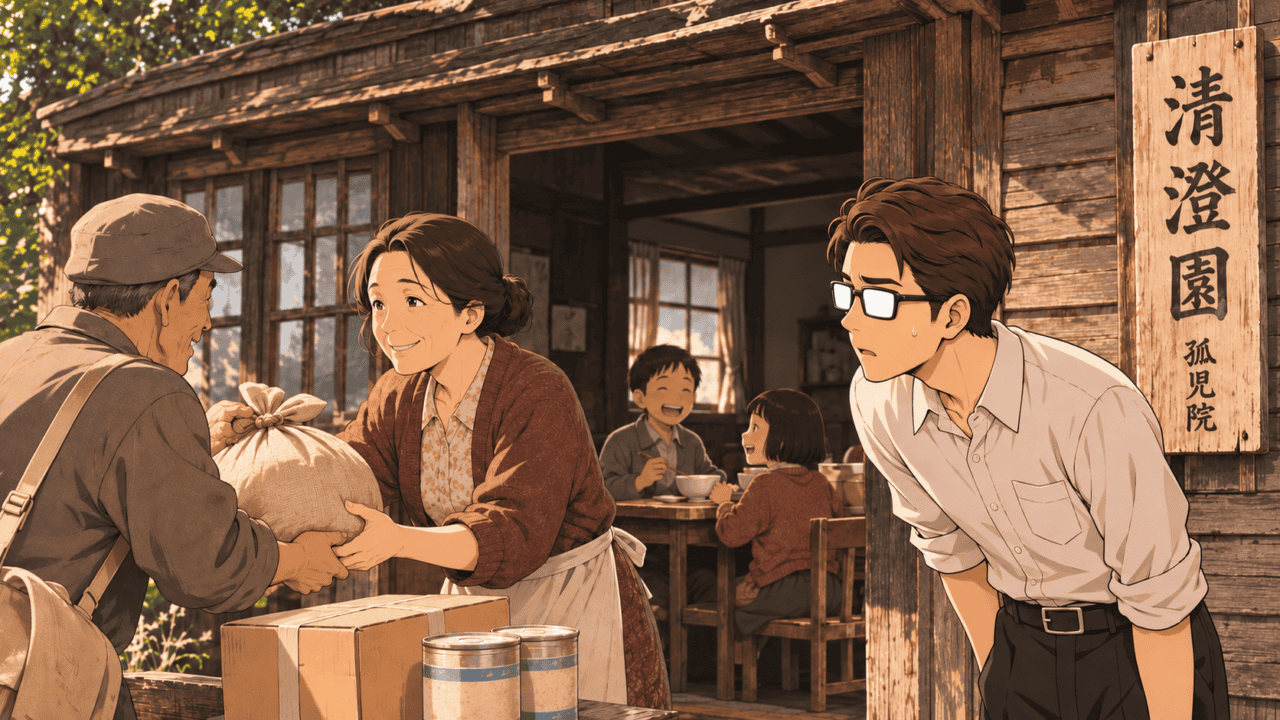
While watching Godzilla Minus Zero, did you wonder how Sumiko Ota kept her orphanage, Seichōen, running?
According to the novelization, Seichōen was funded by government subsidies, Sumiko’s own savings, and help from Seiji Akitsu, captain of the Shinsei Maru. The name Seichōen (淸澄園) takes the character 淸 from Seiji’s name and 澄 from Sumiko’s.
Sumiko was Shikishima’s neighbor in Godzilla Minus One. In the sequel, she takes in children who lost their parents in the war. Providing daily meals, clothes, and bedding costs money, and so does keeping a place where the children can live.
Did people really start orphanages in postwar Japan? If so, how did they pay for them?
Looking through the policies in place in 1949 and records of children’s homes, I came across Satayo Ishiwata, a woman in Tokyo’s Nakano district who took children into her home and invested her own money in a children’s home called Aiji no Ie. Those records, along with the policies of the time, show how closely Seichōen’s story resembles the way a postwar orphanage could operate.
*This is a translated version. The original (Japanese) is available here.
On this pageContents
Japan Had a System to Support Orphanages by 1949
First, consider how many children had lost their parents. A nationwide survey conducted by Japan’s Ministry of Health and Welfare in 1948 reported more than 120,000 orphans. That figure includes children orphaned for reasons other than the war and gives some sense of the scale of the problem Japan faced after the surrender. The survey is discussed in Shōwakan’s exhibition notes on Aiji no Ie.
Some orphaned children went to live with relatives or acquaintances. Others had nobody to take them in and lived in train stations or on the streets. Japan promulgated the Child Welfare Act in 1947 and began putting a system in place to protect children in residential facilities.
How Public Funding Helped Cover Operating Costs
The Relief Act, in force from 1932, allowed municipalities to place children aged 13 or younger who were living in poverty in orphanages and other facilities at public expense. After the war, the government adopted guidelines for the care of war orphans and other children on September 20, 1945, putting local governors in charge of their care. In January 1946, acting on behalf of the Tokyo Metropolitan Government, Airinkai took in children who needed care and adults in hardship. It provided them with food, clothing, and shelter in former barracks.
On April 1, 1946, the national government began providing emergency relief, including food and clothing, to people in hardship, including those affected by the war. It covered the full cost, as recorded in the 1956 health and welfare white paper. The original Public Assistance Act, which took effect on October 1 that year, also allowed local authorities to arrange care for people in need through institutions and other providers.
The Child Welfare Act was promulgated in December 1947. Its provisions for covering residential placement costs with public funds took effect in April 1948. In a circular dated March 31, 1948, the Ministry of Health and Welfare instructed facilities that met conditions such as official approval to shift the living and administrative costs of children already receiving aid from the original Public Assistance Act to placement funding under the Child Welfare Act.
On April 13, 1949, the year in which the film is set, the director of the Ministry of Health and Welfare’s Children’s Bureau sent prefectural governors a circular answering questions about how to apply the Child Welfare Act. Question 6 explains how to calculate administrative expenses for a newly opened home using factors such as the number of children placed there under the law. Question 9 asks that placement costs be paid near the beginning of the month they cover, whenever possible.
By 1949, Japan had rules for calculating and paying public funds to children’s homes.
Opening a home did not guarantee funding for every child. The circular treats placements by local authorities differently from arrangements made directly with families. Eligibility depended on the type of facility and how each child came into its care.
Community Chest Donations Also Supported Private Homes
Community Chest donations gave private orphanages another source of funding. The campaign began in 1947 and is still known as the Red Feather Community Chest.
A report on mutual support in local communities from the Ministry of Health, Labour and Welfare explains that the campaign began to address funding shortages at private welfare facilities, including those caring for war orphans. Donations helped pay for the children’s daily needs.
An orphanage like Sumiko’s could plausibly draw on public funds and donations and receive supplies from people around it. Running the home did not mean she had to pay all the children’s living expenses herself.
Satayo Ishiwata and the Children’s Home She Founded
The system existed, but could one woman really start an orphanage? In Tokyo’s Nakano district, Satayo Ishiwata did just that when she founded Aiji no Ie.
According to Shōwakan’s exhibition on Ishiwata and the war orphans of Aiji no Ie, Ishiwata, born in 1897, first took in one child orphaned by the war. She opened her home, put her own money into caring for the children, and lived with them. They called her “Mama.”
Aiji no Ie grew out of one woman’s decision to welcome a child into her own home. That was enough to start what eventually became a residential facility.
The Family’s Rooms Became Dining and Sleeping Quarters
The Shōwakan Digital Archive has a photograph titled “Children Around the Dinner Table,” taken around May 1946.
According to the photograph’s description, the children ate from surplus military aluminum tableware. There was no separate dining room yet. The children ate and slept in Ishiwata’s husband’s room, and her daughters slept in the maid’s room.
Shōwakan’s description gives a government food allowance of ¥4.93 per child per day. The amount Aiji no Ie actually received was ¥1.60 per child per day.
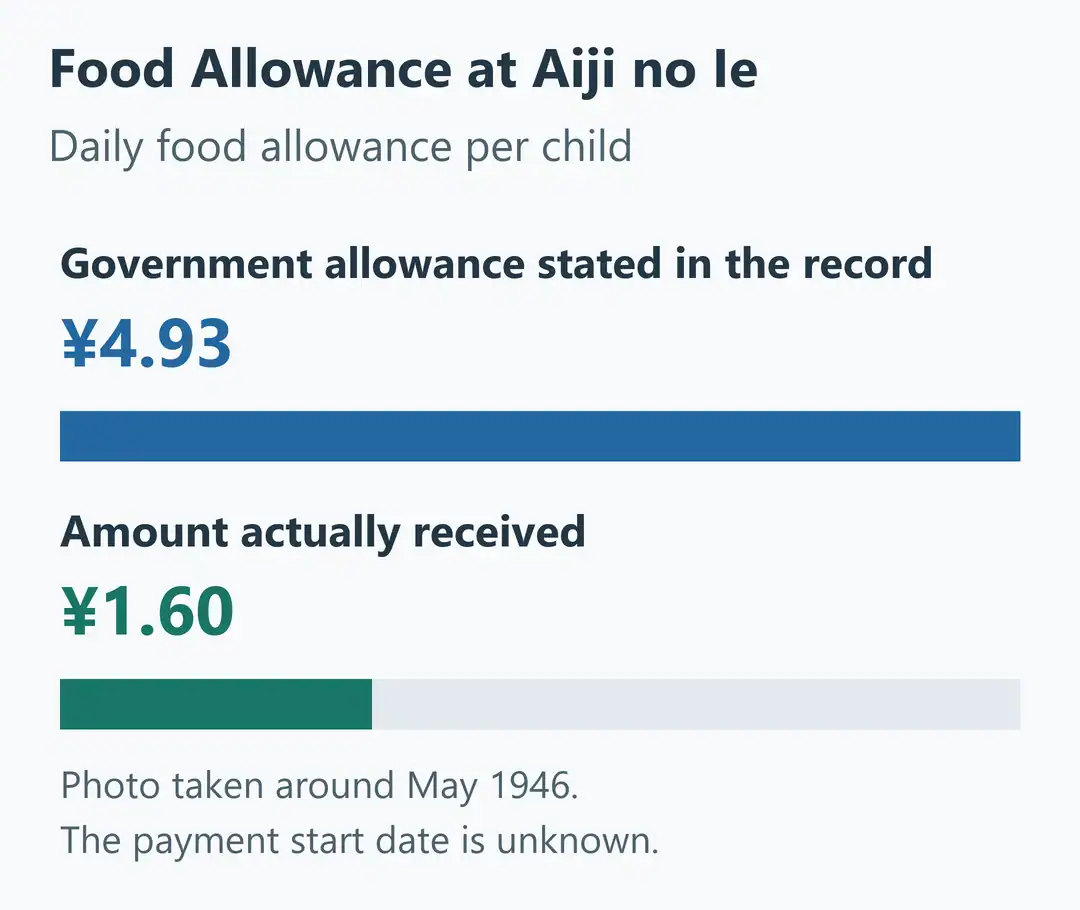
The photograph dates to around May 1946. Its description gives neither a start date for the payments nor the name of the program. Even when public aid was available, it could fall short of what a home needed to feed its children.
Ishiwata gave over part of her own home and covered shortfalls while living with the children. That was what starting an orphanage looked like in practice.
LARA Relief Supplies and Help from U.S. Navy Sailors
Food, clothing, and other supplies also mattered to a home’s finances.
A Shōwakan photograph taken on December 17, 1946, shows children holding LARA relief supplies outside the gates of Aiji no Ie. They are holding boxes of powdered milk sent by a private relief organization in the United States. The archive notes that almost none of the shoes they were given fit, and some children wore trousers sewn from surplus military blankets.
LARA stands for Licensed Agencies for Relief in Asia. The U.S. relief organization sent food, clothing, medicine, and other supplies to Japan after the war.
The shipments still left some needs unmet. Every delivery of milk or clothing meant one less thing the home had to buy. In a time of shortages, support like this helped keep the facility running.
The archive’s description of “Satayo Ishiwata in the Dining Room” says that the crew of the USS Calvert supported the home from 1949 to 1966, when another ship took over. Aiji no Ie began receiving sustained help from overseas supporters in the very year in which the film is set.
The Home Had Nine Staff Members by 1949
Preparing meals, finding clothes, and educating the children took more than Ishiwata could do on her own. Keeping the home open took other people’s help.
The archive entry for “People of Aiji no Ie” includes a roster from April 1949. It lists Ishiwata as chair, along with the head of the board, members of the education committee, and nine staff members.
- One secretary and one administrative assistant
- Four childcare workers
- Three cooks
Ishiwata’s daughters helped run the home too.
The roster does not tell us where the employees’ wages came from. By 1949, the home one woman had started amid the turmoil after the war had grown into a facility with a staff of its own.
Sumiko ran Seichōen, and other people could have helped both with its administration and with the work of caring for the children.
How Did Sumiko Fund Seichōen?
In the novelization, Sumiko first takes children into her home. When the government starts encouraging people to open private orphanages, she rents a building and sets up a home of her own. Sumiko uses government subsidies and draws down her savings to keep it running. Seiji Akitsu then offers to help.
To thank him, Sumiko suggests naming the home after him, using the two characters of his given name (淸治) followed by 園. Akitsu agrees on the condition that she include her name too. They take one character from each of their names and call it Seichōen (淸澄園).
In 1949, the Child Welfare Act gave authorities a way to place children in residential care and cover the cost with public funds. The novel does not name the subsidy program. The historical records do show that private homes could receive public funding.
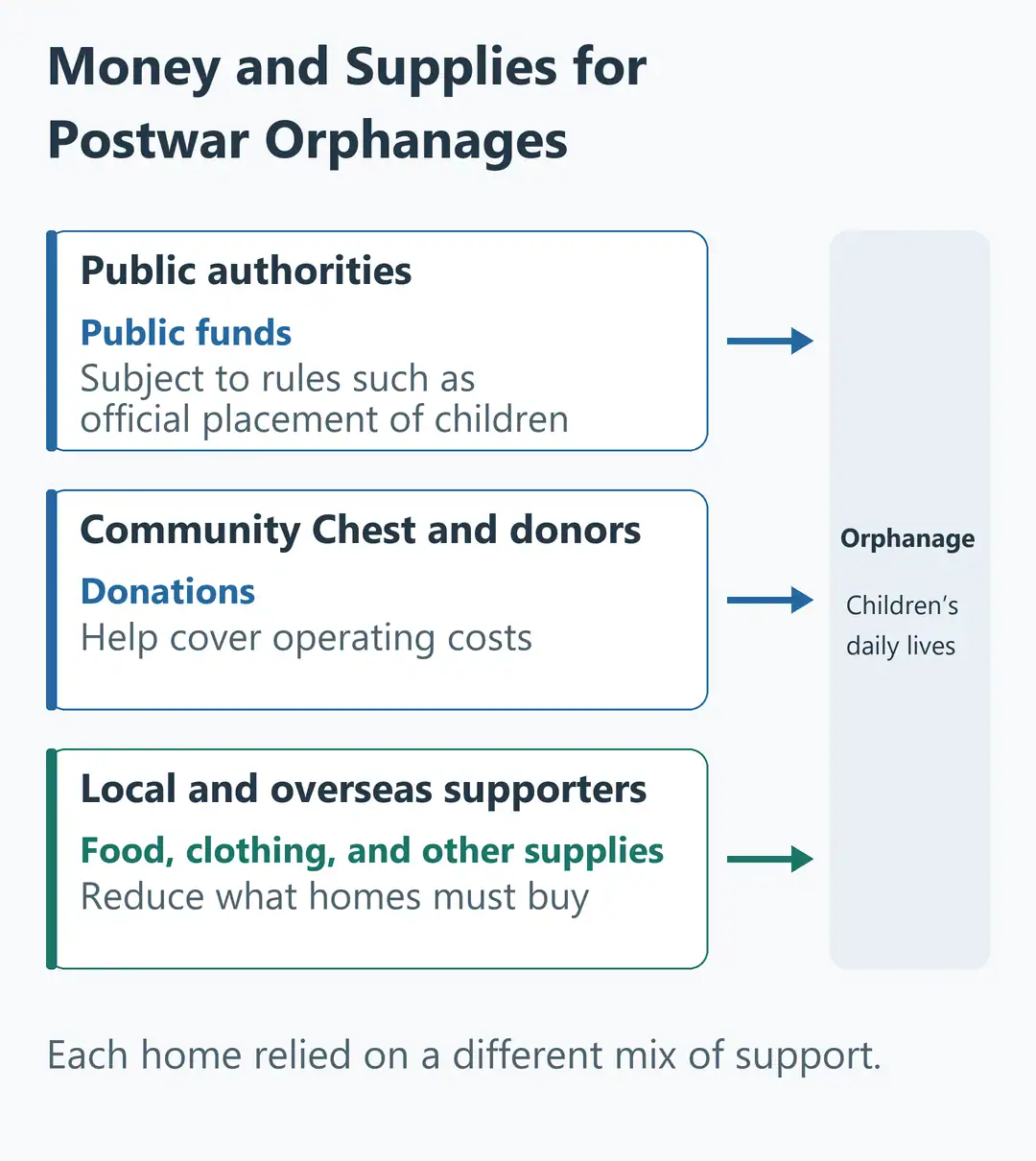
- Public funds. Authorities covered the costs of placing children in residential care.
- Community Chest funds and donations. These helped cover operating expenses.
- Food, clothing, and other supplies. Donations in kind reduced daily expenses.
Aiji no Ie also began when Satayo Ishiwata took children into her home and put her own money into caring for them. According to Shōwakan’s photograph description, the home received less than a third of the food allowance it was supposed to get. The shortfall had to be covered to feed the children every day. Donations such as LARA’s powdered milk helped cut food costs. U.S. Navy sailors began providing ongoing help in 1949.
Sumiko keeps Seichōen running with public support, her own savings, and help from people around her. When we look at the records of Aiji no Ie, Sumiko’s decision to spend her savings and Akitsu’s offer of help ring true for a postwar orphanage.
The account of Seichōen comes from Takashi Yamazaki’s Godzilla Minus Zero novelization. Book details from Shueisha Orange Bunko.
Sumiko Lost Her Children and Took In Children Who Had Lost Their Parents
No evidence establishes Ishiwata’s Aiji no Ie as the model for Sumiko’s orphanage. Knowing that a woman really did open her home and spend her own money taking in orphans gives Seichōen a different kind of reality.
In Godzilla Minus One, Sumiko loses her own children in the war. Even so, she reaches out to Shikishima and the others and helps look after Akiko. Now she has opened an orphanage for children with nobody to turn to.
Another photograph from Shōwakan, taken in November 1949, shows war orphans setting out into the world. Children raised at Aiji no Ie have packed their belongings into trunks and are saying goodbye to the younger children.
Life after leaving the home may have been difficult. For children who had lost their parents, a place to live and grow up until they could go out into the world must have been an irreplaceable source of support.
Perhaps Sumiko opened Seichōen because she wanted to give children a place like that.
Sumiko lost her children in the war and takes in children who lost their parents to it. The film leaves the finances largely unexplained. The policies of the time and records of an actual orphanage show what might have made her work possible.
When I learn about Satayo Ishiwata, the woman the children of Aiji no Ie called “Mama,” Sumiko’s decision to run an orphanage feels like something that truly belonged to the world the film depicts.
Reader poll






Reader Comments
Have a thought or interpretation? Leave a comment