
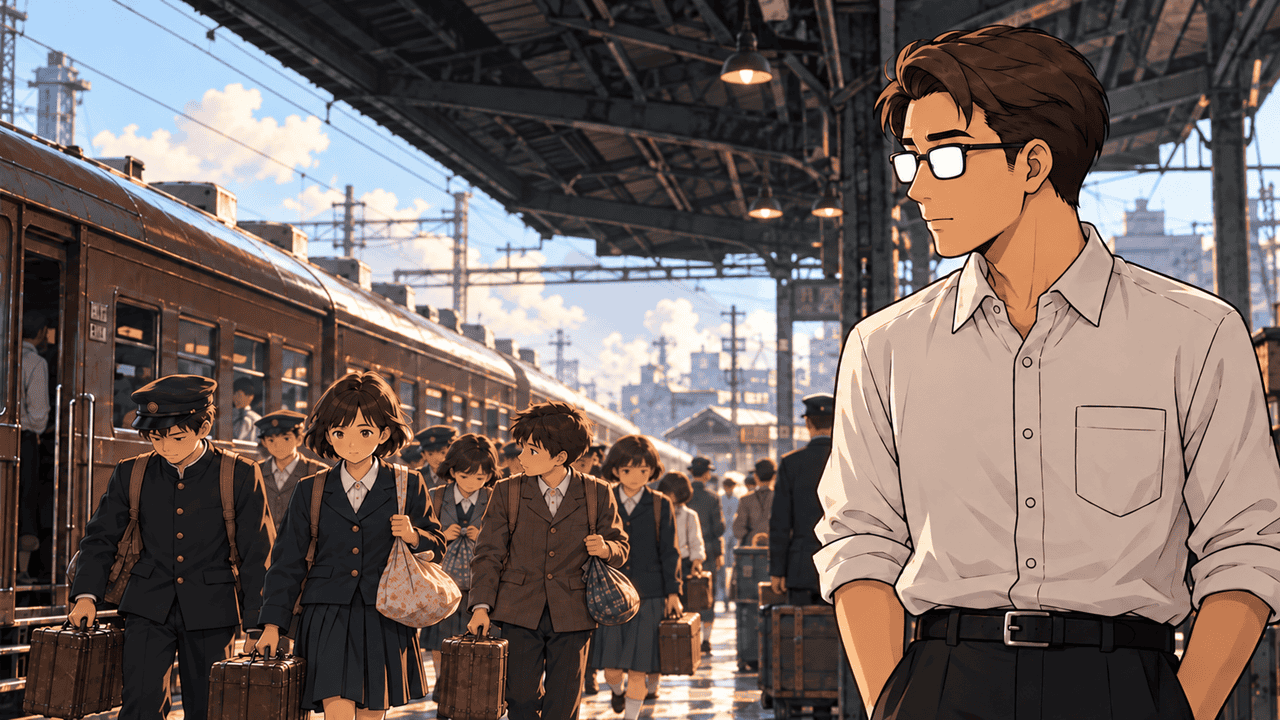
In ALWAYS: Sunset on Third Street, Mutsuko Hoshino travels from Aomori to Tokyo through an organized recruitment scheme for young workers. She expects to become a secretary at a car company, only to discover that her employer is Suzuki Auto, a small repair shop. Both the gap between her expectations and the actual job, and her life with the Suzuki family, become central to the story. JR West’s location report also describes the scene in which she arrives at Ueno Station from Aomori with a group of new recruits.
The film raises some basic questions. Why did young people who had only just finished junior high school leave their parents and travel all the way to Tokyo to work? Was Tokyo short of workers, or were there too few jobs in the countryside? And why was starting work at fifteen unremarkable then, when continuing to high school is now the norm?
To understand Mutsuko’s journey, I want to examine how this system, known as shūdan shūshoku or organized group recruitment, emerged, expanded, and eventually faded away. Its history connects the prewar relationship between countryside and city, wartime population movements, postwar industrial development, and changing attitudes toward education.
*This is a translated version. The original (Japanese) is available here.
On this pageContents
What Was Organized Group Recruitment in ALWAYS?
In the film, Mutsuko arrives at Ueno Station and begins her new life in Tokyo. Young rural school-leavers were introduced to employers by their schools and public employment offices, then traveled to cities in groups, often by train. This was one of the systems that supplied workers to postwar Japan. First, let us look at how many young people began work after junior high school, and where organized group recruitment took place.
Starting Work After Junior High School Was Common
According to the statistical table published by Kunitachi Local History Museum, based on the Ministry of Education’s School Basic Survey, 42.0% of junior high school graduates nationwide entered employment in 1955, 43.3% in 1957, and 40.9% in 1958. In 1958, 774,975 graduates took jobs. Roughly four in ten graduates went straight into working life.
Continuing to high school is now commonplace, but from the mid-1950s to the mid-1960s, beginning work after junior high school accounted for a substantial share of young people’s paths. These national figures, however, include those who found work locally. They do not count only those who left home through organized group recruitment.
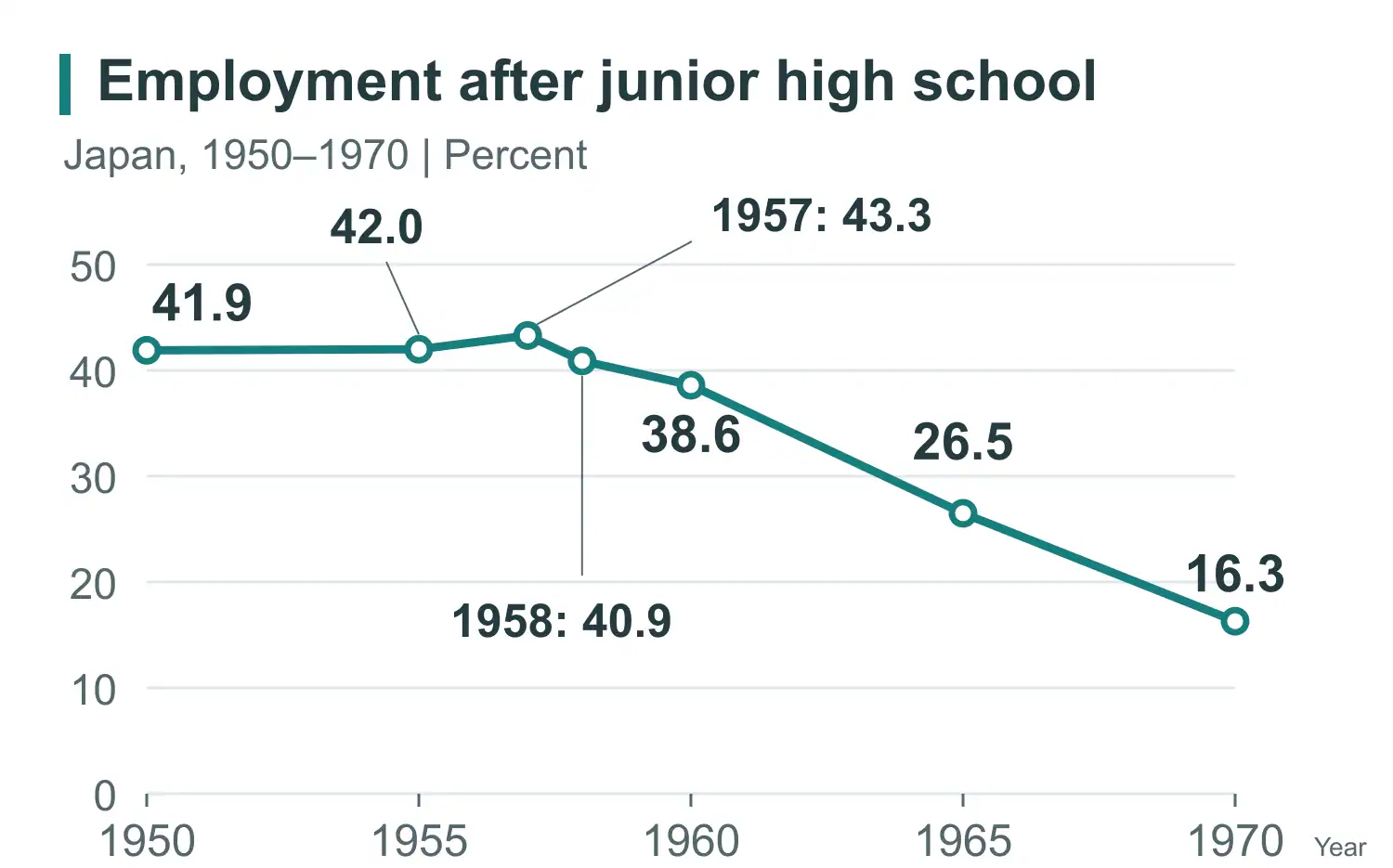
Source: Kunitachi Local History Museum, employment among junior high school graduates, based on the Ministry of Education’s School Basic Survey. Chart prepared from the source’s figures and descriptions.
We must distinguish junior high school graduates entering employment, those taking jobs outside their home prefecture, participants in organized group recruitment, and passengers on special recruitment trains. These are different populations. Group recruitment became a symbol of rural youths moving to cities, but not every junior high school graduate who took a job boarded a train for Tokyo.
- Junior high school graduates entering employment: Those taking jobs after graduation, including local jobs.
- Those taking jobs outside their prefecture: People employed outside their home prefecture, regardless of how they traveled.
- Participants in organized group recruitment: Those placed through organized introductions and departures arranged by schools, employment offices, and similar bodies. Each statistical source must be checked for its coverage.
- Recruitment-train passengers: Those who traveled on special employment trains or similar services. Their number is not the total number of group recruits.
Young People Came from Across Rural Japan, Not Just Aomori
Mutsuko comes from Aomori, but organized group recruitment was not confined to the Tōhoku region. It also drew young people from Kyūshū and the Chūgoku and Shikoku regions. Major destinations included the Keihin industrial area around Tokyo and Yokohama, Chūkyō around Nagoya, and Hanshin around Osaka and Kobe.
A 1963 Tōō Nippō newspaper article reproduced in the Aomori Prefectural History lists not only Aomori and Akita but also Kagoshima, Kumamoto, and Nagasaki among the prefectures sending young recruits. It reports that in Miyazaki, 96% of junior high school graduates entering employment took jobs outside the prefecture, while about 14,000 did so in Kagoshima.
The scale differed by region, but young people leaving home for work was a nationwide phenomenon. The article also records employers considering representatives based in rural areas and visiting the homes of prospective recruits. Young jobseekers were not simply moving to cities on their own: employers were actively recruiting in rural communities too.
The system itself had prewar roots. Kunitachi Local History Museum’s account describes organized employment migration in the 1930s, including a recorded “youth employment train” from Akita to Ueno in 1939. Postwar group recruitment expanded an existing movement of workers from countryside to city under new economic conditions.
Schools, Employment Offices, and Recruitment Trains Connected Countryside and City
Young people’s hopes and companies’ vacancies alone did not make it possible. Rural schools and employment offices gathered information about city jobs, acted as intermediaries, and organized groups of successful applicants to leave together. Recruitment trains, with young people departing as their families saw them off, became a symbol of this organized migration.
The House of Councillors Social and Labour Affairs Committee minutes of March 13, 1958 discuss recruits traveling from Fukushima to Tokyo and shopping districts jointly recruiting young people from rural areas. In Kunitachi, local records introduced by the museum describe a 1958 meeting of shopkeepers interested in joint recruitment and a 1960 welcome ceremony for nineteen new shop employees from Akita.
The destinations were therefore not just large factories. Small neighborhood shops and workshops also recruited young people from far away through schools and employment offices. A small business like Suzuki Auto could receive rural recruits through an established social system.
Why Did Rural Young People Leave Home to Work?
The rural side of this story raises another question. Even if cities had jobs, would young people have needed to leave their parents at fifteen if sufficient work had been available at home? To consider that, we need to look beyond postwar recruitment to the prewar relationship between countryside and city, and the changes the war brought to rural communities. In particular, rural areas that had supplied workers to cities instead became places receiving large numbers of people during the war.
The Countryside Had Supplied Urban Workers Before the War
Leaving the countryside for work was not a new postwar development. Before the war, agriculture could not provide everyone in farming communities with enough employment or income. Farmers’ children and other young people went to work in urban factories and shops. Migration also helped maintain a balance between rural populations and available work.
The 1954 Economic White Paper states that rural areas had supplied cities with about 200,000 people a year before the war. Its analysis links low rural living standards to this movement of labor, showing that the countryside supplied workers who sustained urban industry.
It would therefore be misleading to explain the expansion of group recruitment by saying that rural jobs suddenly disappeared after the war. It makes more sense to see an existing movement of workers transformed by the war and subsequent recovery, then expanded further.
Wartime Migration Added Workers to Rural Communities
Late in the war and immediately afterward, however, migration changed direction dramatically. Air raids and other destruction devastated cities, and many people moved to rural areas. According to the 1955 Economic White Paper, the agricultural workforce, roughly fourteen million before the war, reached 16.62 million in 1947 and remained at 16.16 million in 1950.
Urban industrial activity contracted sharply while rural populations grew. Cultivated land had also decreased. A larger agricultural workforce did not mean that a corresponding amount of new work had appeared. The same white paper observes that the additional workers participated in agricultural production in some form despite being underemployed. Rural areas supported the newcomers, but their participation in farming also spread a condition in which there was not enough work to go around.
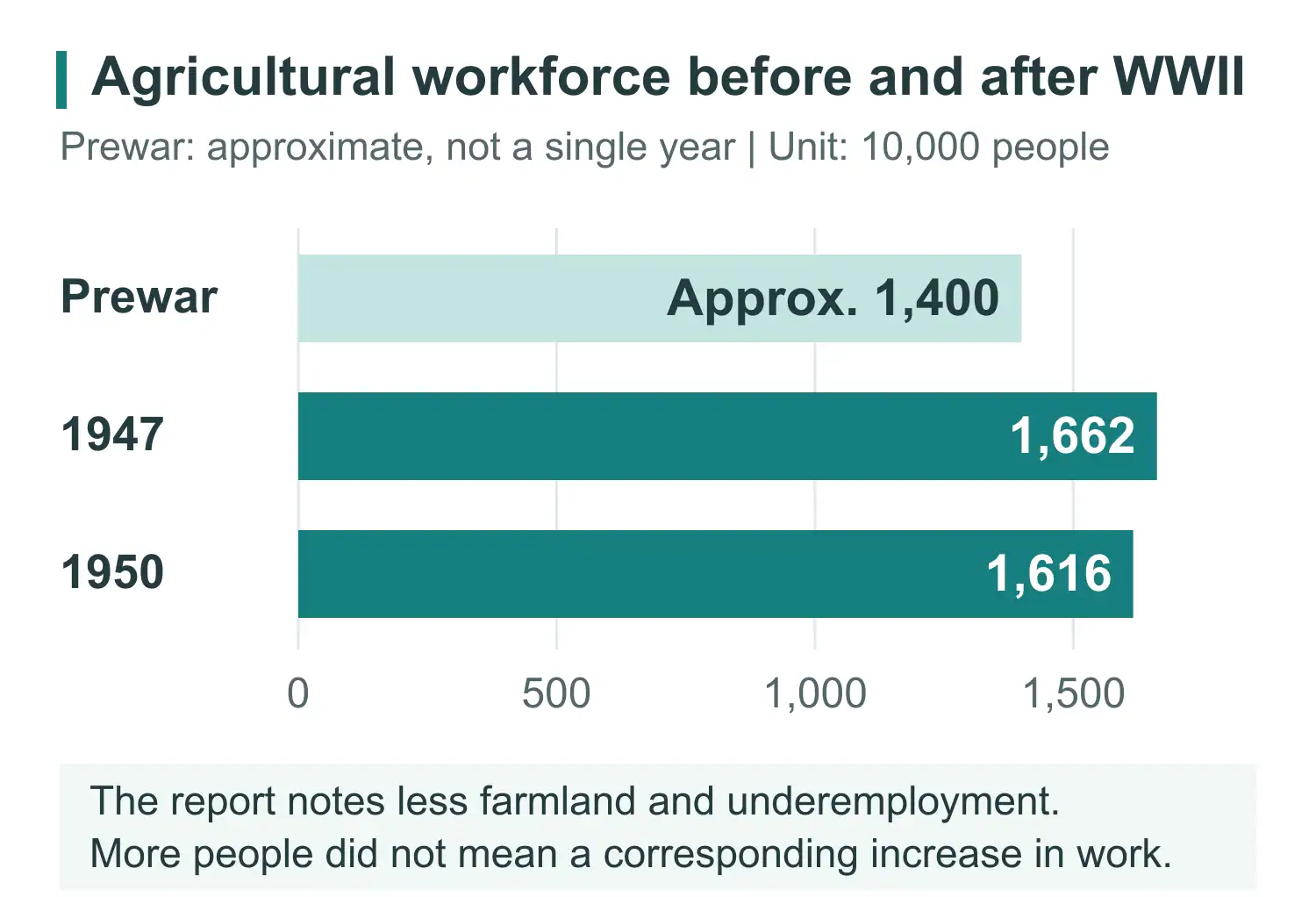
Source: Annual Economic Report, 1955: postwar changes in agriculture. Chart prepared from the source’s figures and descriptions.
Evacuation and policies encouraging a return to farming also contributed. The Emergency Measures for Employing Urban Evacuees in Agriculture, approved by the Cabinet on March 30, 1945, envisaged agricultural work or a return to farming for about one million people from Keihin, 200,000 from Nagoya, and 600,000 from Hanshin: approximately 1.8 million altogether. Plans included providing evacuees with land, agricultural training, and work on farms.
The 1.8 million was the scale of a government plan, not the number who actually entered agriculture. Nevertheless, the policy confirms that the government sought to put people moving out of cities late in the war to work in farming.
In November 1945, after the war, the government adopted the Implementation Guidelines for the Emergency Land Settlement Program. They promoted farming and land settlement for demobilized soldiers, repatriates, unemployed people, and those affected by war damage. A 1957 parliamentary answer reported that postwar settlement had involved about 230,000 farm households in total; after about 80,000 had left, some 155,000 remained.
Evacuees, those returning to rural areas after the war, and new settlers followed different routes. Still, the fact that rural areas came to contain more workers than before is important to the background of group recruitment. Having previously sent workers to cities, the countryside received people late in the war and after it, and its agricultural workforce did not immediately return to prewar levels. Every year, a new generation ready to start work was then added to that population.
Reference: 1957 parliamentary minutes on household settlement under the postwar land settlement program.
Could Rural Areas Absorb a New Generation of Workers?
Could the wartime increase in rural workers have affected the opportunities available to later junior high school graduates? If even those already engaged in agriculture lacked enough work, there would be less room for a new generation locally. Wartime and immediate postwar migration may have contributed in this way to the employment difficulties faced by later school-leavers.
The 1954 Economic White Paper cites a government estimate of between one million and 1.5 million “surplus workers” in farm households as of March 1953. This was not a count of people doing no work, but an estimate of labor potentially in excess of agriculture’s requirements. The white paper also noted that farm households’ capacity to absorb additional people had weakened considerably.
Employment difficulties for junior high school graduates were already a concern early in the postwar period. In April 1949, a government answer described an imbalance among graduates of the new junior high school system handled by employment offices: roughly 120,000 male jobseekers against about 50,000 vacancies. It warned that some 100,000 graduates might remain without jobs. Parliamentary discussion in 1955 reported that, by the end of April, about 242,000 of roughly 265,000 registered junior high school jobseekers had found employment, leaving some 23,000 still seeking it.
These figures cover jobseekers known to the employment offices. They do not include every young person helping with the family farm or everyone who had not registered. Official counts of those without jobs therefore cannot capture the full extent of potentially underused rural labor.
Rural areas that once sent workers to cities had received many people during the war, leaving agriculture less able to absorb newcomers. Each year brought more junior high school graduates, while recovering urban businesses expanded their recruitment into the countryside. Alongside urban labor shortages, the wartime transformation of rural employment may have been an important part of the expansion of organized group recruitment.
References: 1949 parliamentary minutes on employment difficulties among graduates of the new junior high school system; 1955 parliamentary minutes on junior high school jobseekers and placements.
Why Did Cities Need Young Rural Workers?
Understanding the countryside leads to a question about the cities. A shortage of rural jobs could not produce group recruitment unless urban employers had vacancies. Why did businesses in Tokyo, Nagoya, and Osaka begin recruiting young people from so far away? Industrial development and labor market changes lay behind the expansion of recruitment even by small businesses like Suzuki Auto.
From Postwar Recovery to Rapid Growth: Rising Demand for Young Workers
Japan’s industrial production recovered rapidly after the war. According to the 1955 Economic White Paper, manufacturing output fell to an index of 28.9 in 1946 against a prewar baseline of 100. From around 1949–50, mining and manufacturing production recovered and expanded quickly.
Subsequent growth increased employment, especially in manufacturing and construction. The 1960 Economic White Paper reports that in fiscal 1959, new junior high school jobseekers handled by employment offices decreased by 6% from the previous year, while vacancies rose by 45%. There were 1.92 vacancies per jobseeker. Urban demand for young workers was gathering strength.
Demand expanded beyond large companies. Growth in machinery and automotive industries brought more work for subcontractors and component manufacturers. Shops and service businesses also needed young employees. Companies began hiring from a wider geographical area.
Urban industry was recovering and growing, while rural young people were looking for work. The connection between these two developments greatly expanded organized group recruitment.
Workers and Jobs Were Unevenly Distributed Across Regions
Did differences in regional population structure also play a part? According to the National Institute of Population and Social Security Research’s prefectural population statistics, Table 12-12, children aged 0–14 made up 37.9% of Aomori’s population in 1955, compared with 33.4% nationwide and 28.1% in Tokyo. Aomori had a larger proportion of children than Tokyo.
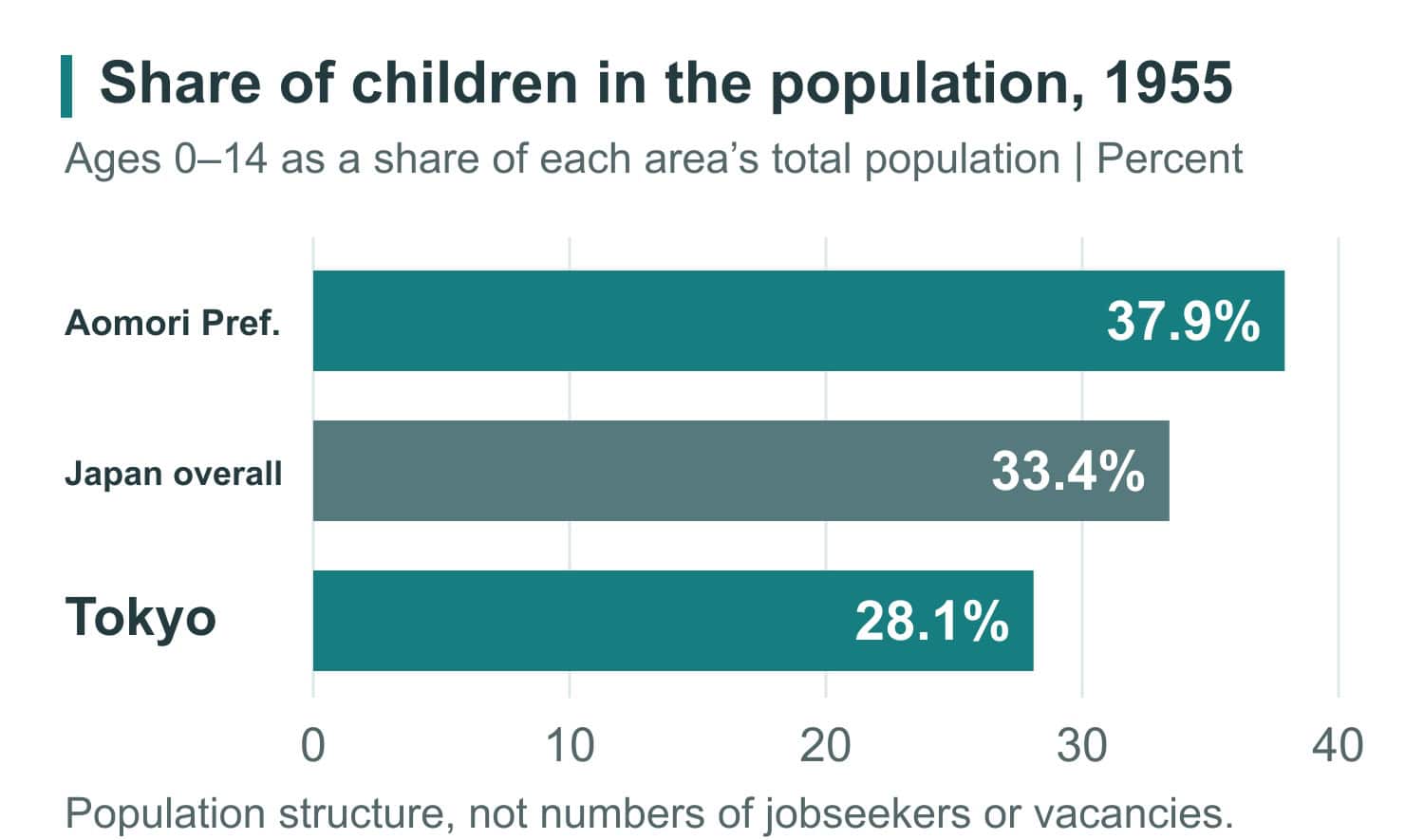
Source: National Institute of Population and Social Security Research, Population Statistics of Japan 2025, Table 12-12, based on the census and other data. Chart prepared from the source’s figures and descriptions.
A higher share of children does not, however, mean the same thing as a larger number of young jobseekers. More important was the mismatch between the workers available in each region and the amount of labor required there.
The 1960 Economic White Paper describes rapidly rising vacancies in major industrial areas such as Keihin, Chūkyō, and Hanshin, while improvements in labor supply and demand were weaker in Tōhoku, San’in, and southern Kyūshū. Regional imbalances between vacancies and jobseekers encouraged employment migration from countryside to city.
Under those conditions, a region might contain young people willing to work without having enough local industry to employ them. In cities, meanwhile, growing businesses needed employees. Organized group recruitment connected labor supply and demand across distant regions.
Large and Small Companies Recruited Differently
Urban companies did not all recruit from the countryside in the same way. The 1961 Economic White Paper records differences by company size. Among new school-leaver hires in the major industrial areas in fiscal 1960, over 90% of recruits at companies with at least 5,000 employees came from the same region. At small companies with 30–99 employees and medium-sized ones with 100–999, the proportion was only about half.
The white paper explains that large companies’ advantages in employment conditions and housing enabled them to recruit local graduates first. Small and medium-sized companies could not find enough workers locally and needed to extend recruitment into rural areas.
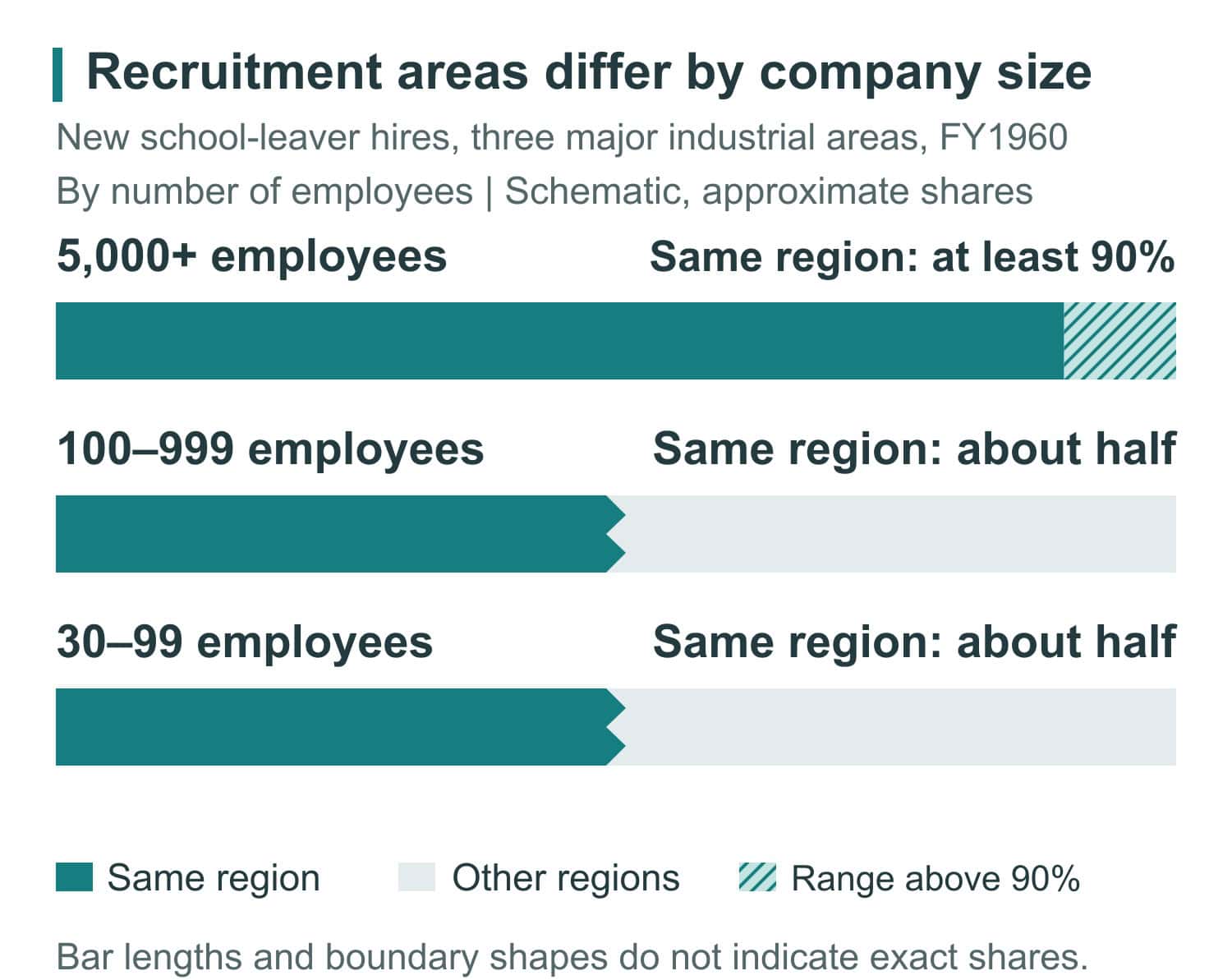
Source: Annual Economic Report, 1961: employment and interregional migration. Chart prepared from the source’s figures and descriptions.
This is revealing when we consider Mutsuko joining a small business like Suzuki Auto. Rural young people needed jobs, while smaller urban employers could not find enough workers nearby. School and employment-office introductions, together with organized transport, must have mattered greatly in those circumstances.
Mutsuko’s journey depicts more than a general flow of people from countryside to city. It also shows young people willing to leave home being connected with small urban businesses that needed them through an organized system.
How Did Young Recruits Live in the Cities?
Even with a job secured, young people leaving their parents faced not just the challenge of working, but of making a life. In ALWAYS: Sunset on Third Street, Mutsuko works at Suzuki Auto while living with the Suzuki family.
What was live-in employment actually like? Contemporary surveys and parliamentary minutes record long hours, few days off, the management of wages, and problems with housing and meals: aspects of young workers’ lives that the film alone cannot show.
Thirteen and a Half Hours of Work a Day, Two Days Off a Month
In 1957, the employment office and a local shopping district jointly surveyed 166 shop employees in Setagaya, Tokyo. Most were young people hired through joint recruitment, although some longer-serving employees were included.
The results hardly describe an easy life. Among respondents whose break times were known, actual working time averaged thirteen and a half hours a day. Around six in ten shops offered only two days off a month.
| Item | Result |
|---|---|
| Survey sample | 166 people, including 55 women |
| Average actual working time per day | 13 hours 30 minutes |
| Average sleep | Just under 7 hours |
| Shops offering two days off a month | About 60% |
| Employees whose job was not their first choice | About 40% |
| Women whose job was not their first choice | 56% |
Note: The survey appeared in the November 1957 issue of Shōtenkai. The figures here follow Hiroyuki Yagi’s account in “A Study of Collective Recruitment by Shopping District Organizations” (2024). The average working time excludes respondents whose break times were unknown. It is not a national average for all participants in organized group recruitment.
The actual job did not always match the description given during recruitment. The survey identifies cases in which young women hired as live-in sales assistants were instead made to spend their time doing housework for their employers.
Even when shop sales were the intended job, live-in employees shared daily life with the owner’s family. They helped in the shop when it was busy and might also be asked to do household chores. Work and private life were difficult to separate.
At the House of Councillors Social and Labour Affairs Committee on March 13, 1958, Labour Minister Hirohide Ishida himself acknowledged that live-in workers tended to face longer hours and inadequate rest.
Starting Wages and the Money Workers Could Actually Spend
How much were these young people paid for all that work?
In the parliamentary discussion of March 13, 1958, Yoshinobu Yamashita introduced recruitment terms offered to junior high school graduates by a federation of shopkeepers in Ikejiri, Setagaya, Tokyo.
The advertised starting wage was ¥6,200 a month. Yet only ¥700 was to be handed to the employee as freely spendable pocket money.
| Item | Amount | Treatment |
|---|---|---|
| Starting wage | ¥6,200 | Monthly pay |
| Food | ¥4,000 | Deducted from pay |
| Social insurance | ¥130 | Deducted from pay |
| Savings | ¥1,370 | Held by the employer |
| Pocket money | ¥700 | Handed to the employee |
Note: These were the recruitment terms of a particular shopkeepers’ federation presented in Parliament, not a national average starting wage. Parliamentary records confirm that young people did take jobs in Ikejiri, but I have not established whether these exact wage terms were actually applied. They do not show Mutsuko’s pay in the film.
Food accounted for ¥4,000, about 65% of the wage. Another ¥1,370 was placed in savings held by the employer. The remaining ¥700 was the money available to the employee for clothes, everyday purchases, outings, and similar expenses.
The savings arrangement raised another problem. Shopkeepers explained that after ten years of work, the employee would receive a “retirement payment” of ¥500,000.
About ¥470,000 of that amount was a projection of money saved from the employee’s own wages, with interest compounded at 6% a year. The employer would add approximately ¥30,000.
It might initially sound reasonable, but Yamashita challenged the description of savings from the employee’s own pay as a retirement benefit. Ishida also acknowledged that the fund was not a retirement payment in the ordinary sense. It belonged to the worker and should be returned even if the worker left before the ten years were up.
Employer-managed savings schemes for workers’ voluntary deposits did exist at the time, so a 6% interest rate was not inherently implausible. However, I have not established where the Ikejiri shopkeepers planned to deposit the money, how they intended to manage it, or how contributions after pay rises were supposed to produce the projected ¥470,000.
What Was ¥6,200 Worth Against Contemporary Prices and Rent?
To imagine life at the time, it is more useful to look at what things actually cost than to make a simple conversion into today’s money.
Consider prices in Tokyo’s ward area in 1958, based on the government’s retail price statistics.
| Item | Quantity or unit | Contemporary price |
|---|---|---|
| Rice | Equivalent to 5 kg | About ¥510 |
| White bread | 400 g | About ¥28 |
| Eggs | 400 g, roughly 6–7 eggs | About ¥96 |
| Cabbage | 400 g | About ¥11 |
| Chicken | 400 g | About ¥189 |
| Milk | One delivered bottle, 180 ml | About ¥14 |
| Udon | One bowl eaten out | About ¥27 |
| Public bath | One adult admission | ¥16 |
Note: Prices are for Tokyo’s ward area in 1958. The rice figure converts the contemporary price per kilogram into an equivalent price for five kilograms. Food weights, volumes, and surveyed categories follow the standards used at the time. The estimated number of eggs is based on a weight of 400 grams.
On paper, ¥700 could buy about twenty-six bowls of udon or forty-three visits to a public bath. But workers needed clothes and everyday essentials as well as food. It is hard to describe that as a generous amount of freely spendable money.
Housing was an even bigger issue. A 1958 record puts the monthly rent for a privately rented room in Tokyo at ¥600 per tatami mat of floor area. At that rate, a four-and-a-half-mat room would cost ¥2,700 a month in rent alone.
The following year, reports on newly built Japan Housing Corporation apartments described rents ranging from ¥5,000 to more than ¥7,000 a month. These were examples of new public corporation apartments, not the average rent for ordinary private housing. Even so, they suggest how difficult securing an independent home in the city could be.
Parliamentary discussion in 1959 also cited the National Personnel Authority’s standard living cost estimate for a single adult man in Tokyo in March 1958.
| Item | Monthly cost |
|---|---|
| Food | ¥3,480 |
| Clothing, housing, utilities, miscellaneous expenses, etc. | ¥4,080 |
| Total | ¥7,560 |
This calculation concerned one unmarried adult man, not a fifteen-year-old live-in shop worker. Nevertheless, it exceeded the monthly wage of ¥6,200 offered by the Ikejiri shopkeepers’ federation.
If we assume ¥2,700 for a four-and-a-half-mat rented room and add the standard food budget of ¥3,480, the two alone come to ¥6,180 a month. A ¥6,200 wage would be almost entirely used up by rent and food, leaving virtually nothing for clothes, utilities, or other expenses.
Note: The ¥2,700 rent is a hypothetical amount calculated from a rate per tatami mat, not an advertised rent for an actual property. Combining it with an adult man’s standard food budget is also an illustrative calculation intended to convey the scale of living costs.
Such housing conditions were part of the background to live-in employment. For boys and girls just beginning work, having accommodation with an employer mattered greatly. It also made their basic living arrangements dependent on that employer.
Wages Rose Quickly, but Problems in Daily Life Remained
Wages did not remain unchanged for years, however. As rapid economic growth intensified demand for young workers, starting pay for junior high school graduates rose quickly.
A statistical table in the Ministry of Labour’s Analysis of the Labour Economy, 1974 lists starting wages for female junior high school graduates in the industries surveyed nationwide: ¥5,590 in 1960 and ¥10,980 in 1964. Looking at the amounts alone, the later figure is roughly twice the earlier one, just four years apart.
These figures were not compiled on strictly comparable terms. The table notes that through 1961 the median was based on the distribution of establishments, whereas from 1962 it was based on the distribution of workers. For 1964, figures from a different survey, the Survey on Employment Trends, were used.
The ministry itself cautions that changes in survey coverage prevent direct comparison of the amounts. These two figures therefore cannot establish a precise rate of starting-wage growth. They are presented here only as reference points for the changing wage levels of the high-growth period.
They also cover industries surveyed nationwide. They do not show how the wage terms offered by the Ikejiri shopkeepers in 1958 subsequently changed.
What, then, was life like for young workers in the 1960s?
In March 1964, the government’s Public Relations Office interviewed 499 young people working in businesses with fewer than 300 employees in Tokyo’s ward area. All were less than three years out of junior high school.
About 63% earned at least ¥12,000 a month. Yet about 36% reported having less than ¥7,000 left after food and accommodation costs were deducted.
As for housing, 44.1% lived with their employers, 30.0% lived in company or shop dormitories, boarding houses, apartments, or similar accommodation, and 23.5% commuted from home. Altogether, more than seven in ten lived either with their employers or in employer-provided housing.
Note: The 1964 government survey included workers in manufacturing and other industries; not all respondents had arrived through organized group recruitment. The shares earning at least ¥12,000 and retaining less than ¥7,000 after food and accommodation come from separate questions. They do not necessarily describe the same people.
Even as wages rose rapidly, young workers’ lives remained closely tied to the housing and living conditions provided by their workplaces.
The Difficulties of Living with an Employer “Like Family”
Shopping districts and employment offices did try to address these problems. As joint recruitment developed, they identified the need to put working conditions in writing, establish rules on days off, and improve accommodation.
Rules that had been agreed were not necessarily implemented in every shop. In a survey of forty-two shopkeepers in a Setagaya shopping district that received group recruits in 1957, only eighteen said they were applying the wage regulations.
Fewer than half reported implementing them. This is a figure about compliance with wage regulations, however. It does not mean that the remaining shops paid no wages.
Nor was every live-in employment relationship harsh. In the 1957 Setagaya survey, 42% described the atmosphere at their shop as “better than expected,” and 31% as “as expected.”
Live-in work could mean being welcomed like a family member and receiving support in daily life. It could also blur the line between work and private life, leaving the worker dependent on the employer for almost everything. Which side a young person experienced probably varied greatly with the shop and its owner.
Young people arriving from rural areas also faced homesickness and the challenge of building relationships in an unfamiliar place.
A 1964 issue of the Kunitachi Community Centre Newsletter introduced by the local history museum records the wishes of young people working mainly as live-in employees in local shops and factories. They wanted to learn about society and meet others working in similar circumstances.
The community centre ran a class for young workers in commerce and industry as a place for them to meet. Beyond work and pay, making friends, becoming part of the neighborhood, and building lives of their own mattered too.
In the film, Mutsuko gradually becomes like a member of the Suzuki family as she learns her job. Some real recruits must also have received a warm welcome. But many faced long hours, few holidays, employer control of wages, and the particular difficulties of living at work.
The boys and girls who came to cities through organized recruitment were more than the “golden eggs” celebrated for supporting rapid economic growth: valued young workers seen as holding promise for the economy. Each was a young person trying to build a new life away from family and home while learning a job. Knowing this history gives a more concrete context to Mutsuko’s growing bond with the Suzukis.
References: Hiroyuki Yagi, “A Study of Collective Recruitment by Shopping District Organizations,” Urban Social Studies, no. 16 (2024); House of Councillors Social and Labour Affairs Committee minutes, March 13, 1958; the same committee’s minutes, March 19, 1959; Statistics Bureau, retail prices of major items in Tokyo’s ward area, 1950–2010; reproduced Tokyo retail price data based on Historical Statistics of Japan, Table 22-19; Tokyo public bath association, historical bathing charges; Shōwakan digital archive, reporting on Japan Housing Corporation apartments in 1959; Ministry of Labour, Analysis of the Labour Economy, 1974, Appendix Table 33, starting wages of new school-leavers, including notes on changes in survey methods; Public Relations Office, Survey on the Lives and Attitudes of Young Workers (1964); Kunitachi Local History Museum, photographs transferred from municipal public relations archives.
Why Did Group Recruitment Decline as High School Became the Norm?
Organized group recruitment expanded as an important connection between rural and urban employment. Later, fewer young people began work immediately after junior high school, and the system gradually faded. Changes in household finances, attitudes toward education, and the kinds of workers employers sought all played a part.
Rapidly Rising Participation in High School
According to the National Institute of Population and Social Security Research’s progression statistics, the proportion continuing to high school and equivalent institutions rose from 42.5% in 1950 to 57.7% in 1960, 70.7% in 1965, 82.1% in 1970, and 91.9% in 1975. Japan moved from a society where starting work after junior high school was common to one where continuing to high school became the norm.
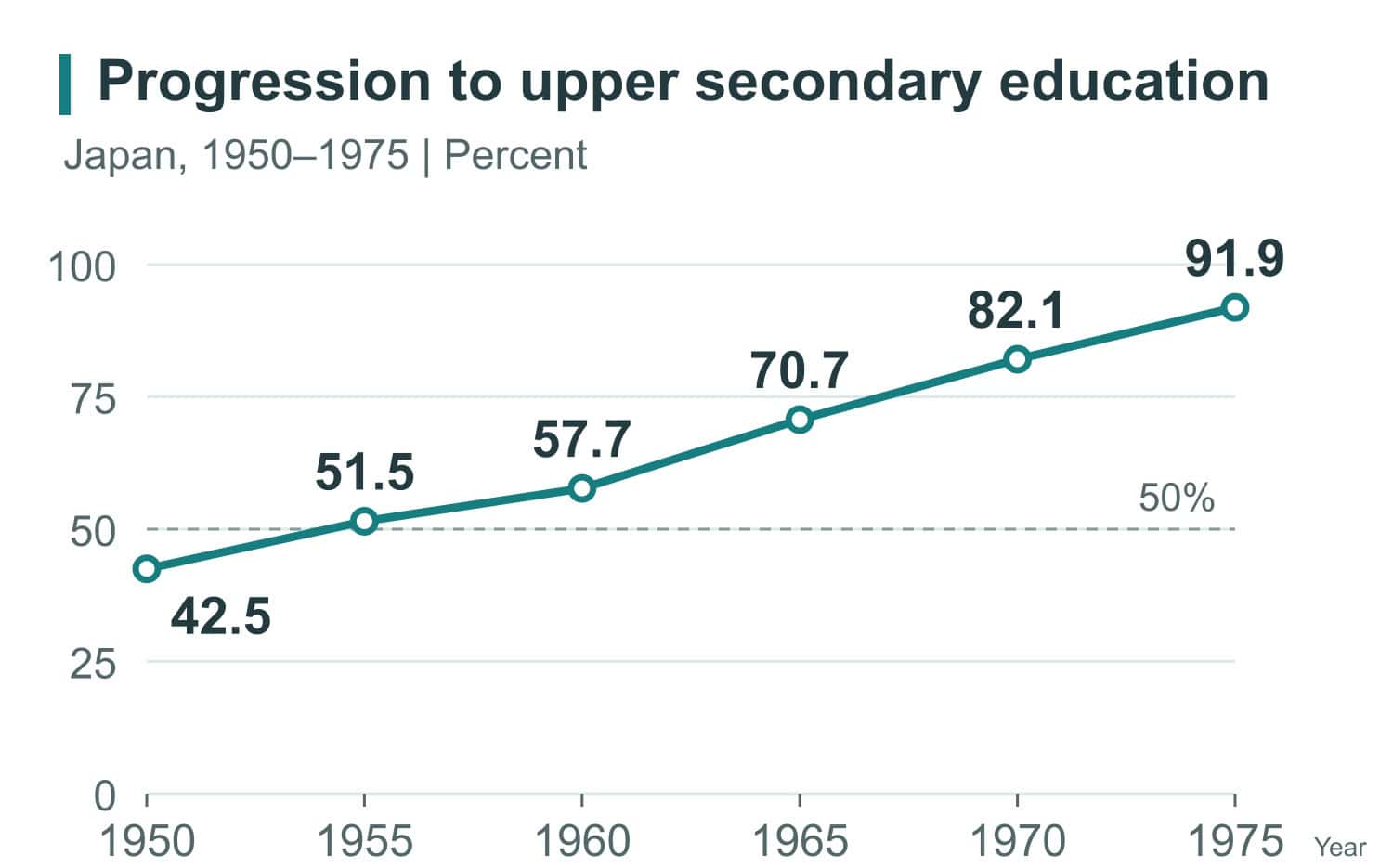
Source: National Institute of Population and Social Security Research, Population Statistics of Japan 2026, Table 11-3, based on the Ministry of Education’s School Basic Survey. Chart prepared from the source’s figures and descriptions.
Postwar growth probably enabled more households to choose further education. Schools also expanded their capacity. According to the Ministry of Education’s One Hundred Years of School Education in Japan, from the mid-1950s to the mid-1960s, institutional changes supported the expansion of upper secondary education and improvements in vocational education.
Financial access alone, however, does not seem to explain the change fully. Becoming able to send a child to high school and coming to want to do so are not necessarily the same thing.
How, then, did the desire to send children to high school spread?
Why Did Parents Come to Want High School for Their Children?
One question is the prewar relationship between educational credentials and social status. A traditional expression hoped that a child might become “a scholar or a cabinet minister.” What education had people in leading positions actually received? Might the educational backgrounds of politicians, bureaucrats, business leaders, and senior military officers have influenced how people thought about schooling?
For politicians, a study by Makoto Fukumoto of Waseda University analyzes the biographies of 1,086 members of the House of Representatives between 1936 and 1942. Published in 2026, it reports that about 69% had attended university. This is not a university graduation rate, but it shows that university experience was common among the legislators studied.
In the bureaucracy, too, the Japan Center for Asian Historical Records explains the close connection between imperial universities and the higher civil service examination. During part of the Meiji period, imperial university graduates could be appointed without an examination; the system was subsequently revised to make the higher civil service examination the general rule. The military had the Army War College, which trained officers for senior roles such as staff appointments. Its entrants amounted to roughly one in ten Military Academy graduates, and its graduates received advantages in promotion and appointment to important posts.
Business leaders offer another interesting case. Kyūichi Takahashi’s “The Role of the Japan Economic Federation During Wartime” examines the educational backgrounds of 160 people who served as officers of the influential federation before and during the war. Sixty, or 37.5%, had attended Tokyo Imperial University, and twenty-five, or 15.6%, the Tokyo Higher Commercial School. This is not a survey of all Japanese business managers. It nevertheless reports that many prominent business leaders had received higher education, with university-educated figures becoming predominant among later appointees.
These links between education and status did not disappear completely after the war. A 1978 parliamentary answer reported that 111 of a combined 145 senior Foreign Ministry officials at headquarters and heads of major overseas missions had attended the University of Tokyo. The visibility of highly educated people in leading political, administrative, and business positions may have influenced how education was valued.
We do not actually know, however, how much these elite educational backgrounds affected ordinary parents’ wishes for their children. The idea that prewar respect for educational credentials shaped later expectations of education remains a hypothesis.
Still, explaining rising participation in education may require considering changing parental expectations as well as improved affordability. Education could appear connected to future work and status, while high school gradually became a more familiar option. These developments may together have helped spread the desire to send children to high school.
Reference: 1978 parliamentary minutes on the educational backgrounds of senior Foreign Ministry officials.
Did Employers Demand High School Graduates, or Did More Students Stay in School?
Employers’ recruitment policies also mattered. Did more young people stay in education because companies began demanding high school graduates? Or did companies switch to high school graduates because rising participation made junior high school leavers harder to recruit?
The 1970 Economic White Paper reports that in 1969 about 320,000 junior high school graduates and 780,000 high school graduates entered employment. Companies were switching to high school recruitment as junior high school leavers became scarce. This suggests that firms did not necessarily need high school graduates from the outset: in some cases, the declining number of younger jobseekers prompted the change.
At the same time, companies gained reasons to seek workers with more education actively. The 1961 Economic White Paper points out that technological innovation changed the labor companies needed, creating demand for high school graduates as technicians and skilled workers able to work with new technologies.
Both processes seem to have been at work: rising participation encouraged a switch to high school recruitment, while technological change created demand for better-educated workers.
- A switch prompted by fewer junior high school leavers: As more students continued to high school, fewer younger jobseekers remained, and high school graduates took jobs previously given to junior high school leavers.
- Demand for workers able to handle new technologies: More advanced industries sought people with longer education or specialized training.
Rather than treating either as the single cause, perhaps we should see increasing participation in education and changing recruitment policies as developments that influenced one another.
Technical High Schools Expand, and Kōsen Are Established
Changes in education also reveal the growing demand for people to work with new technologies. According to One Hundred Years of School Education in Japan, new technical high schools and departments were established and existing ones expanded from the mid-1950s to the mid-1960s in response to industry’s requests. Technical high schools became important providers of specialized vocational education.
The college of technology system was established in 1961, and the first kōsen opened in fiscal 1962, providing five years of integrated education after junior high school. The same education history explains that industrial development and scientific and technological advances had created a shortage of engineers, generating strong demand for specialist education to train them.
Proposals leading to the kōsen system had been discussed since the 1950s. A 1961 parliamentary answer forecast future shortages of about 170,000 science and technology specialists and 440,000 skilled workers educated to technical high school level. The new colleges were positioned mainly to train the former, alongside an expansion of technical high schools.
The ratio of applicants to places at national kōsen reportedly reached 17.5 to one in fiscal 1962. Training engineers for new industries had become a pressing issue.
The creation of kōsen alone cannot explain ordinary families’ aspirations for high school. It does, however, show how employers’ staffing needs and the institutions training those workers were changing. The society that had recruited large numbers of junior high school leavers through organized schemes gradually changed on both the educational and industrial sides.
Reference: 1961 parliamentary minutes on the creation of kōsen and demand for engineers.
Seeing the Era of Group Recruitment Through Mutsuko
Mutsuko’s journey from Aomori to Tokyo took place against social changes too large to explain simply as rural youths longing for city life.
Before the war, rural areas supplied urban workers. Late in the war, evacuation reversed that flow, followed after the war by returns to farming and land settlement. With more agricultural workers and limited farmland, rural communities may have struggled to absorb each new cohort of junior high school graduates. Recovering and growing urban businesses, meanwhile, wanted young workers. Schools, employment offices, and recruitment trains connected the two.
Small and medium-sized businesses in particular struggled to recruit locally and extended their search into rural areas. Knowing this helps place Mutsuko’s arrival at a small Tokyo repair shop within the society of the time.
Real young recruits did not all find lives as warm as the film’s. Living with an employer could offer security, but wage management, working hours, and days off caused problems serious enough to be debated in Parliament. Knowing those conditions may change how we see Mutsuko becoming almost a member of the Suzuki family while working for them.
Later, high school became the normal path in Japan, and fewer young people started work immediately after junior high school. Companies shifted toward high school recruitment, while education expanded to train people for new technologies. Organized group recruitment gradually lost its former role amid those changes.
Mutsuko arrives in ALWAYS: Sunset on Third Street at a time when the effects of war remain, yet recovery and economic growth are reshaping society. Her departure from home to begin work in Tokyo brings together experiences shared by many young people of the period and the wider transformation of Japanese society.







Reader Comments
Have a thought or interpretation? Leave a comment