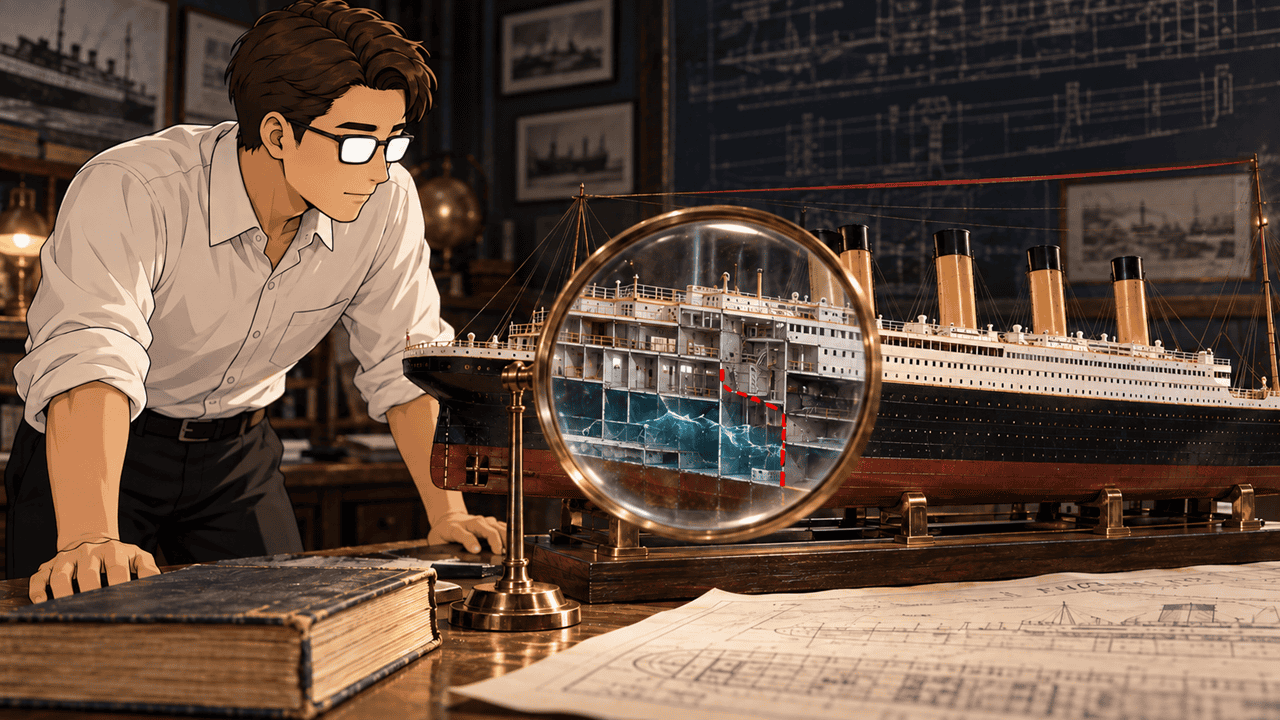
Titanic (1997) is set aboard the ocean liner that sank on April 15, 1912. Jack and Rose’s romance is fictional, but that does not mean everything happening around them was invented.
The ship continued at high speed after receiving information about ice. There were not enough lifeboats for everyone, and some left with empty seats. There is testimony that gates blocked third-class passengers, and that officers actually fired revolvers during the confusion. Some of these events can be traced directly to the United States Senate inquiry and the British wreck inquiry held in 1912.
Elsewhere, the film combines several accounts into one scene, assigns an action to a particular real person when the actor’s identity is uncertain, or gives a definite visual form to an event that remains unresolved.
A scene is not historical fact simply because it appears in the film. But dismissing it as invention simply because it is in a film is no better.
Instead of dividing every scene into “true” or “false,” this article compares the film with the records through four questions:
- Is it an established historical fact?
- Is it a dramatization based on historical events?
- Was it invented for the film?
- Is the answer still unknown?
For the disaster itself, the main sources are the 1912 United States Senate inquiry and the British wreck inquiry’s final report, available through the Titanic Inquiry Project. Contemporary accounts and the 1912 biography Thomas Andrews, Shipbuilder help with people’s final actions and stories circulating soon after the sinking. Other sources include NOAA’s Titanic expedition records for wreck research, the Smithsonian’s history of the Hope Diamond for the jewel, and Encyclopedia Titanica for people, cargo, and contemporary reporting.
An official finding, an eyewitness account, a newspaper story, and a later reconstruction are different kinds of evidence. The discussion below keeps those differences visible rather than treating every source as equally conclusive.
*This is a translated version. The original (Japanese) is available here.
On this pageContents
Were Jack and Rose Real People?
Neither Jack Dawson nor Rose DeWitt Bukater was an actual passenger aboard Titanic. Their love story was created for the film.
There was, however, a man named Dawson aboard the real ship: Joseph Dawson, a 23-year-old crew member who worked as a coal trimmer in the engineering department. His body was recovered after the disaster and buried at Fairview Lawn Cemetery in Halifax, Canada.
After the film’s release, this helped fuel the idea that Jack had a real-life model. But the fictional Jack Dawson and the real Joseph Dawson are different people.
Rose is fictional too. So are her romance with Jack, the love triangle involving Cal, and the story surrounding the Heart of the Ocean diamond.
That does not make the entire cast fictional. Captain Edward Smith, Thomas Andrews, J. Bruce Ismay, and Margaret Brown are among the many historical figures around the two lovers.
Titanic places two invented characters aboard a real ship, among real people, during a real disaster. Jack and Rose’s fictional status does not tell us whether the events they witness really happened.
Was the Heart of the Ocean Really Aboard Titanic?
Rose’s blue diamond, the Heart of the Ocean, is another thread running through the entire film. It is the jewel Brock Lovett searches for in the wreck, the gift Cal gives Rose, and the diamond the elderly Rose eventually drops into the sea.
The Heart of the Ocean itself is fictional. There is no record of a huge blue diamond of that name aboard Titanic. Sotheby’s also describes it as a fictional jewel from the film.
Its backstory nevertheless draws on the history of real blue diamonds, especially the famous Hope Diamond.
In the film, the stone once belonged to the crown of Louis XVI. It was stolen in 1792 during the French Revolution and later recut into a heart shape.
The real French royal collection included a large blue diamond known as the French Blue, or the Blue Diamond of the Crown. Owned by the monarchy since the reign of Louis XIV, it disappeared when the royal jewels were stolen in 1792.
In 1812, a blue diamond weighing approximately 45.5 carats appeared in London with an unexplained earlier history. This was the stone now known as the Hope Diamond.
The Smithsonian considers the evidence sufficient to identify the Hope Diamond as a recut version of the stolen French Blue. Its present weight is 45.52 carats.
- The French royal family possessed a large blue diamond.
- It was stolen in 1792 and disappeared.
- A blue diamond later emerged in a different cut.
The film incorporates this history into an invented account in which the stolen stone becomes the 56-carat, heart-shaped Heart of the Ocean.
The real Hope Diamond was not aboard Titanic either. Like Rose, the huge blue diamond she wears belongs to the film’s fiction.
There was, however, a woman on the real Titanic carrying a necklace with a blue gemstone.
Second-class passenger Kate Florence Phillips was eloping with Henry Samuel Morley, a married man, to begin a new life. They traveled under the assumed names “Mr. and Mrs. Marshall.”
Records discussed by Worcestershire Archive & Archaeology Service describe a necklace Morley gave Phillips: a blue sapphire surrounded by diamonds, known as L’Amour de la Mer, or “Love of the Sea.”
Phillips survived in a lifeboat. Morley died.
- A lover gave a woman a necklace with a blue gemstone.
- They boarded Titanic together.
- The woman survived; the man did not.
The resemblance to Rose and the Heart of the Ocean is striking. RMS Titanic Inc. describes the necklace as a jewel believed to have inspired the fictional diamond.
However, no primary source establishing Kate Phillips’s necklace as the film’s direct model has been identified here. We cannot state that James Cameron knew about it and created the Heart of the Ocean from that story.
- The Heart of the Ocean: a fictional jewel.
- Its backstory: echoes the French Blue and the Hope Diamond.
- The real Titanic: carried a woman with a blue sapphire necklace.
- A direct model for the film? Not established.
- Sotheby’s The Everlasting Brilliance of Fancy Colored Diamonds
- Smithsonian National Museum of Natural History History of the Hope Diamond
- Worcestershire Archive & Archaeology Service Henry Morley & Kate Phillips — Titanic Second-Class Passengers
- RMS Titanic Inc. Titanic Love Stories — Kate Phillips and Henry Morley
Even as a fictional jewel, the diamond raises another question within the film: why does Rose keep it for 84 years, then throw it away? I explore that question in a separate article on why Rose throws away the Heart of the Ocean.
How Long Did Titanic Take to Sink?
About two hours and forty minutes passed between the collision and the ship’s disappearance beneath the surface. The British inquiry placed the collision at approximately 11:40 p.m. on April 14 and the sinking at approximately 2:20 a.m. on April 15.
- Collision: approximately 11:40 p.m., April 14.
- Sinking: approximately 2:20 a.m., April 15.
- Elapsed time: about two hours and forty minutes.
The huge liner struck an iceberg and vanished roughly two hours and forty minutes later. But not everyone understood immediately after the collision that the ship would sink.
In some parts of the ship, the initial disturbance seemed minor. Some passengers could not imagine the great liner really going down. That delayed recognition also helps explain why some lifeboats later left with empty seats.
Did Titanic Keep Sailing Fast Despite Knowing About the Ice?
The film repeatedly shows ice in the surrounding waters while Titanic maintains a high speed. The real ship did not enter the area completely unaware of the danger.
The British inquiry found that Titanic had received information about ice. No course alteration was made in response to that information, and no order to reduce speed was given.
- Information about ice in the surrounding area reached Titanic.
- No course alteration was made because of that information.
- No order to reduce speed was issued.
- The inquiry placed the speed at the collision at approximately 22 knots.
Asked what Titanic’s speed had been immediately before and at the collision, the final report answered approximately 22 knots. Asked whether that speed had been excessive under the circumstances, it answered yes.
Titanic’s high speed through waters where ice could be expected was therefore not invented for dramatic effect.
Still, “because she was doing 22 knots” is not a complete explanation of the disaster. We also need to consider which ice reports arrived, how they were handled, and the lookout arrangements under which the ship was proceeding.
Did Ismay Really Pressure the Captain to Increase Speed?
J. Bruce Ismay of the White Star Line is one historical figure to whom the film gives a role close to that of a villain.
He suggests that Captain Smith should surprise the public by arriving in New York ahead of schedule. The film consequently makes it appear that Titanic maintained her high speed in dangerous waters partly because of Ismay’s pressure.
It is not established historical fact that Ismay ordered Smith to increase speed. The British inquiry examined the suspicion that Smith had maintained speed because of Ismay’s wishes or influence, but did not accept that explanation.
Ismay also testified that he had given Smith no instructions about speed:
“I had no conversation with the Captain with regard to speed or any point of navigation whatever.”
— J. Bruce Ismay, British Wreck Inquiry Q18640
On the other hand, when asked whether a conversation involving Chief Engineer Joseph Bell and Ismay’s secretary had resulted in a decision to run Titanic at full speed at some stage of the voyage, he answered:
“It was.”
— J. Bruce Ismay, British Wreck Inquiry Q18648
- Not established: Ismay ordered Captain Smith to make a dangerous increase in speed.
- Supported: there was a conversation about running the ship at full speed during the voyage.
It is reasonable to read the film as combining the suspicions raised at the time about Ismay’s influence with the conversation about full-speed running that he acknowledged, turning them into one dramatic scene.
The Lookouts Really Had No Binoculars
The British inquiry confirmed that binoculars had not been provided for the lookouts. Its answer to whether binoculars were supplied and used by the lookout men was no.
That does not establish that binoculars would have allowed an earlier sighting and prevented the collision. The same inquiry also answered no when asked whether their use was necessary or customary in those circumstances.
- Historical fact: the lookouts were not supplied with binoculars.
- The inquiry’s finding: their use was not judged necessary or customary in the circumstances.
- Not established: binoculars would have prevented the disaster.
Concluding that the collision must have been avoidable simply because binoculars were absent goes beyond what that fact proves.
Did the Lookout Really Ring the Bell Three Times?
In the film, Frederick Fleet spots the iceberg from the crow’s nest, rings the bell three times, then immediately telephones the bridge. That sequence matches his testimony to the United States Senate inquiry:
“I struck three bells first. Then I went straight to the telephone and rang them up on the bridge.”
— Frederick Fleet, United States Senate Inquiry Q5239
He then reported an iceberg directly ahead by telephone.
When discussing the three bells, Fleet initially described their meaning as an iceberg ahead. In the following questions, however, he also explained them as a way of telling the bridge there was something ahead. It would therefore be too rigid to claim that three bells exclusively meant an iceberg directly ahead.
Even so, the film’s sequence—sighting, three bells, then a telephone call—has clear support in Fleet’s own testimony.
From Sighting to Collision: Are the Film’s Maneuvers Accurate?
The lookout sounds the alarm and contacts the bridge. First Officer Murdoch immediately gives a helm order, while orders to stop and reverse go to the engines.
The film compresses these actions into a few dozen seconds, but much of the sequence is supported by the 1912 records.
The British final report recorded the order “Hard-a-starboard,” followed by orders to stop the engines and then go full astern.
“Hard-a-starboard” can be confusing. In the Japanese version I watched on Disney+, the command was rendered as hidari-kaji ippai, an unusual expression explicitly indicating a turn to the left. A modern dictionary explanation of the English command, however, may suggest turning right, even though the ship clearly turns left on screen.
Starboard meant the right-hand side then, as it does now. But the scene is not wrong on that account.
British ships at the time used tiller orders, inherited from the sailing era, rather than commands naming the direction in which the bow should turn.
A tiller is the handle used to move a rudder. Moving it to starboard turns the rudder to port. Water acting on the rudder pushes the stern to starboard, turning the bow to port.
Thus, under the system used aboard Titanic, “Hard-a-starboard” meant a sharp turn of the bow to the left. Britain changed to direct helm orders in 1933, after which the command indicated a turn to the right.
| Step | Movement |
|---|---|
| Tiller | To starboard (right) |
| Rudder | To port (left) |
| Stern | Pushed to starboard (right) |
| Bow | Turns to port (left) |
Japanese normally uses torikaji for a turn to port. My own guess is that the unusual hidari-kaji wording was chosen with the historical mismatch in the English command in mind, although the Japanese meaning of torikaji itself has not changed.
The British final report likewise stated that Titanic’s head had turned about two points to port between the order and the collision. The film’s leftward attempt to avoid the iceberg is consistent with that account.
Quartermaster Robert Hichens testified that he acted immediately on the order, but the ship had turned only about two points when she struck:
“We had the order, ‘Hard-a-starboard,’ and she just swung about two points when she struck.”
— Robert Hichens, British Wreck Inquiry Q949
Using turning trials involving Titanic’s sister ship Olympic and other evidence, the inquiry estimated that the iceberg had been about 500 yards away when sighted. For a huge ship moving at approximately 22 knots, that left very little distance to change direction sufficiently.
The film also shows the engine-room crew urgently switching to reverse. The inquiry established that stop and full-astern orders were given. It did not establish that the machinery had actually reached full astern in the short interval before impact.
- “Hard-a-starboard” was ordered.
- The bow turned to port.
- Stop and full-astern orders were sent to the engines.
- Whether the engines reached full astern before impact is not established.
The film is not a verified, second-by-second reconstruction of the machinery’s state. Its basic account of the attempted avoidance maneuver nevertheless follows the British inquiry’s records.
- Titanic Inquiry Project British Wreck Commissioner’s Inquiry — The Collision
- Titanic Inquiry Project British Inquiry — Robert Hichens
- Titanic Inquiry Project British Inquiry — Edward Wilding
- Encyclopedia Titanica Maritime Terminology in 1912
- Titanic Inquiry Project British Inquiry — Joseph G. Boxhall
Were the Watertight Doors Really Closed from the Bridge?
In the film, the watertight doors are operated from the bridge immediately after the collision, creating a tense scene as the men below hurry to get through.
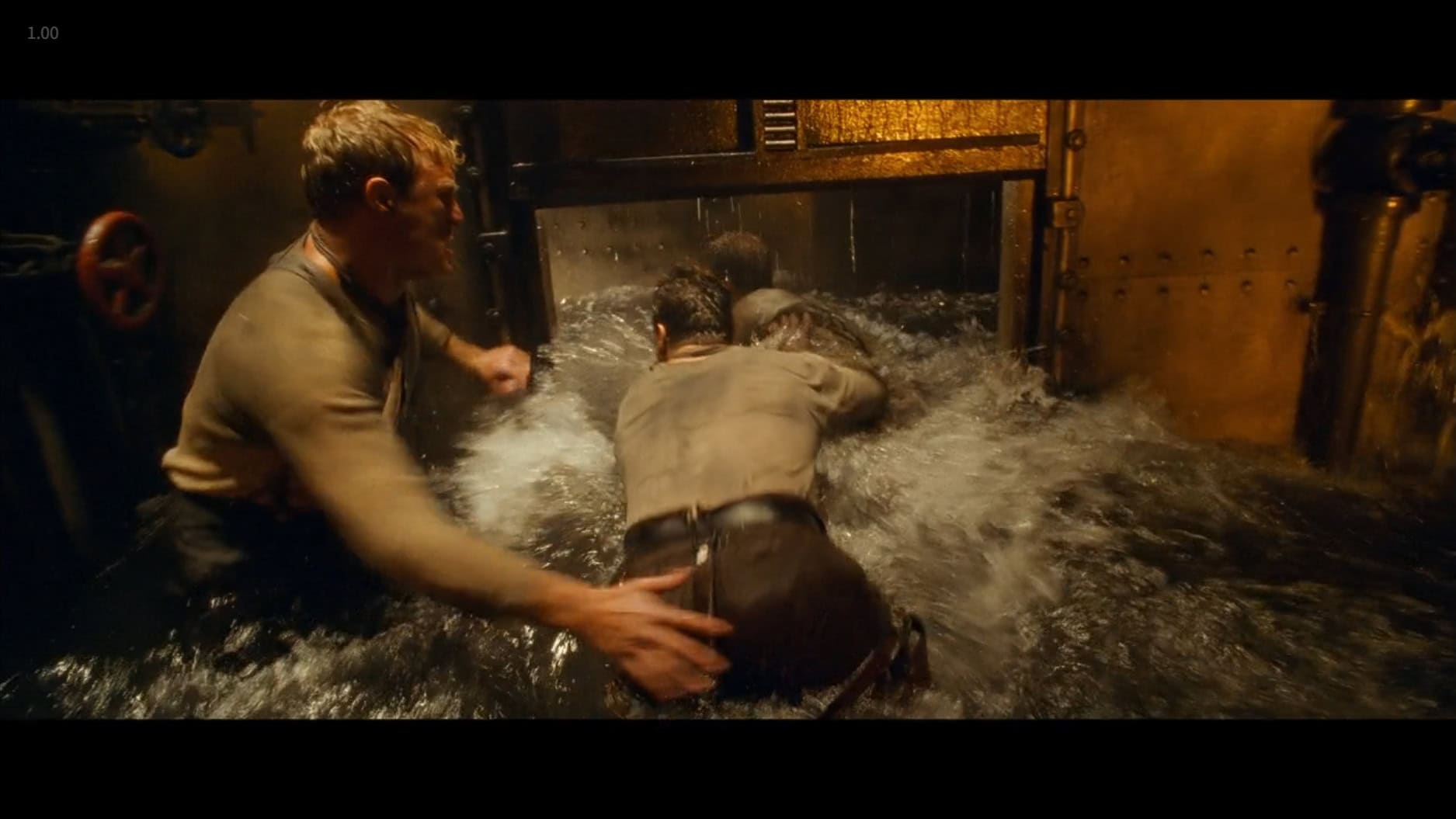
The British inquiry found that twelve watertight doors in the engine and boiler rooms were closed from the bridge. Titanic did not sink because those doors simply failed to close.
The report also contains a less familiar detail. There was testimony that the doors were subsequently reopened, except those forward of the No. 4 boiler group, and no evidence that the reopened doors were closed again afterward.
The doors also had an automatic mechanism that would close them when water reached them. An open door did not mean that water could keep flowing aft without any further barrier.
Looking back at the sequence of flooding, the inquiry even suggested that leaving the doors open might have kept Titanic afloat somewhat longer:
“the life of the ship would have been lengthened somewhat if these doors had been left open”
— British Wreck Commissioner’s Inquiry, Observations
If some of the water concentrated forward had spread aft, the bow might have remained slightly higher, temporarily reducing the rate at which seawater entered the ship.
That does not mean open doors could have prevented the sinking. The amount of water already entering the first five compartments had made the ship’s loss unavoidable.
- Twelve watertight doors were closed from the bridge.
- Testimony indicated that most were subsequently reopened.
- Automatic mechanisms could close them when water reached them.
- Leaving them open might have extended the time afloat somewhat.
- It would not have prevented the sinking.
The doors worked, but the iceberg damage exceeded the limits of the design. Once the ship was doomed, dispersing water farther aft rather than concentrating it forward may, counterintuitively, have allowed her to float a little longer.
Why Did Titanic Sink? Were Five Compartments Really Flooded?
After inspecting the damage, Thomas Andrews explains in the film that flooding in five forward compartments makes the sinking inevitable. The explanation agrees with the British inquiry’s later analysis.
Watertight bulkheads divided Titanic’s interior into compartments. According to the inquiry, she could remain afloat with the first four flooded. Adding No. 6 boiler room, and thus flooding the first five, changed the situation.
As the bow sank deeper, water could pass over the top of the bulkhead behind No. 6 boiler room and enter No. 5. Once that filled, the process could continue into the next compartment.
- First four compartments flooded: the design allowed the ship to remain afloat.
- First five flooded: the bow sank far enough for water to overtop the bulkhead.
- Afterward: water could spread successively into compartments farther aft.
The iceberg did not have to slice open every compartment farther down the ship. The bow’s increasing immersion allowed water to move aft over the bulkheads.
The inquiry also concluded that the water entering the first five compartments in the first ten minutes was beyond the capacity of Titanic’s pumps. The central explanation behind Andrews’s verdict in the film—that flooding those five compartments doomed the ship—has official support.
Could the Pumps Have Saved the Ship?
It is tempting to think that pumping out the water might still have saved Titanic. The British inquiry reached a much harsher conclusion.
In just the first ten minutes, the volume entering the forward compartments greatly exceeded the ship’s pumping capacity. Even if every pump aboard had been available, they could neither have saved the ship nor appreciably prolonged the time she remained afloat.
This was not flooding on a scale that better pumping arrangements after the collision could have overcome.
Were There Really Too Few Lifeboats for Everyone?
Titanic’s twenty lifeboats and collapsibles had a combined capacity of 1,178. They could never have held all 2,201 people aboard on the night of the disaster, using the British inquiry’s figures.
- Passengers: 1,316.
- Crew: 885.
- Total aboard: 2,201.
- Boats: 20.
- Total boat capacity: 1,178.
The inquiry also found that at least eight boats left without their full complement.
There was no single reason for the empty seats. Many people initially failed to appreciate the danger and were reluctant to leave the ship. There was also an intention to lower boats toward the water and take additional people aboard through openings in the ship’s side. Officers, meanwhile, were uncertain about the boats’ strength and how many people they could safely carry.
- Some passengers did not yet understand the danger and resisted leaving.
- There were plans to add people through side openings after lowering the boats.
- Officers lacked confidence about the boats’ strength and safe capacity.
The loss of life was worsened by both the shortage of boats and the failure to use all the carrying capacity that was available.
Why Were There Not Enough Lifeboats?
There were 2,201 people aboard, but space in the boats for only 1,178. The familiar explanation that boats were reduced because Titanic was considered unsinkable does not, by itself, explain the situation.
One major factor was British regulation. The lifeboat rules adopted in 1894 largely based requirements on a ship’s gross tonnage rather than the number of people aboard.
The table stopped at “10,000 tons and upwards.” It provided no further scale to distinguish a 10,000-ton vessel from Titanic, which exceeded 46,000 tons.
With the additional provisions applicable to an emigrant ship such as Titanic, the legal requirement amounted to capacity for approximately 962 people. The ship actually carried boat capacity for 1,178.
Titanic therefore exceeded the legal minimum. That minimum still fell far short of space for everyone.
- Legally required capacity: approximately 962.
- Actual boat capacity: 1,178.
- People aboard: 2,201.
The issue was not that the company broke the law by carrying too few boats. The law itself had failed to keep pace with the number of people carried by increasingly large liners.
Nor did the problem first become apparent in 1912. The British report traced concern back to an 1886 committee that recognized that existing legislation could not provide for the safety of everyone aboard large passenger ships.
In 1887, a House of Commons select committee also favored providing life-saving equipment for as many people as possible, while acknowledging the practical difficulty of carrying large numbers of wooden boats.
Yet the rules adopted in 1894 remained in place long after ships had grown substantially larger.
Contemporary ideas about safety mattered too. Large ships had stronger hulls and improved watertight subdivision. Wireless could summon nearby assistance. Making the liner itself less likely to sink could consequently seem more important than carrying large numbers of small boats.
The regulations even allowed reductions in boat and raft requirements for ships judged to have particularly effective watertight subdivision. That concession was not applied to Titanic, but it could theoretically have reduced the requirement still further.
A new set of proposed standards existed in 1911. It would have provided capacity for the 2,201 people aboard on the disaster voyage, although still not for the maximum number Titanic was legally permitted to carry.
The White Star Line also emphasized the ship’s own resistance to sinking. Company official Harold Sanderson explained that, before the accident, he had not envisaged a situation in which everyone aboard a ship such as Titanic would need to transfer into boats.
Large numbers of boats were thought capable of obstructing decks and hindering safe operation. Testimony also shows that boats were understood as a means of transferring people from a damaged vessel to a rescue ship or to land.
- A great liner was not expected to sink quickly.
- Wireless could bring a rescue ship.
- Boats could ferry people from the damaged ship to assistance.
Together with outdated regulations, these expectations and practical concerns made it possible for a ship carrying 2,201 people to have legal boat capacity for only 1,178.
- Rules had failed to keep pace with growing ships.
- Design philosophy emphasized keeping the ship afloat.
- Wireless encouraged confidence in outside assistance.
- Large numbers of boats were difficult to carry and operate.
- Boats were seen as a means of transfer.
The British inquiry did not excuse the long failure to revise the 1894 standards. Olympic’s lifeboats had already been questioned in Parliament in 1910, and the Board of Trade was considering revisions in 1911. Titanic nevertheless began her maiden voyage before new rules took effect.
Was “Women and Children First” Applied Consistently?
The policy of giving women and children priority has clear documentary support. Second Officer Charles Lightoller told the Senate inquiry that, as the boats were being prepared, he asked Captain Smith whether women and children should be put into them, and received an affirmative answer.
That did not mean no men could board. Some boats took men once women and children had entered and seats remained. On the port side, where Lightoller worked, there were many cases of much stricter restrictions on men.
- Women and children were to have priority.
- Some boats then admitted men to remaining seats.
- Men often faced stricter restrictions on Lightoller’s port side.
- Practice varied by boat, officer, and location.
The film makes these differences relatively easy to grasp. But an absolute division in which Murdoch always admitted men and Lightoller always refused them would simplify the actual evacuation too far.
Were Third-Class Passengers Really Locked Behind Gates?
One of the film’s most disturbing scenes shows third-class passengers blocked by gates as they try to reach the upper decks.
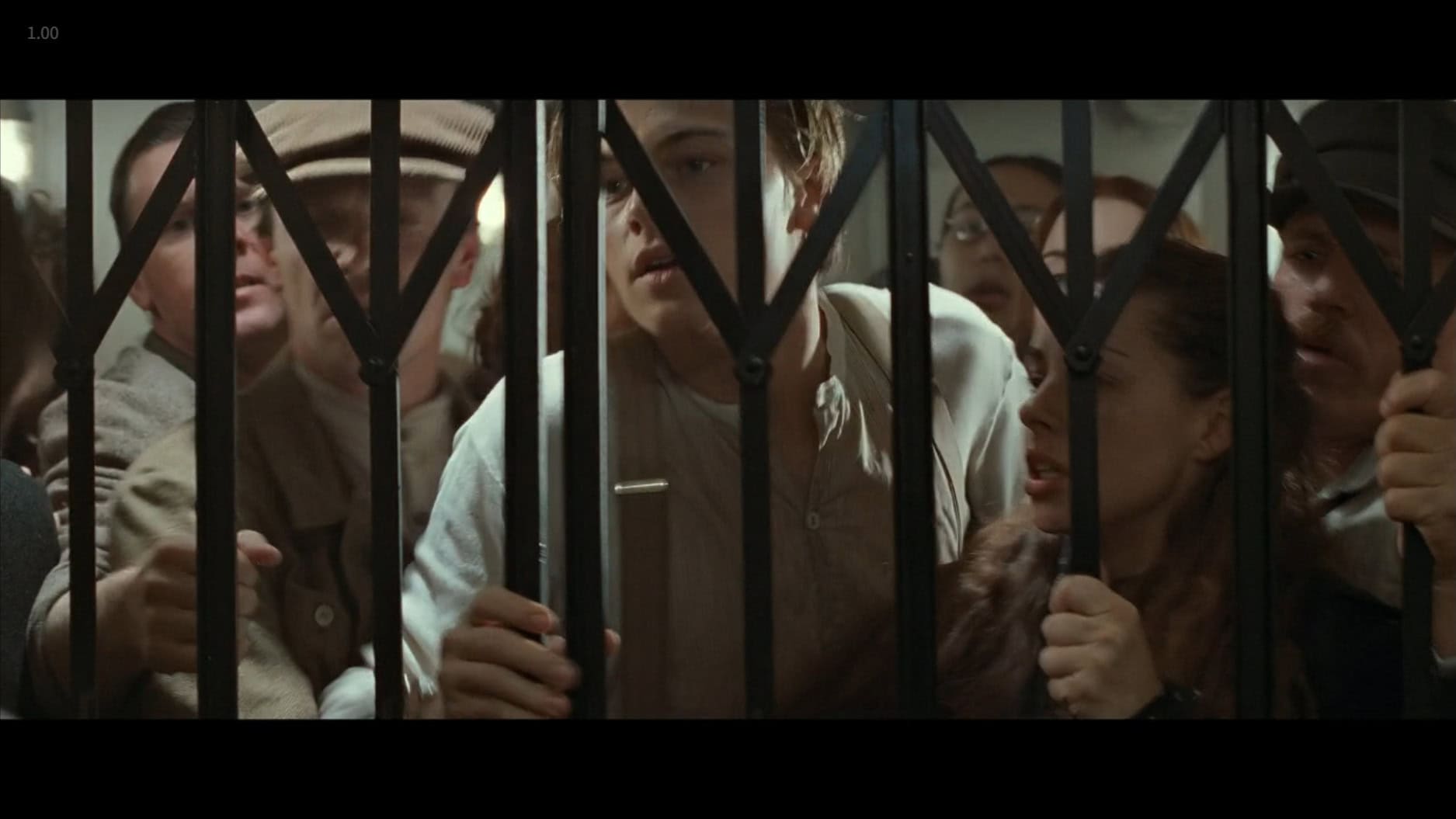
Not every detail of the scene can be treated as historical fact. There is, however, direct testimony that third-class passengers encountered a locked gate.
Third-class passenger Daniel Buckley gave a specific account under oath to the United States Senate inquiry.
According to Buckley, the gate had not initially been locked. Someone he believed to be a sailor then came and locked it:
“It was not locked … but the sailor, or whoever he was, locked it.”
— Daniel Buckley, United States Senate Inquiry Q14971
Another third-class passenger subsequently broke the lock, allowing people to go up.
Thus, a survivor directly described third-class passengers being blocked by a locked gate. His testimony does not establish an organized order by the company or crew to imprison them with the intention of letting them die.
Buckley himself said they could go up after the lock was broken. The British inquiry also concluded that there was no evidence of deliberate obstruction of third-class passengers, or discrimination against those who reached the boat deck when admitting people to the boats.
- Established: gates separated third class from other areas.
- Direct testimony: someone apparently belonging to the crew locked one gate.
- Direct testimony: another passenger broke the lock.
- Not established: an organized order to confine third-class passengers so they would die.
The numbers nevertheless show how disadvantaged third-class passengers were. Figures submitted to the British inquiry recorded 178 survivors out of 706 third-class passengers, a survival rate of 25.21 percent.
Whether or not there was organized confinement, their markedly lower chance of survival remains a fact.
Were the Officers’ Gunshots Invented for the Film?
As the sinking progresses, the film shows several officers using revolvers.
Fifth Officer Harold Lowe fires warning shots while lowering Boat 14 to prevent passengers from jumping into it. Second Officer Charles Lightoller also uses a revolver to stop men rushing a boat, firing into the air.
The most dramatic incident involves First Officer William Murdoch. After firing into the air to restrain a crowd, he shoots two men pushed toward him, then immediately shoots himself in the head.
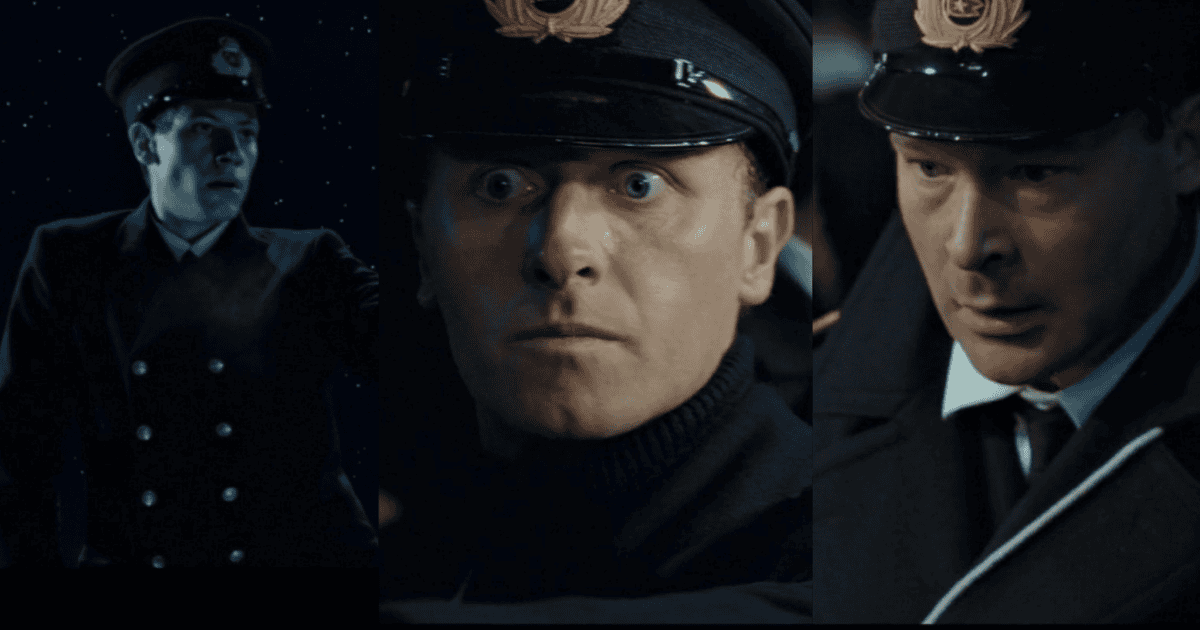
The film therefore shows Lowe, Lightoller, and Murdoch all firing guns. The historical evidence for those three depictions is not equally strong.
Lowe’s Warning Shots Are Supported by Direct Evidence
Of the three, Lowe is the officer whose actual firing of a revolver is most clearly established.
When asked about shots at the Senate inquiry, he explicitly acknowledged firing them:
“I heard them, and I fired them.”
— Harold Lowe, United States Senate Inquiry
Lowe admitted firing at the British inquiry too. Boat 14 was already well occupied and being lowered. He explained that further people jumping aboard would endanger it, and that he used his revolver to deter another attempt.
Able Seaman Joseph Scarrott also testified at the British inquiry that he saw Lowe draw his revolver and fire twice between the boat and the ship:
“He pulled out his revolver and he fired two shots between the ship and the boat’s side.”
— Joseph Scarrott, British Wreck Inquiry Q393
Lowe remembered three shots; Scarrott remembered two. Their accounts differ on the number, but the central fact—that Lowe fired near Boat 14—is supported by both his own sworn testimony and another witness’s. The film’s portrayal of Lowe firing warning shots has a clear basis in the records.
There Is Testimony About Lightoller Firing, but It Is Not Conclusive
The 1912 inquiries also contain an account corresponding to Lightoller’s warning shots in the film.
First-class passenger Archibald Gracie told the Senate inquiry that Lightoller fired a revolver to turn back third-class passengers rushing a boat. Asked who had fired, he replied:
“Lightoller. That is what he told me.”
— Archibald Gracie, United States Senate Inquiry Q14686
When asked whether it had instead been Murdoch or Lowe, Gracie said no, repeating that Lightoller himself had told him.
But Gracie had not witnessed the shooting:
“I did not hear the pistol. That is what I was told by Lightoller himself. That is all hearsay, Senator.”
— Archibald Gracie, United States Senate Inquiry Q14688
There is therefore sworn testimony that Lightoller told Gracie he had fired. It is not eyewitness testimony of Lightoller firing.
Later accounts differ as well. In The Truth About the Titanic, Gracie wrote that Lightoller drew a revolver, ordered men out of a boat, and threatened to shoot if they entered again. That account does not say he actually fired.
In his own 1935 memoir, Titanic and Other Ships, Lightoller described vigorously brandishing a revolver to drive the men out, but added that the weapon was not even loaded.
- The film: Lightoller fires warning shots.
- Gracie in 1912: testified under oath that Lightoller told him he had fired.
- The limitation: Gracie neither saw nor heard the firing himself.
- Gracie’s later book: describes drawing the revolver and threatening to shoot.
- Lightoller’s later memoir: describes brandishing an unloaded revolver.
- Conclusion: there is strong support for threatening passengers with a revolver, but actual firing is not established.
There Is Also Testimony Suggesting Murdoch Fired Warning Shots
It would be inaccurate to say there is no evidence at all of Murdoch using a revolver.
First-class passenger Hugh Woolner told the Senate inquiry that, shortly before the sinking, he saw two pistol flashes into the air as men rushed a collapsible boat on the starboard side:
“I saw two flashes of a pistol in the air.”
— Hugh Woolner, United States Senate Inquiry Q13346
He also described Murdoch immediately afterward shouting at the men to stand back. Asked again about the shooter, Woolner identified Murdoch as far as he could tell, explaining that recognition of the voice made him fairly certain.
Other testimony attributes the firing to someone else, however, leaving uncertainty about the officer’s identity.
The possibility that Murdoch fired warning shots shortly before the sinking thus has support in 1912 testimony. That evidence is different in strength from Lowe’s admission corroborated by another witness.
Murdoch Shooting Passengers and Then Himself Is Not Established
The crucial issue in the film’s portrayal of Murdoch is what follows the warning shots: shooting passengers, then taking his own life.
There is no conclusive evidence that he shot two men and immediately shot himself in the head as shown in the film.
Accounts and hearsay about an officer shooting passengers and then himself circulated soon after the disaster. But they disagree about the identity, number of people involved, location, and timing. They do not securely identify Murdoch as the man responsible.
Lightoller, meanwhile, testified under oath at the British inquiry that he saw Murdoch almost until the moment he himself went underwater:
“Mr. Murdoch I saw practically at the actual moment that I went under water.”
— Charles Lightoller, British Wreck Inquiry Q14767
He said Murdoch was working to lower a collapsible at the forward starboard side.
That testimony does not account for every final second of Murdoch’s life, so it cannot completely disprove the suicide theory. It also does not allow the film’s sequence to be accepted as his established fate.
- Lowe in the film: fires to prevent a rush into a boat.
- The evidence: his own and an eyewitness’s sworn accounts establish that he fired.
- Lightoller in the film: fires warning shots near a boat.
- The evidence: sworn hearsay that he admitted firing conflicts with later accounts; firing remains uncertain.
- Murdoch in the film: fires warning shots, kills two men, then himself.
- The evidence: testimony suggests warning shots by an officer believed to be Murdoch.
- Not established: Murdoch shot passengers dead.
- Not established: Murdoch killed himself.
Officers using revolvers to restrain a crowd were not simply invented for the film. Several accounts describe threats or shots aboard the real Titanic.
Their certainty varies by officer. Lowe’s actual firing is clearly supported. Lightoller’s alleged admission reaches us through Gracie and conflicts with later accounts. Murdoch may have fired warning shots, but the identification remains uncertain.
The most memorable part of the film’s sequence—Murdoch killing passengers and then himself—still cannot be treated as established historical fact.
The portrayal caused controversy after the film’s release. In Murdoch’s hometown of Dalbeattie, Scotland, relatives and residents strongly objected to a real person being depicted as both a killer and a suicide, and protested to the studio.
In April 1998, 20th Century Fox executive Scott Neeson visited Dalbeattie, expressed regret about the portrayal, and donated £5,000 to a fund commemorating Murdoch.
That £5,000 was not a legal settlement. It was the studio’s response to the objections, rather than money paid to settle litigation with the family.
Cameron himself later acknowledged, in substance, that assigning those actions to a particular real individual had been a mistake.
- Titanic Inquiry Project United States Senate Inquiry — Harold G. Lowe
- Titanic Inquiry Project British Inquiry — Joseph Scarrott
- Titanic Inquiry Project United States Senate Inquiry — Archibald Gracie
- Encyclopedia Titanica The Truth About the Titanic — Archibald Gracie
- Project Gutenberg Australia Titanic and Other Ships — Charles H. Lightoller
- Titanic Inquiry Project United States Senate Inquiry — Hugh Woolner
- Titanic Inquiry Project British Inquiry — Charles Lightoller
Did Lifeboats Really Return for People in the Water?
After Titanic sinks, the film shows different responses to the question of returning for those left in the sea.
Lowe gathers several boats, transfers passengers between them, and goes back to the sinking site. In Boat 6, Molly Brown urges a return and clashes with Quartermaster Hichens.
Both scenes have documentary foundations. But evidence that a boat actually returned is different from evidence that people asked it to return.
Did Fifth Officer Lowe Really Go Back?
Lowe’s own testimony supports the film’s sequence of gathering boats, transferring passengers, and returning to search for survivors.
He told the British inquiry that he tied together several boats under his command, transferred his passengers to the others, and returned to the people in the water with only crewmen in his own boat.
- Tie together the boats under his command.
- Transfer passengers into the other boats.
- Leave his own boat occupied only by crew.
- Return to search for survivors.
He did not go straight into the mass of people immediately after the sinking. Fearing that a rush of people would swamp the boat, he waited until their numbers had diminished:
“I had to wait until I could be of some use. It was no good going back there to be swamped.”
— Harold Lowe, British Wreck Inquiry Q15994
His testimony corresponds not only to the return but also to the preparations shown in the film. That does not mean the film’s elapsed time or number of rescues exactly matches the historical event.
Did Molly Brown Really Demand That Her Boat Return?
While Lowe’s boat actually returned, the film also stages an argument aboard Boat 6. Margaret “Molly” Brown insists that they go back, confronting Quartermaster Robert Hichens.
First-class passenger Arthur Peuchen, who was aboard Boat 6, gave a vivid account of the sounds coming from the sea after Titanic sank:
“We could not distinguish the exact cry for assistance; moaning and crying; frightful.”
— Arthur Peuchen, United States Senate Inquiry Q5547
He said the sounds continued for some time, growing weaker:
“gradually getting fainter, fainter.”
— Arthur Peuchen, United States Senate Inquiry Q5547
The women whose husbands were still aboard Titanic were deeply affected. Peuchen also testified that, while the cries continued, some of the women asked Hichens to return:
“Yes; some of the women did.”
— Arthur Peuchen, United States Senate Inquiry Q5549
There is therefore testimonial support for some women in Boat 6 asking to go back. Hichens himself, however, said he did not remember such a request.
- Peuchen: some women asked to return.
- Hichens: did not remember that request.
- Supported: testimony about disagreement in Boat 6 over returning.
- Not established: Molly Brown personally spoke the film’s dialogue.
- Not established: Brown took command of the boat.
The scene is not wholly invented: there is direct testimony that women hearing the cries asked to return.
It does not establish that Brown was the leading speaker as she is in the film. And, unlike Lowe’s boat, Boat 6 did not return to the people in the water despite those requests.
Did Ismay Really Sneak Into a Lifeboat Like a Coward?
Ismay is best remembered for surviving in a lifeboat while heading the company that owned Titanic. In the film, he seizes a moment when no one seems to be watching, enters a collapsible, and leaves with an air of guilt.
His survival in Collapsible C is historical fact. The surrounding actions are more complicated than the film’s impression suggests.
Several accounts describe him helping with the boats and encouraging women to enter. Ismay testified that women and children had been put into Collapsible C, the people on the deck there had boarded, and he entered as the boat was beginning to be lowered.
This was not merely his own defense. After considering other testimony, the British inquiry did not censure his boarding under those circumstances.
- Ismay survived in Collapsible C.
- Witnesses described him helping with the boats.
- The British inquiry did not condemn his boarding in the circumstances.
- A moral judgment can still differ from an inquiry’s finding.
The image of a man pushing women and children aside to escape before everyone else does not fit the primary evidence. Whatever judgment we make about the company head surviving, the film’s impression alone cannot settle what he did.
Did Andrews Really Die in the First-Class Smoking Room?
Thomas Andrews, who was closely involved in Titanic’s design, was a real person. In the film, he recognizes early that the ship is doomed and eventually waits alone in the first-class smoking room, staring at a painting.
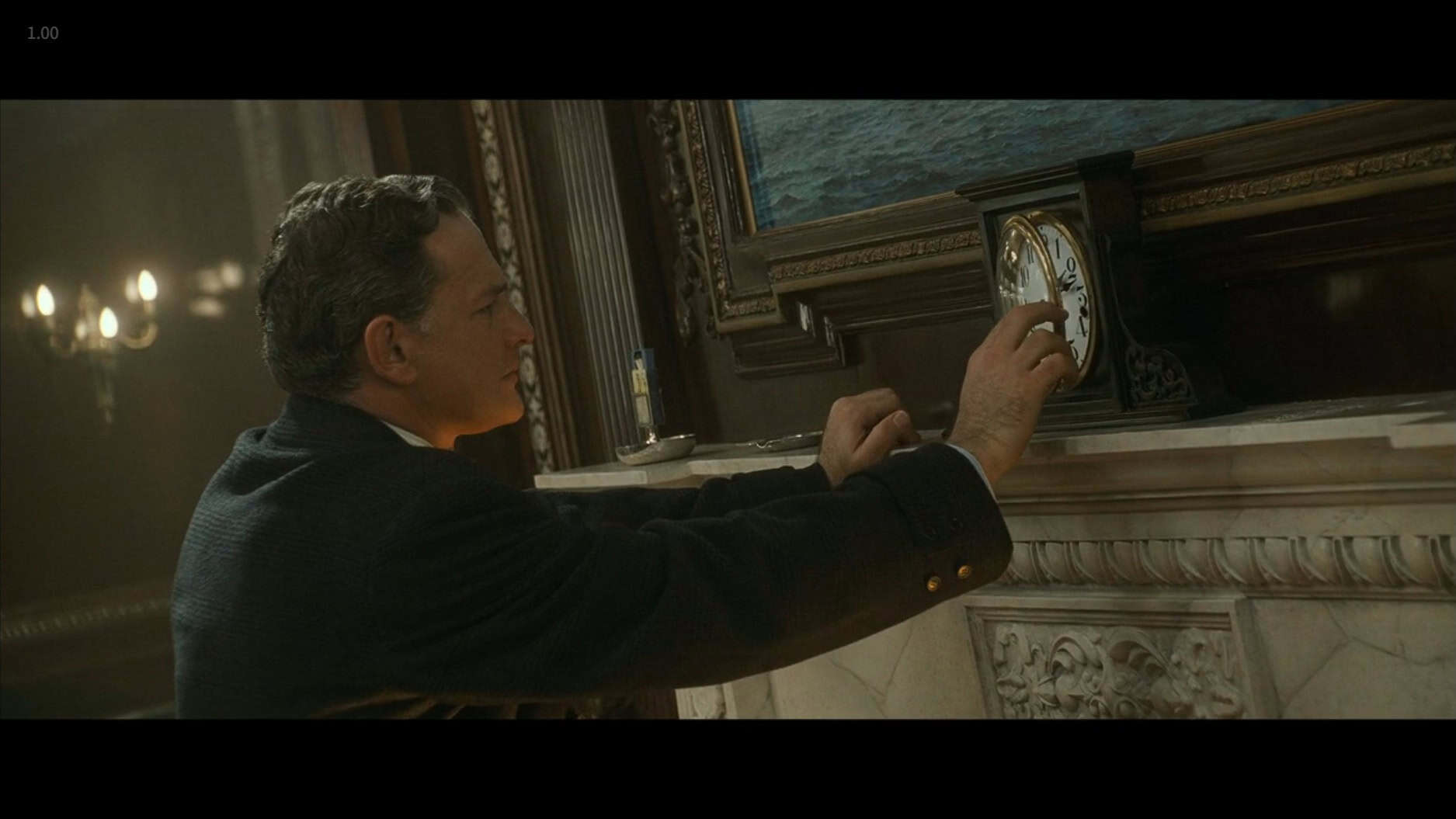
There is an account of Andrews in the smoking room. It does not establish that he died there.
Shan F. Bullock’s Thomas Andrews, Shipbuilder, published in 1912, describes steward John Stewart seeing him alone in that room. The film appears to turn this famous account directly into a scene.
The same book, however, also includes other reports of Andrews continuing to work after that sighting.
- In the source: an account of Andrews in the first-class smoking room.
- Also in that source: other reports of him being seen afterward.
- Not established: the smoking room was his final location.
- Not established: the exact time he was in the room.
The film selects the smoking-room account and presents it as his final scene. His precise location and actions at the moment of death remain unknown.
Did Captain Smith Really Die in the Wheelhouse?
As the bow goes under in the film, Captain Edward Smith enters the wheelhouse and looks outside. Water pressure eventually breaks the windows, killing him inside.
Where and how Smith actually died has not been established.
Wireless operator Harold Bride told the Senate inquiry that he last saw Smith a few minutes before the ship sank. In Bride’s account, the captain went overboard from the bridge:
“The last I saw of the captain he went overboard from the bridge, sir.”
— Harold Bride, United States Senate Inquiry Q2783
In the following testimony, Bride estimated that this had been about five minutes before the sinking.
There is no conclusive evidence that Smith remained in the wheelhouse and died as it flooded. Other accounts of his final moments survive, but they do not agree.
The film chooses a single, symbolic image of a captain going down with his ship.
Did the Elderly Couple Really Stay Together? The Strauses
During the sinking, the film shows an elderly couple embracing on a bed as water approaches. They are based on Isidor and Ida Straus.
There is clear testimony that Ida refused to enter a boat without her husband. First-class steward Alfred Crawford told the British inquiry that he urged her to board, but she would not leave Isidor behind.
There is no established evidence, however, that the couple returned to their cabin and waited together on a bed as shown in the film.
- Historical evidence: Ida refused to leave her husband for a lifeboat.
- Not established: they returned to a bed in their cabin.
- The film: turns their real decision into a symbolic image of their deaths.
The scene is best understood as an invented final image built around the couple’s documented choice to remain together.
Did Guggenheim Really Dress for Death?
The film shows first-class passenger Benjamin Guggenheim changing into formal dress and remaining aboard with his valet to face death as a gentleman. Guggenheim was real, and the account of him changing his clothes appears in sources from immediately after the disaster.
At the Senate inquiry, first-class steward Henry Etches described visiting Guggenheim’s cabin, putting a lifebelt on him, and urging him to dress. He also testified that Guggenheim subsequently came out of his room.
The famous account of putting on his best clothes and preparing to go down as a gentleman appeared in newspapers within days of the sinking.
- Sworn testimony: supports an account of Guggenheim getting dressed.
- Early newspaper reporting: carried the famous story of facing death as a gentleman.
- The distinction: a newspaper’s reported dialogue is not equivalent to sworn testimony.
The story was not suddenly invented many years later. But sworn testimony does not establish that he spoke the familiar movie dialogue word for word.
Did the Drinking Baker Really Stay at the Stern Until the End?
Near the end of the film, a man in white appears close to Jack and Rose as they cling to the stern rail. He takes out a drink and remains at the very back of the sinking ship.
He represents Chief Baker Charles Joughin, a real crew member. Several of the actions depicted correspond to his testimony at the British inquiry.
Joughin admitted returning to his cabin during the sinking and drinking a little alcohol:
“I went down to my room and had a drop of liqueur that I had down there.”
— Charles Joughin, British Wreck Inquiry Q6020
His drinking in the film is therefore more than an invented character detail; it has a basis in his own account.
He also testified to throwing deck chairs overboard—about fifty, in his recollection—and moving to the stern in the final stage, where he said he stood outside the rail.
- He drank a little alcohol during the sinking.
- He said he threw about fifty deck chairs into the sea.
- He remained near the stern until the final stage.
- He entered the water and survived.
His survival after a prolonged period in the water has encouraged the claim that alcohol protected him from hypothermia.
His testimony establishes that he drank. It does not establish a medical explanation in which alcohol made his survival possible. What the inquiry records is that he drank, stayed outside the stern rail, entered the water, and nevertheless survived.
Did the Band Really Play Until the Ship Sank?
Several early accounts support the band playing during the sinking. The film’s portrayal of music continuing as an attempt to calm passengers therefore has a documentary foundation.
The disputed point is the final piece. The film uses “Nearer, My God, to Thee,” but conflicting accounts existed almost immediately.
- Harold Bride was reported as identifying “Autumn.”
- Other survivors described hearing “Nearer, My God, to Thee.”
- Archibald Gracie heard the band but did not believe it was playing a hymn.
There is strong support for the musicians continuing to play. Their final selection remains unresolved.
“Nearer, My God, to Thee” was already part of the early tradition surrounding the disaster. It was not newly invented for Cameron’s film.
“Shut Up, I Am Busy”: Was Californian’s Ice Warning Really Dismissed?
Accounts of the disaster often mention a Titanic wireless operator replying “Shut up” to an ice message from Californian. The exchange itself appears in Californian operator Cyril Evans’s testimony to the Senate inquiry.
Californian had stopped for the night because of ice. Evans tried to tell Titanic that his ship was stopped and surrounded by it.
His strong, nearby signal interrupted Titanic’s operator, who was handling a large volume of passenger traffic with Cape Race:
“Say, old man, we are stopped and surrounded by ice.”
“Shut up, shut up, I am busy; I am working Cape Race.”
— Cyril Evans, United States Senate Inquiry
To a modern reader, the response sounds like a reckless dismissal of a danger warning. But this was not a formal captain-to-captain warning received and rejected by Titanic’s bridge. It was an exchange between wireless operators while Titanic was working passenger messages with Cape Race.
- Californian had stopped because of ice.
- Evans sent that information to Titanic.
- Titanic was handling passenger traffic with Cape Race.
- The “Shut up” response is supported by testimony.
- This was not the bridge deliberately rejecting a formal warning it had received.
Titanic had also received ice information from several ships earlier. Some reports reached the captain or officers; others did not. The disaster cannot be reduced to a single story that the last warning was met with “Shut up.”
Could the Nearby Californian Really Have Rescued People?
Californian’s role remains one of the disaster’s most disputed questions. Stopped because of ice, she was in relatively nearby waters while Titanic was sinking.
Her crew saw rockets rising into the night sky, but did not immediately go to the rescue.
The British inquiry in 1912 found that Californian could have reached Titanic had she tried to assist when the first rocket was seen.
The claim that a nearby ship failed to come therefore has a clear foundation in the inquiry’s findings.
That does not establish an exact arrival time or number of people who would have been saved. The precise positions of the two ships have continued to be debated.
How Did Carpathia Rescue Titanic’s Survivors?
The ship that responded to Titanic’s distress call and actually rescued survivors was the Cunard liner Carpathia.
According to the British final report, Captain Arthur Rostron immediately turned his ship around and headed to the rescue after learning of the distress message. Carpathia made the highest speed she could, reported as up to approximately 17.5 knots.
- Rescue run: up to about 17.5 knots.
- Stopped at the scene: approximately 4:05 a.m.
- First boat taken aboard: approximately 4:10 a.m.
- People rescued, in the British final report: 712.
There was ice in the area. Carpathia navigated around icebergs before dawn and stopped at approximately 4:05 a.m., taking in the first boat about five minutes later.
Titanic had sunk at about 2:20 a.m. The survivors therefore spent a long time on the cold sea after their ship disappeared. The boats were spread over a wide area, and the rescue continued through the morning.
The British final report gives the number taken aboard Carpathia as 712. Official sources differ slightly on the total number of survivors, so a precise figure should be kept attached to its source.
Did Titanic Really Break in Two as Shown in the Film?
At the film’s climax, the bow sinks and the stern rises steeply until the hull fails around its middle. The stern falls back to the surface, then rises again to an almost vertical position and disappears.
The separation of the hull is now established by the wreck itself. Bow and stern lie apart on the seabed, so the film’s broad account of the ship breaking into two is correct.
The debate concerns how high the stern had risen when major structural failure began.
In the 1997 film, the stern is extremely high when the main break occurs. Later wreck investigations and structural analyses have produced models in which failure begins at a lower angle.
Some studies place the onset of major structural failure at a relatively shallow angle of about 11 to 15 degrees.
- The film: a major break after the stern has risen very high.
- Later models: major failure may have begun at a lower angle.
- Established: the hull separated into two principal sections.
- Unresolved: the exact angle when the breakup began.
The hull is also thought to have separated through a complex sequence of failures involving the bottom and upper structures, rather than one clean, instantaneous snap.
Different reconstructions produce different results. The precise angle cannot be fixed to one indisputable number.
Some testimony from 1912 also differs from the steep sinking image familiar from the film. Chief Baker Joughin rejected a description of the stern standing nearly upright when questioned at the British inquiry.
One witness cannot settle the angle. But accounts inconsistent with the film’s steep-angle image existed in 1912, not only in research conducted after the film appeared.
In the 2017 National Geographic documentary Titanic: 20 Years Later with James Cameron, Cameron also tested whether the ship could sink as depicted in the film. The experiment could reproduce a stern sinking vertically, but not the full sequence of returning to a level position and then rising again to sink vertically. Cameron described the film’s version as partly right and partly wrong.
Even that experiment demonstrates a possible sinking behavior. It does not prove that the real ship followed exactly that sequence.
Was Jack and Rose’s Car Really Aboard Titanic?
In the film, Jack and Rose escape into the cargo area and spend time alone inside a Renault car.
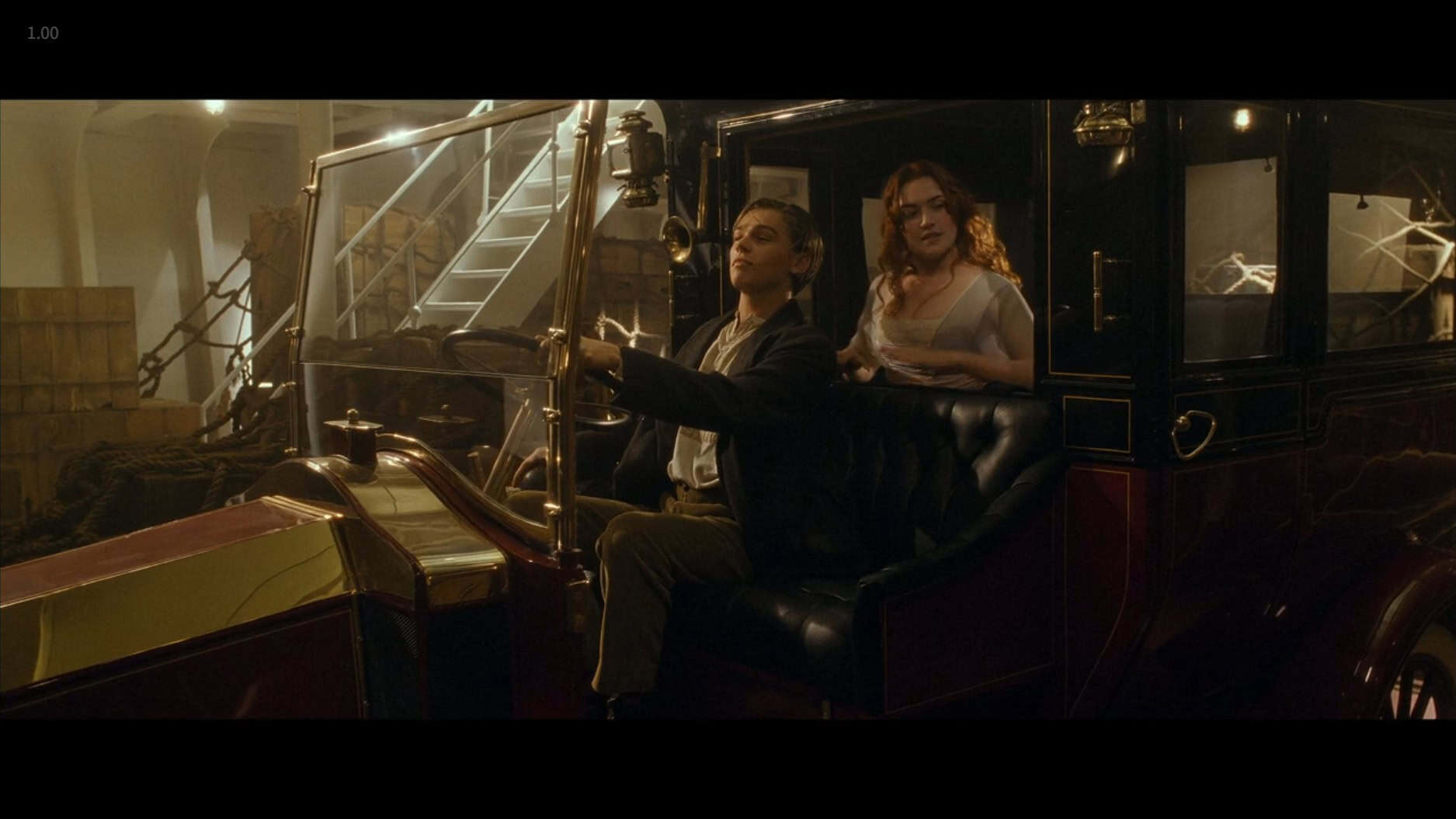
Their encounter is fictional. The presence of a motorcar among Titanic’s cargo is not.
Cargo records list one car belonging to first-class passenger William E. Carter, identified as a 25-horsepower Renault.
- Real: Titanic carried a motorcar as cargo.
- Owner: William E. Carter.
- Car: identified as a 25-horsepower Renault.
- Fiction: Jack and Rose entering it together.
The filmmakers did not simply choose an arbitrary period car. They used an actual item of cargo in the story. Its position and the surrounding cargo-space arrangement on screen should not, however, be assumed to reproduce the exact historical loading.
Is Titanic a True Story?
After comparing the scenes and records, it becomes difficult to classify Titanic simply as either a true story or fiction.
Jack and Rose’s romance is fictional. The ship through which they move was real, and many of the people around them actually existed.
- Ice warnings.
- A speed of around 22 knots.
- The absence of binoculars for the lookouts.
- The bell rung at the iceberg sighting.
- Collision-avoidance orders.
- Closure of the watertight doors.
- Flooding of five compartments.
- Too few lifeboats.
- Boats leaving below capacity.
- Testimony about gates obstructing third-class passengers.
- Officers firing revolvers.
- Carpathia’s rescue.
Many of these events can be traced back to the 1912 inquiry records.
By contrast, the final moments of several real people remain uncertain:
- Did Murdoch shoot passengers and then himself?
- Did Andrews die in the smoking room?
- Did Captain Smith die in the wheelhouse?
- Was the band’s last piece really “Nearer, My God, to Thee”?
Some accounts conflict. In other cases, the film chooses one of several accounts and fixes it as an image. Research since 1997 has also revised aspects of the sinking reconstructions available when the film was made.
- Which source lies behind this scene?
- Which of several accounts did the film choose?
- Where does dramatization begin?
Asking those questions changes how we see the film.
Titanic is not a documentary reproducing established history exactly. It is also much more than a romance that merely borrows the 1912 disaster as scenery.
It brings together a vast body of historical facts, testimony, tradition, and the sinking research available during production, then lets two fictional people, Jack and Rose, walk through it.
Following the boundary between history and fiction reveals a more complicated disaster than the film alone can show.



Reader Comments