
Your Name. (Official Website) is a 2016 animated feature film written and directed by Makoto Shinkai.
In this article, I have selected 12 of my favorite quotes and memorable lines from Your Name.
Memorable dialogue often uses expressions that are quite different from ordinary conversation, so I have sometimes found myself wondering, “How did they translate this into English?” For that reason, I also took a closer look at the English subtitles.
Makoto Shinkai’s films are often accompanied by an English title or subtitle. In the case of Your Name., it is:
Your name.
Translation note: The English subtitle wording in this article is based on the commercially released Blu-ray available to the author. Subtitle wording may vary between releases and territories.
▼ Read the full story and analysis behind these quotes
On this pageContents
Taki Tachibana Quotes in Japanese and English
“I… I! Me? I?”
わたし。あ、わたくし!ぼく?おれ?
Watashi. A, watakushi! Boku? Ore?
I (watashi)… I (watakushi)! I (boku)? I (ore).
I. Ah, I! Me? Me?
Read the Commentary and Analysis
Mitsuha, trapped in Taki’s body, says this while trying to determine which first-person pronoun Taki normally uses by watching the reactions of his friends.
I cannot say that I found anything particularly profound in the line itself.
But I was extremely curious about how on earth it would be translated into English.
And unfortunately, the subtitle does not really solve the problem at all.
Japanese has several common first-person pronouns whose choice can suggest gender, formality, age and personality: watashi, watakushi, boku and ore.
English has only I.
So the subtitle has little choice but to leave the Japanese pronouns in parentheses.
Your Name. also has an English dub, and this is exactly the sort of scene that makes me wonder how the translators approached the problem.
The joke depends almost entirely on a distinction that simply does not exist in ordinary English.
Translation can be cruel.
“Your name is Mitsuha… Who are you?”
君の名前は、三葉。大丈夫、憶えてる。三葉、三葉、三葉。名前は三葉。君の名前は…/お前は誰だ
Kimi no namae wa, Mitsuha. Daijōbu, oboeteru. Mitsuha, Mitsuha, Mitsuha. Namae wa Mitsuha. Kimi no namae wa… / Omae wa dare da.
Your name is Mitsuha. It’s OK. I remember. Mitsuha. Mitsuha. Mitsuha. Your name is Mitsuha. Your name is… Who are you?
Your name is Mitsuha. It’s all right, I remember. Mitsuha, Mitsuha, Mitsuha. Your name is Mitsuha. Your name is… Who are you?
Read the Commentary and Analysis
Taki goes so far as to drink the kuchikamizake Mitsuha painstakingly made in order to return to the past.
And yet, after all that, he begins forgetting the one thing he absolutely must not forget:
her name.
Immediately after this scene, RADWIMPS’ “Sparkle” begins playing, and those of us watching the film are quite properly swallowed whole by the sequence.
But I think the scene tells us something beyond its immediate emotional impact.
One of the distinctive qualities of Your Name. is that it depicts things normally treated as opposites with equal beauty.
This is unquestionably a negative moment: Taki is losing Mitsuha.
Yet an extraordinarily beautiful song plays over that loss, and the result becomes one of the most beautiful scenes in the film.
Perhaps the point is that separation and loss can possess a value equal to encounter and reunion.
If we use this scene as a clue, perhaps the same idea explains the film’s treatment of Tokyo and rural nature.
Tokyo in Your Name. is beautiful.
Honestly, it may be more beautiful than the real Tokyo.
But the countryside surrounding Itomori is depicted with exactly the same beauty.
The film does not fall into the simplistic idea that things made by humans are “unnatural” and therefore ugly, while untouched “nature” is automatically beautiful.
Everything is placed on the same plane.
Another way to put it would be:
Human beings are also part of nature.
I completely agree.
There is nothing particularly unusual about the English wording itself.
What matters is the terrifyingly simple transition from repeating Mitsuha’s name over and over to:
“Who are you?”
▼ Read more about Taki Tachibana’s age, voice actor, background, and character analysis

Mitsuha Miyamizu Quotes in Japanese and English
“Taki… Don’t you remember me?”
瀧くん、あの、私… 憶えて、ない?
Taki-kun, ano, watashi… oboete, nai?
Taki… Don’t you remember me?
Taki, um… don’t you remember me?
Read the Commentary and Analysis
Near the end of the film—and also, in a sense, near its beginning—Mitsuha travels to Tokyo to meet the boy whose body she has been swapping with.
By complete coincidence, she finds Taki on the Yamanote Line and says this to him.
Unfortunately, the Taki standing in front of her has not begun swapping bodies with Mitsuha yet.
He has absolutely no idea who she is.
So Mitsuha is treated like a suspicious stranger and undergoes what might politely be called an extremely embarrassing experience.
Since she has no reason to suspect that a three-year time difference exists between them, the encounter must have been devastating.
But Mitsuha, you really did not need to worry that much.
Taki’s reaction was almost certainly nothing more than panic.
A very cute girl around his own age suddenly approached him on the train, and he was desperately trying to keep the last fragments of his adolescent ego intact.
The truth inside Taki’s head at that moment must have been something like this:
“Huh? Who is she? She’s really cute… Wait, what does she mean, ‘Don’t you remember me?’ Is this some kind of pickup technique? Hang on. What am I supposed to do? If I just go along with this, she’ll have complete control of the situation. I should act like I’m used to this. Stay calm. Pretend this is nothing!”
Young men are like this.
His internal monologue may say, “Who is this girl?” but I am convinced the above is closer to the truth.
Once a man gets older, he may acquire enough shameless confidence to respond to a complete stranger with, “Of course! From back then!” and simply create a situation out of nothing.
Taki is still too young for that.
Mitsuha, on the other hand, decided to travel all the way to Tokyo and actually speak to him when she found him.
That way of living was far more admirable.
That courage is exactly why she was eventually capable of saving her town.
There is nothing especially unusual about the English translation itself.
There is, however, a small piece of English-language trivia hidden in this scene.
Middle-school Taki is holding English vocabulary cards. Two of the sentences visible on them are:
“Have you seen Tiamat’s comet?”
and:
“I’m looking for my counterpart.”
It is probably nothing more than a little visual joke or bit of foreshadowing, but look for it the next time you watch the film.
“I can’t remember his name.”
あの人の名前が、思い出せんの
Ano hito no namae ga, omoidasen no.
I can’t remember his name.
I can’t remember that person’s name.
Read the Commentary and Analysis
On the night the comet fragment is about to strike Itomori, Mitsuha says this to Teshigawara, even though the two of them are supposed to be working together to save the townspeople.
Teshigawara responds forcefully:
“I don’t know. You started all this!”
On the surface, it is an easy scene to overlook.
But reading the storyboard changes the way I see it.
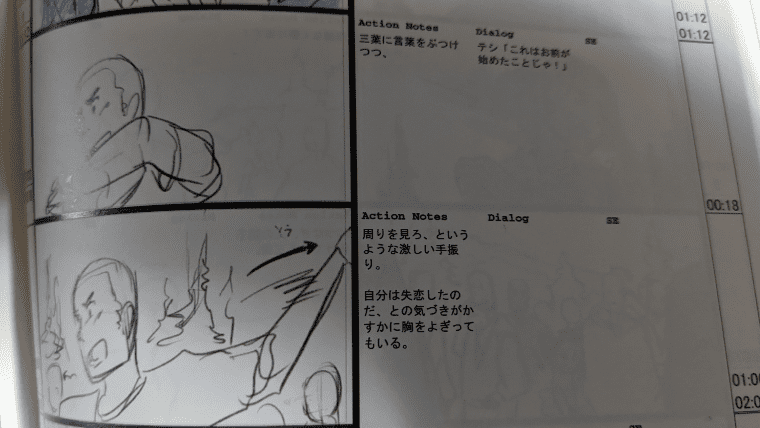
The storyboard explicitly notes that the faint realization that he has lost the girl he loves crosses Teshigawara’s heart.
Thinking back, Teshigawara’s feelings toward Mitsuha were obvious throughout the film.
Perhaps they were so obvious that it became difficult to tell exactly what kind of feeling they represented.
But yes.
He really was in love with her.
At least we, the audience, should remember that.
You have probably been there too, haven’t you?
There is nothing particularly unusual about the English subtitle.
Looking back, Teshigawara had been expressing his feelings from very early in the story.
When Sayaka asks whether the gods would really be happy to receive kuchikamizake, Teshigawara immediately replies, “Of course they would.”
The person you love and the person who loves you are often different people.
That fact has been causing human beings pain for a very long time.
But life is like that.
Life is like that.
▼ Read more about Mitsuha Miyamizu’s age, voice actor, background, and character analysis
Taki and Mitsuha Quotes in Japanese and English
“The day when the stars came falling…”
あの日、星が降った日、それはまるで/まるで夢の景色のように、ただひたすらに/美しい眺めだった
Ano hi, hoshi ga futta hi, sore wa marude… / Marude yume no keshiki no yō ni, tada hitasura ni… / Utsukushii nagame datta.
The day when the stars came falling. It was almost as if… as if a scene from a dream. Nothing more, nothing less than a beautiful view.
That day, the day the stars fell, it was almost… almost like a scene from a dream, simply and completely… a beautiful sight.
Read the Commentary and Analysis
As discussed above, Your Name. is, in my view, a story that depicts opposites as equally valid and equally beautiful.
This line announces that idea in the opening scene.
In other words, it is effectively saying:
The thing that killed people that day was beautiful.
Whether the comet is beautiful is entirely a matter of human perception.
Whether it becomes a threat to us is equally irrelevant from the comet’s point of view.
We exist as ourselves.
The comet exists as a comet.
There is nothing more to it than that.
This is one of the places where I think we can glimpse Shinkai’s remarkably flat—or non-hierarchical—view of nature.
The noteworthy English expression is nothing more, nothing less than.
Literally it means “neither more nor less than,” but in actual use it can emphasize that something is exactly what is being described: nothing beyond it and nothing beneath it.
Here, the terrible event is presented simply as “a beautiful view.”
“Your name is…”
君の、名前は…
Kimi no, namae wa…
Your name is…
Your name is…
Read the Commentary and Analysis
The more someone loved Makoto Shinkai’s earlier films, the more likely they may have been to feel dissatisfied with this ending.
I understand that reaction.
But I think this film absolutely needed Taki and Mitsuha to meet again at the end.
Without that reunion, I do not think the film would have fulfilled the reason it exists.
I discuss that idea in detail here:
Longtime Shinkai fans may have wanted a more painful or ambiguous ending.
But no.
I am convinced this ending is better.
Hitoha Miyamizu Quote in Japanese and English
“I also remember seeing strange dreams when I was a young girl.”
わしも少女の頃、不思議な夢をみとった覚えがある
Washi mo shōjo no koro, fushigi na yume o mitotta oboe ga aru.
I also remember seeing strange dreams when I was a young girl.
I remember that I, too, used to have strange dreams when I was a young girl.
Read the Commentary and Analysis
Near the end of the story, Grandma Hitoha casually says this to Taki while he is inside Mitsuha’s body.
She phrases it vaguely enough that the film avoids stating anything completely outright.
But come on.
There is about a ninety-nine-percent chance that Grandma herself once swapped bodies with somebody.
That means Mitsuha and Taki’s experience is not a one-time accident.
Whether body-swapping had continued uninterrupted for the entire 1,200-year history of the Miyamizu family is impossible to know.
But at the very least, it appears to have occurred in Hitoha’s generation.
Which leads to another conclusion:
Mitsuha’s mother Futaba probably swapped bodies with someone too.
So who was it?
I discuss my own theory in these articles:
If you have time, take a look.
There is nothing especially difficult about the English subtitle.
▼ Read more about Hitoha Miyamizu’s voice actor, background, and character analysis
Yotsuha Miyamizu Quote in Japanese and English
“Hurry up!”
はよきない!
Hayo kinai!
Hurry up!
Come on, hurry up!
Read the Commentary and Analysis
Near the beginning of the film, Yotsuha is trying to drag Mitsuha to breakfast.
Her older sister has just woken up and is still standing there in a daze, so Yotsuha fires this line at her while forcefully sliding the door shut.
It is unquestionably intended as a little comedy beat.
And I did, in fact, properly chuckle.
Shinkai’s films before Your Name. certainly contained humorous scenes, but this may be the first one that really made me laugh.
For example, there is a scene in The Place Promised in Our Early Days where Hiroki and Takuya are asked by their boss why they are working part-time.
The conversation refuses to line up properly for an extended period, clearly as a comedy scene.
Even now, though, I find myself thinking, “I can’t watch this.”
And I say that as someone who loves The Place Promised in Our Early Days.

Shinkai seemed to develop a taste for this kind of humor afterward, and Weathering with You contains plenty of it as well.
I still did not laugh very often.
Comedy is probably one of the most brutally difficult things to create.
The more people who watch something, the more viewers like me there will be for whom a particular joke simply does not work.
Even so, these moments of comic relief are important when constructing a story, so I imagine they are a constant source of suffering for writers and directors.
In that sense, Hayao Miyazaki’s ability to make people chuckle with almost terrifying consistency is remarkable.
At least he gets me nearly every time.
The subtitle reduces hayo kinai!, with its regional flavor and comic rhythm, to the extremely simple “Hurry up!”
The comedy is almost completely lost.
But what else could the translator realistically do?
Comedy may be one of the hardest things in the world to translate.
▼ Read more about Yotsuha Miyamizu’s voice actor, background, and character analysis
Toshiki Miyamizu Quote in Japanese and English
“Who… who are you?”
お前は、誰だ
Omae wa, dare da.
Who… who are you?
Who are you?
Read the Commentary and Analysis
Near the end of the film, Taki—inside Mitsuha’s body—aggressively confronts Mitsuha’s father, Mayor Toshiki Miyamizu.
Seeing his daughter behaving in a way completely unlike anything he has ever seen before, Toshiki suddenly says:
“Who are you?”
Perhaps it was simply the natural reaction of a father confronted with a completely different version of his daughter.
But in a film called Your Name., the words “Who are you?” carry unusual weight.
Taki had already used those same words.
This may sound like overthinking things, but I do not believe such a central phrase emerges from Toshiki’s mouth at precisely this moment by accident.
My interpretation is that Toshiki had once asked someone else, “Who are you?”
So who was that person?
I discuss my theory here:
Why did the mayor use those particular words?
There is nothing especially difficult about the English translation itself.
▼ Read more about Toshiki Miyamizu’s voice actor, background, and character analysis
Miki Okudera Quote in Japanese and English
“You used to have a bit of a crush on me, right?”
君は昔、私のことがちょっと好きだったでしょう?そして今は、別に好きな子がいるでしょう?
Kimi wa mukashi, watashi no koto ga chotto suki datta deshō? Soshite ima wa, betsu ni suki na ko ga iru deshō?
You used to have a bit of a crush on me, right? But now you like someone else.
You used to like me a little, didn’t you? And now there’s another girl you like, isn’t there?
Read the Commentary and Analysis
Okudera says this to Taki after his long-awaited date with the older coworker he had been infatuated with for so long.
With this one sentence, Taki’s romantic story with Okudera ends before it ever truly begins.
And if we trace the cause backward, it is probably less accurate to say that Taki ruined the date than to say that Mitsuha had raised the bar impossibly high.
Remember: Taki was not even the one who arranged the date.
Mitsuha did that for him.
If Taki had been the kind of man capable of effortlessly setting up and executing a brilliant date with Okudera, he would probably have been dating her long before the body-swapping ever began.
By this point, however, Taki’s feelings have already shifted toward Mitsuha.
And those feelings ultimately become part of what allows him to prevent the destruction of Itomori.
So although the situation may have been a tragedy for Taki’s romance with Okudera, the residents of Itomori should probably be saying:
“Well done, Mitsuha!”
Ladies of the world:
If the man you love is interested in another woman, perhaps one possible strategy is to become extremely good friends with your rival.
Your rival may gradually start seeing the man you both liked as rather ordinary, improving your own chances.
Speaking as a man, this sounds terribly inconvenient.
But perhaps it is worth trying.
The important English expression is have a crush on someone.
It means to be romantically attracted to or infatuated with someone.
Because crush can sound somewhat stronger than the simple Japanese suki, the subtitle adds a bit of and says “a bit of a crush.”
This is the kind of expression that is difficult to produce—or even recognize immediately—unless you already know it.
▼ Read more about Miki Okudera’s voice actor, background, and character analysis
Katsuhiko Teshigawara Quote in Japanese and English
“I’ll probably keep on living a normal life in this town.”
別に。普通にずっとこの町で暮らしてくんやと思うよ、俺は
Betsu ni. Futsū ni zutto kono machi de kurashite kun ya to omou yo, ore wa.
Nothing special. I’ll probably keep on living a normal life in this town.
Nothing in particular. I think I’ll probably just keep living an ordinary life in this town.
Read the Commentary and Analysis
Until this point, Teshigawara can seem like a joking, slightly theatrical guy who enjoys creating situations around himself.
This is one of the moments when we suddenly see Teshigawara simply as a human being.
Perhaps he has ambitions that the film never explicitly gives him the opportunity to express.
The first may be his feelings for Mitsuha.
The second, perhaps hidden underneath those feelings, may be his desire to escape Itomori.
But he also understands that he is the son of the family behind one of the town’s central construction businesses.
He knows what that probably means for his future.
He is expected to inherit the business.
His room is packed with expensive equipment and hobbies.
Creating that kind of environment costs money.
It reminds me of the son of a rural temple driving an expensive sports car.
Sometimes parents give their children these things with an unspoken message:
“So please inherit the family business.”
I understand the feeling extremely well.
That is why Teshigawara’s line feels strangely sad.
How we should judge this situation is difficult.
But I cannot help thinking of Makoto Shinkai himself.
Shinkai was born into the family of a construction company, yet chose to pursue the path he wanted and became a film director.
Perhaps precisely because he understood that reality, he could not casually write a future for Teshigawara in which the boy simply abandoned everything and left town.
Ironically—or perhaps fortunately—the comet fragment eventually destroys Itomori.
As a result, Teshigawara is finally able to reach Tokyo, that great “somewhere else” beyond his hometown.
Perhaps the greatest beneficiary of everything that happens in Your Name. is Teshigawara.
And perhaps, somewhere behind him, Makoto Shinkai himself.
I think that is perfectly fine.
There is nothing especially difficult about the subtitle.
One useful expression is live a normal life, meaning simply to live an ordinary, conventional life.
Even “I’ll live normally in this town” would communicate the basic meaning, but “live a normal life” is much more natural English.
▼ Read more about Katsuhiko Teshigawara’s voice actor, background, and character analysis
Sayaka Natori Quote in Japanese and English
“Do the gods appreciate sake made that way?”
口噛み酒。神様嬉しいんかなぁ。あんな酒もらって
Kuchikamizake. Kami-sama ureshii n kanaa. Anna sake moratte.
“Kuchikamisake.” Do the gods appreciate sake made that way?
Kuchikamizake… I wonder if the gods are really happy to receive sake like that.
Read the Commentary and Analysis
This line practically speaks on behalf of everyone watching Your Name.
Thanks to Sayaka asking this question, kuchikamizake is properly relativized inside the film.
We learn that even within the world of the story, ordinary people can look at this tradition and think:
“That is kind of wild.”
But I think the line contains another layer.
Teshigawara is standing there when Sayaka says it.
And his rather hopeless response is:
“Of course they do.”
I do not think Teshigawara realizes it, but Sayaka may have been testing him.
Imagine if he had replied:
“If it was your kuchikamizake, of course they’d be happy.”
Sayaka might have ascended directly to heaven.
Instead, his answer effectively reveals his interest in Mitsuha.
For Sayaka, it must have been an extremely disappointing response.
Still, perhaps this is the weakness of being the person who is in love.
Even knowing that Teshigawara’s evacuation plan is ultimately being carried out for Mitsuha, Sayaka cannot simply abandon him.
Fortunately, the ending suggests that the two eventually become rather close.
So perhaps things work out all right after all.
The situation reminds me somewhat of Sugimura and Yuko in Studio Ghibli’s Whisper of the Heart.
Sugimura is in love with the protagonist Shizuku and barely notices Yuko, who is obviously interested in him.
Then Shizuku rejects him.
By the ending credits, Sugimura has apparently noticed Yuko’s feelings and the two are happily walking home together.
What an opportunistic fellow.
Still, both Yuko and Sayaka eventually seem to become close to the men they liked, so perhaps we should simply be happy for them.
Although it is admittedly difficult to completely ignore the fact that these are stories written by men.
I am a man, so I suppose I am fine with it.
The important English word here is appreciate.
It can mean to recognize the value of something, to understand something fully, or to feel grateful for it.
In this sentence, both “value” and “be grateful for” are reasonably close to the intended meaning.
▼ Read more about Sayaka Natori’s voice actor, background, and character analysis
Reader Comments