
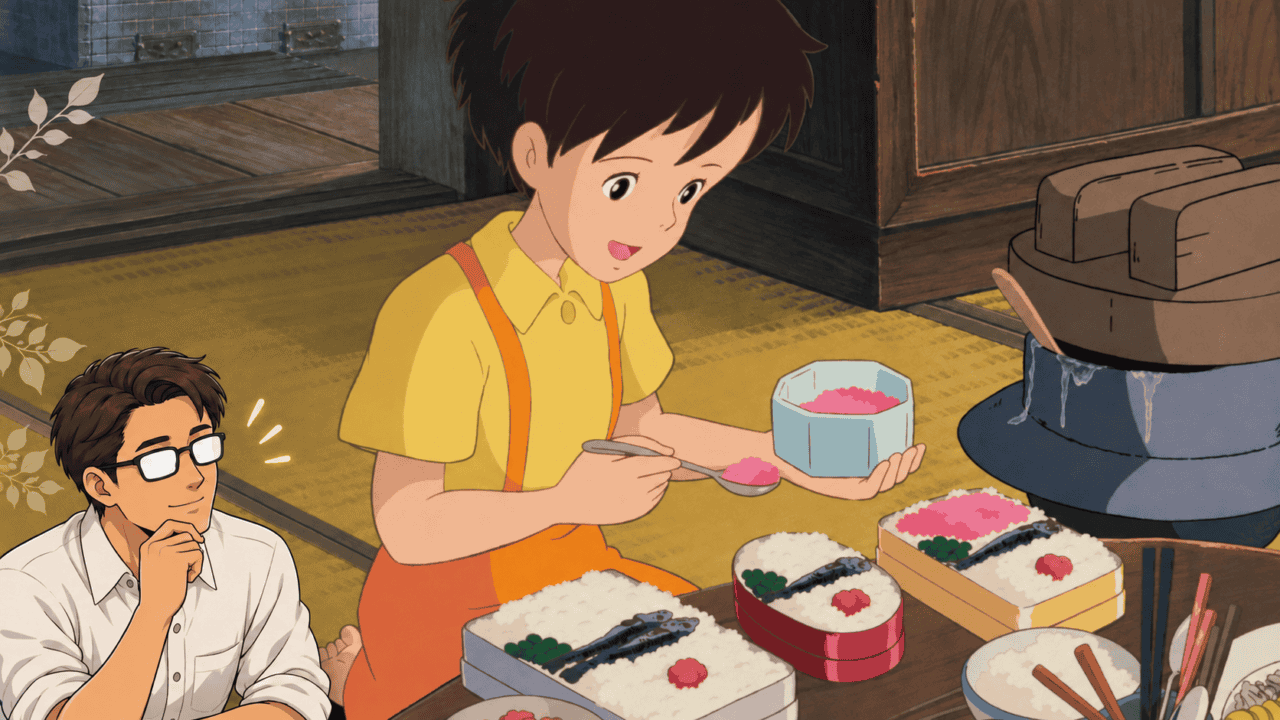
In Hayao Miyazaki’s 1988 film, My Neighbor Totoro(Official Studio Ghibli), Satsuki and Mei live with their father while their mother is in hospital. Neither girl usually shows how lonely she feels without her. Yet both eventually burst into tears. Here, I want to consider what Satsuki’s crying scene reveals. What do we see in her tears?
*This is a translated version. The original (Japanese) is available here.
- Satsuki’s Tears Reveal Her Humanity
Satsuki appears to be a cheerful, capable character who handles the housework and cares for her sister. When she cries after her mother’s visit home is cancelled, we finally see the lonely, frightened child beneath that role. - The Scene That Would Keep Satsuki from Becoming a Delinquent
Toshio Suzuki’s observation prompted Miyazaki to make Satsuki cry. Their exchange reveals how personally Miyazaki identified with her, and how important it was to him that she could show her feelings. - Mei’s Tears Give Satsuki the “Right to Cry”
Perhaps Satsuki can cry because Mei cries first. By letting her feelings out, the younger sister may give Satsuki permission to show her own weakness. Seen that way, Mei’s tears are a blessing.
On this pageContents
My Neighbor Totoro (1988): What Does It Mean When Satsuki Cries?
How Satsuki’s Crying Scene Came About
Toshio Suzuki describes the scene’s origins in Shigoto Douraku New Edition – The Studio Ghibli Workplace (仕事道楽 新版―スタジオジブリの現場, in Japanese). Uneasy at how perfectly Satsuki managed the housework and cared for Mei, he raised the point with Miyazaki. Their exchange went as follows:
…”There’s no way a child like that really exists.” At the time, perhaps because I was young, I added, “If she does all this stuff as a child, Satsuki will become a delinquent when she grows up.”
At that, Miya-san (Miyazaki) got genuinely angry. “No, a child like that does exist. Or rather, did exist.” I wondered what he was going to say, and he said, “I was like that.”
[Omitted]
…You know the scene where Satsuki cries, worried that her mother might die? When the storyboard for that scene was ready, he said, “Suzuki-san, take a look.”
When I said, “Oh, so she cries here,” he replied, “I made her cry.” Then he said, “Suzuki-san, now Satsuki won’t become a delinquent, right?” When I replied, “No, she won’t,” Miya-san was pleased and said, “Good.”
(Original Text, in Japanese)
……「こんな子がほんとにいるわけないじゃないですか」。そのとき、ぼくも若かったからですけど、さらにこう言った。「こんなことを子供のうちから全部やってたら、サツキは大きくなった時に不良になりますよ」。子の時、みやさんは本気で怒りましたねえ。「いや、こういう子はいる。いや、いた」。なにを言うのかと思ったら、「おれがそうだった」。
中略
……お母さんが死ぬんじゃなかと心配してサツキが泣くシーンがあるでしょう、そこのシーンの絵コンテできて「鈴木さん、みて」と言うんです。
「お、ここで泣くんですね」と言ったら、「泣かせた」というんですよ。そして「鈴木さん、これでサツキは不良にならないよね」。ぼくが「なりません」と言うと、宮さんは「よかった」と喜ぶ。
Miyazaki also discusses the scene in an interview in Ghibli Textbook 3: My Neighbor Totoro (ジブリの教科書3:となりのトトロ, in Japanese).
That is how the scene came about. Now I want to consider what it does for us as viewers.
From a “Character” to a Human Being
Thinking back to how I saw Satsuki as a child, I remember a cheerful girl who handled housework effortlessly and looked after her little sister. I accepted her so naturally as that kind of character that I hardly noticed I was doing it. Take this scene:
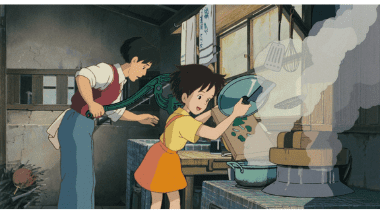
Satsuki deftly prepares breakfast while her father, who has forgotten his turn at the housework and overslept, washes his face. As a child, I thought, “Get up, you useless dad!” Of Satsuki, though, I thought little more than, “That’s Satsuki for you—so capable.” We should give her a little more consideration. That morning, she might have been thinking:
“Damn it, Dad, you’re still asleep. I knew this would happen. Why do I have to do this? It’s your job, you useless dad!“
She must have thought something like that. Or perhaps she didn’t—not that morning. The ease with which she handles everything suggests that there have been plenty of mornings like it, though, and I imagine she must have felt that way at least once. There must also have been moments when she thought:
“Why am I always the one looking after Mei? Come on, Dad—she’s your daughter. Take better care of her!“
The feelings of a girl who ties her sister’s hair every morning cannot have been simple. And beyond those frustrations lies another thought: “If only Mom were here.“
Seen that way, Satsuki’s feelings as she waits for her mother to return become more complicated.
Of course she wants her beloved mother to get well, and she wants to live with her again. But her mother’s return also promises an escape from this exhausting situation. Her father is little use, after all, so her mother seems her only hope.
When her mother’s visit home is cancelled, I see Satsuki facing two fears: “Mom might die,” and “These days might go on forever.” That is when she finally cries.
Only then do we think, “Of course she would,” and realize how close to her limit she has been.
In that scene, Satsuki changes from a character playing the role of the cheerful, perfect girl who manages the housework and cares for Mei into a human being trying to live with complicated feelings she does not show. Or, at least, she changes in the eyes of an inattentive viewer like me, who failed to notice her distress.
We easily treat animated figures as characters assigned particular roles, rather than as people. We assume that someone cheerful feels cheerful inside, or that someone who speaks positively must feel positive too. People are not that simple. As a child, I also badly misunderstood Ashitaka in Princess Mononoke: it never occurred to me how tangled his feelings might be when he left his village. Perhaps Suzuki’s objection served to remind distracted viewers like me that Satsuki is a human being.
My Neighbor Totoro (1988) Appendix: The Blessing of Mei’s Tears
So far, I have considered Satsuki’s tears, but Mei also sobs in the film. I have an older brother; perhaps that is why, as a child, I found Mei’s crying difficult to accept. I remember thinking, “Don’t cry now—you’re making things harder for your sister!”
Satsuki’s outburst is considerably harsher in Japanese than the English subtitle suggests. For the original Japanese, romanization, English subtitle, literal translation, and a comparison with the dub, see “Mei, you idiot! I don’t care anymore!” in our guide to memorable My Neighbor Totoro quotes.
Perhaps I was confident that I would not have cried. I doubt I was the only child who thought, “What are you crying for?” Still, let’s look at it another way.
“Perhaps Satsuki could cry because Mei cried first.“
As I said at the start, Satsuki and Mei generally do not cry. Even when Mei falls, she holds back her tears. Satsuki may have noticed that Mei, too, was fighting the loneliness of living without their mother at home.
Perhaps that is why Satsuki kept her own loneliness hidden. When Mei finally sobbed, she may have given Satsuki the “right to cry.”
Seen that way, Mei’s tears are a blessing for Satsuki. Perhaps we can even tell her, “Good work, Mei!”
The images used in this article are from Still Images of Studio Ghibli Works.
Can you name the movie before the scene comes into focus?
Put your visual memory to the test with a blurred Studio Ghibli scene.


Reader Comments
Have a thought or interpretation? Leave a comment