
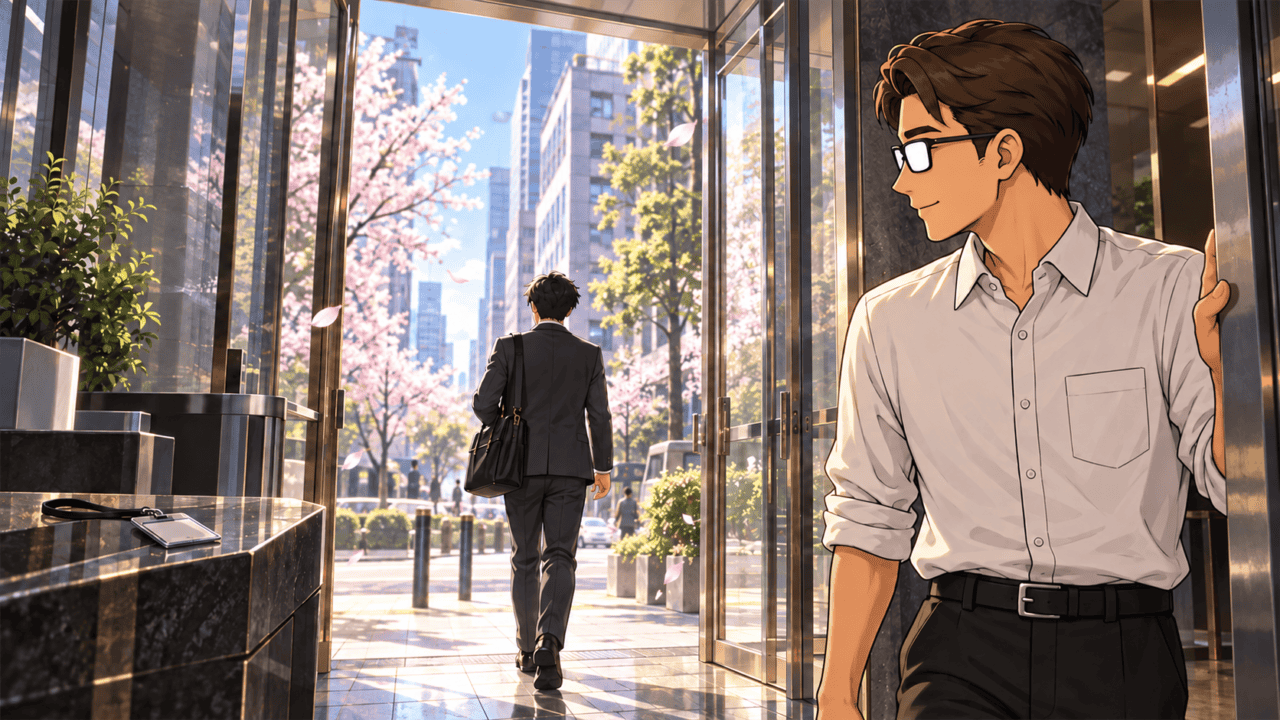
Released in 2007, 5 Centimeters per Second (official site, in Japanese) is an animated feature directed by Makoto Shinkai. I already knew his work at the time and am fairly sure I had seen The Place Promised in Our Early Days. My memory of Voices of a Distant Star is less certain.
People often seem to describe 5 Centimeters per Second as a depressing or cruel story. I used to see it that way too, but I no longer think that is what the film is about. I want to explain why I now see 5 Centimeters per Second as a thoroughly positive film, with nothing depressing about it. Let’s begin by looking back at the first chapter.
*This is a translated version. The original (Japanese) is available here.
- Cherry Blossom: Becoming Buddies
I read Takaki and Akari’s reunion as an acceptance that they cannot always be together, and a positive farewell. They become “buddies”: two people who share a precious memory and remain important to one another. - Cosmonaut: Anxiety about the Future
The second chapter is told through Kanae’s perspective, but I see her words as expressing Takaki’s own uncertainty about the future. The Earth-like celestial body that appears in the story symbolizes that anxiety. - The Third Chapter: A New Step
Takaki quits his job and becomes a freelancer. I see this as a real step forward rather than stagnation, giving the story a hopeful conclusion. - Another Reading: A Comedy of Memory
If the film is an older Takaki’s recollection, its apparently depressing romance becomes an embarrassing story of youth embellished by memory. Kanae’s inner monologue and her sister’s presence can be read as parts of his imagined past. That makes it rather funny.
On this pageContents
Why I Don’t See 5 Centimeters per Second as a Depressing or Cruel Story
Following Takaki through the three chapters reveals a possible movement toward a new life.
Part 1: Cherry Blossom—Becoming Buddies
The first chapter, “Cherry Blossom,” follows Takaki from elementary to middle school and his love for Akari, who initially appears to be the heroine. Their parents’ circumstances separate them, but Takaki takes a solitary train journey to see her again. After a special night together, they part without exchanging the letters each has written.
It is a powerful, poignant story. But what matters most is Takaki’s narration after their reunion:
“I knew with absolute certainty that we couldn’t be together forever. Before us lay a life still too immense, a vast and empty expanse of time stretching out helplessly. But the anxiety that had gripped me eventually, slowly melted away, and in its place, only the memory of Akari’s soft lips remained.”
(Original Text in Japanese)
僕たちはこの先もずっと一緒にいることは出来ないと、はっきりと分かった。僕たちの前には未だ巨大すぎる人生が、茫漠とした弛緩が、どうしようもなく横たわっていた。でも、僕を捕らえたその不安は、やがて緩やかに溶けていき、あとには、明里の柔らかな唇だけが残っていた
After this narration, they spend their special night together and part the following morning. The crucial words are: “I knew with absolute certainty that we couldn’t be together forever.” They confirm their feelings that night, but they also say goodbye.
In this reading, it is a mistake to think Takaki remains hung up on Akari throughout the later chapters. At the end of the first, he does say, “I strongly wished for the strength to protect her.” That may look like lingering attachment, but I understand it as a declaration that he wants to become stronger, rather than a refusal to let go.
Akari does not give him her letter either. Perhaps she, too, thinks, “I want to become strong enough to make Takaki stay.”
“Cherry Blossom,” then, is a story about finding the first person with whom you share your youth, your powerlessness, and the problems life will require you to face.
I think they become “that person you cannot help thinking about.” Because this is a story about a boy and a girl, that may be hard to see. But they are not necessarily clinging to one another. They become the person who first comes to mind at important moments: “I wonder how they’re doing.” Think of La La Land, or the Breath of Fire games.
Reading it this way also helps explain the puzzling scenes in the second chapter.
Part 2: Cosmonaut—A Future as Distant as Deep Space
The most puzzling image in “Cosmonaut” is the Earth-like body in the sky that Takaki and a figure who seems to be Akari gaze at. Its presence makes the chapter harder to understand. I read it as a symbol of Takaki’s anxiety about his future.
The chapter speaks of a lonely journey through space. To me, that is the loneliness of a young person facing a future that does not yet exist. It is much the same when you get older, of course.
Although this is Kanae’s story of being in love with Takaki, he faces the same problems she does. In that sense, the chapter uses her words to express his anxiety about the future.
In this reading, Takaki is not occupied by lingering romantic feelings for Akari. Facing his own uncertain future, he thinks of her: “How is she doing? Is she struggling like me, or can she picture her future clearly?” That thought may encourage him—or make him feel smaller. The Earth-like body symbolizes this uncertainty: “I’m such a tiny being. How am I supposed to live through a future as vast as deep space?”
Part 3: 5 Centimeters per Second—A New Step
That brings us to the third chapter, “5 Centimeters per Second.”
What Is Happening in the Third Chapter?
Takaki looks weighed down throughout the final chapter. He is clearly not in a good situation, but what is wrong? He tells us himself:
“For the past few years, all I wanted was to move forward, to touch something I couldn’t reach. I didn’t even know what that specifically was, or where that almost obsessive compulsion came from. I just kept working, and when I realized my heart was losing its resilience day by day, the pain became unbearable. Then one morning, I noticed that the earnest, sincere passion I once had was completely gone. Knowing I had reached my absolute limit, I quit my job.”
(Original Text in Japanese)
この数年間とにかく前に進みたくて、届かないものに手を触れたくて、それが具体的に何を指すのかも、ほとんど脅迫的とも言えるようなその思いが、どこから湧いてくるのかも分からずに僕はただ働き続け、気づけば日々弾力を失ってく心がひたすら辛かった。そしてある朝、かつてあれほどまでに真剣で切実だった思いが、キレイに失われていることに僕は気づき、もう限界だと知った時、会社をやめた
This is one of the film’s longest and most important monologues. For the original Japanese, the English subtitle, a literal translation, and a closer look at its wording, see my 5 Centimeters per Second quotes guide.
As in “Cosmonaut,” Takaki is driven by the feeling that he must keep moving forward. Work overwhelms him, though, and that desire fades. Being busy would be fine if the work were fulfilling, but apparently it is not. He cannot endure his days as part of an organization devoted to maximizing its profits.
That is probably why his relationship is not going well either.
His girlfriend ends the relationship by email, saying their hearts have not grown even one centimeter closer. Why? I do not think it is because he still longs for Akari. He is caught in “the foolish sadness of a man who cannot enjoy his private life when his work is unfulfilling.” Work is work, and private life is private life, but men can be stupid about keeping them separate. Without fulfillment at work, his relationship feels empty too, and he cannot commit himself to it.
But is the third chapter ultimately a good story? Of course it is. The beginning makes that clear: Takaki is now working freelance. He spent his time in an organization feeling that something was wrong, but he had the ability to work on his own.
I see it as a story of “a man who keeps questioning his situation, finally resolves to quit his job, and reaches a way of life that suits him: working freelance.” That is surely a positive story. Akari, too, takes a new step by getting married—though making marriage the woman’s step forward does not seem particularly modern.
What Does “5 Centimeters per Second” Mean?
The film gives “5 centimeters per second” as the speed at which cherry blossom petals fall. But why is it also the third chapter’s title? I think it represents “the pace of the small steps taken by people trying hard to live.”
Five centimeters per second is three meters a minute. You would have to walk very slowly to move at that speed. You would almost seem to be standing still.
Takaki’s days must have felt like that—not only after he began working, but throughout a life that did not quite feel right. He feared he was standing still. I think Shinkai is offering people who struggle through life a powerful message, which I would put like this:
“You may feel as though you’re standing still. But you’re not! You really are moving forward at five centimeters per second. Don’t lose heart. Believe in yourself and keep trying to live. The future you want is surely waiting ahead!”
(Original Text in Japanese)
君たちは停滞しているように思ってしまうだろ?でもそうじゃないんだ!君たちは秒速5センチメートルで確かに前に進んでいる。くじけず自分を信じて懸命に生きていくんだ!その先に君の望んだ未来がきっとある!
What a good story. Seen this way, there is nothing depressing about it. 5 Centimeters per Second is a refreshing film that cheers on people trying their hardest. This reading lets us watch it without being weighed down by sadness.


Appendix: How to Watch 5 Centimeters per Second as a “Comedy”
A more speculative reading treats parts of the film as Takaki’s memories of his own past.
Flipping the Timeline: The “Real” First Part
The main article offers a way to watch the film without feeling depressed. Here, I want to consider how we might make it a comedy. This is admittedly a stretch, which is why it belongs in the appendix.
The first question is which chapter really begins the story. Chronologically, “Cherry Blossom” is obviously the first. But in terms of the film’s structure, I think the third chapter, “5 Centimeters per Second,” might be its true beginning.
I see the film as a story of anxiety about the future and a new step forward, making the third chapter its most important part. Perhaps the first two chapters are memories that occur to Takaki on a spring day after he has found a way to live as a freelancer.
If this is a story Takaki is remembering, the first chapter’s dramatic romance starts to make me laugh. Perhaps the real events were much less dramatic: the train did not stop for three hours, and he arrived fairly early. (There may still have been a special night, though.)
Perhaps the film feels so melancholy because he is remembering it, making it more tragic than it was. Don’t we all want our pasts to be as dramatic as possible? Even the poetic email from his girlfriend might actually have been something much more ordinary—or much nastier.
With this reading, the second chapter becomes especially funny. What would that make its story?
The Puzzling Presence of Kanae’s Sister
If the second chapter is Takaki’s recollection, Kanae’s monologue is already funny. How can her thoughts appear in a story he is remembering? He must be thinking, “She was definitely in love with me. I bet this is what she was thinking.” That alone makes it a wonderful example of a foolish man’s fantasy. But the most important question is why Kanae’s sister appears.
Her presence seems natural while we watch. But here is my suspicion: perhaps the person Takaki loved in high school was Kanae’s older sister—his teacher. That would explain why she has to appear when he remembers his past.
Midway through the chapter, the sister watches Kanae struggle to stand on her surfboard. Her expression is very serious. It could be the look of a sister worried about something going wrong for Kanae. But perhaps it means something else.
Soon afterward, Kanae waits for Takaki as usual but cannot find him. We then see him sitting alone in a field, staring at his phone. A deliberately suspicious reading might suggest that he had tried to confess his love to Kanae’s sister that day, perhaps by email or in person. She could hardly accept him.
Perhaps he was trying to nurse that heartbreak alone. Then the younger sister, who apparently loves him, arrives. And all of this is supposedly Takaki’s memory. You want to ask him, “What on earth are you doing?”
The main interpretation may already be a stretch, and I know this appendix goes much further. Still, reading 5 Centimeters per Second as a story being remembered does not seem so strange to me.
Your Take: The Ending of 5 Centimeters per Second
The final scene can feel like a loss, a new beginning, or both. What did it leave you with?
Reader poll


Reader Comments
Have a thought or interpretation? Leave a comment