
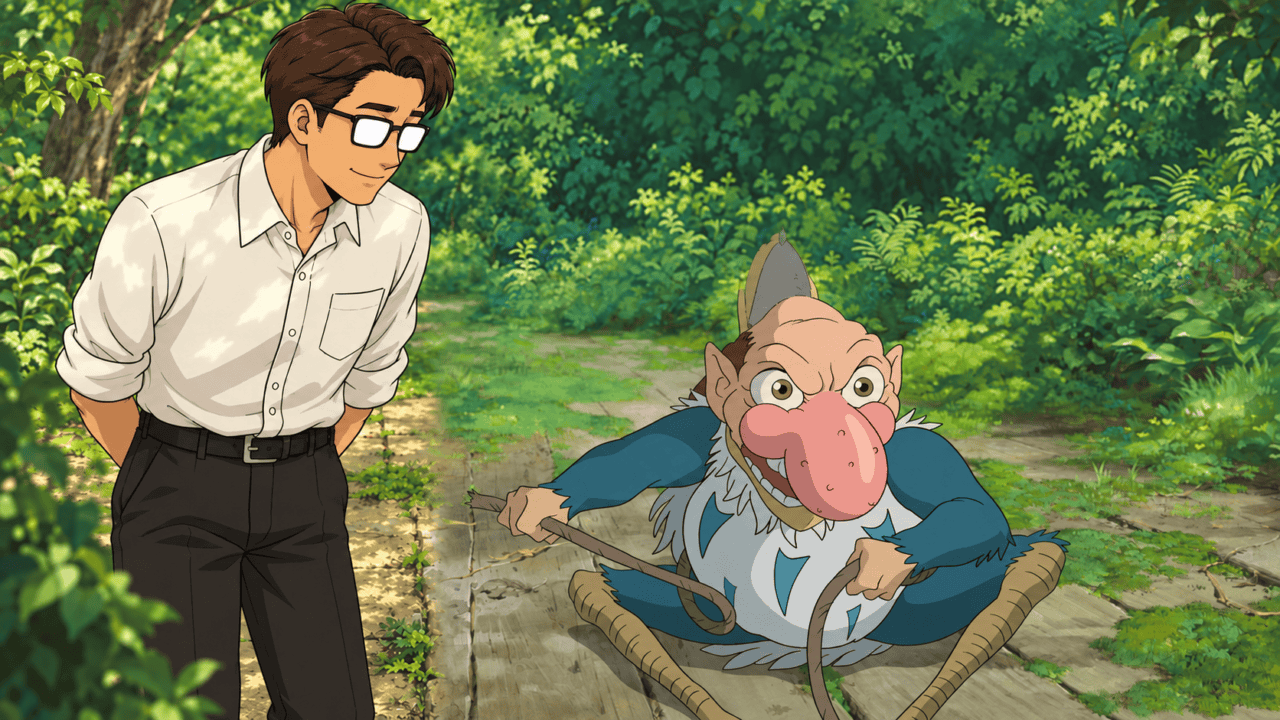
Hayao Miyazaki’s The Boy and the Heron (Official Studio Ghibli Website) is an animated feature released in 2023.
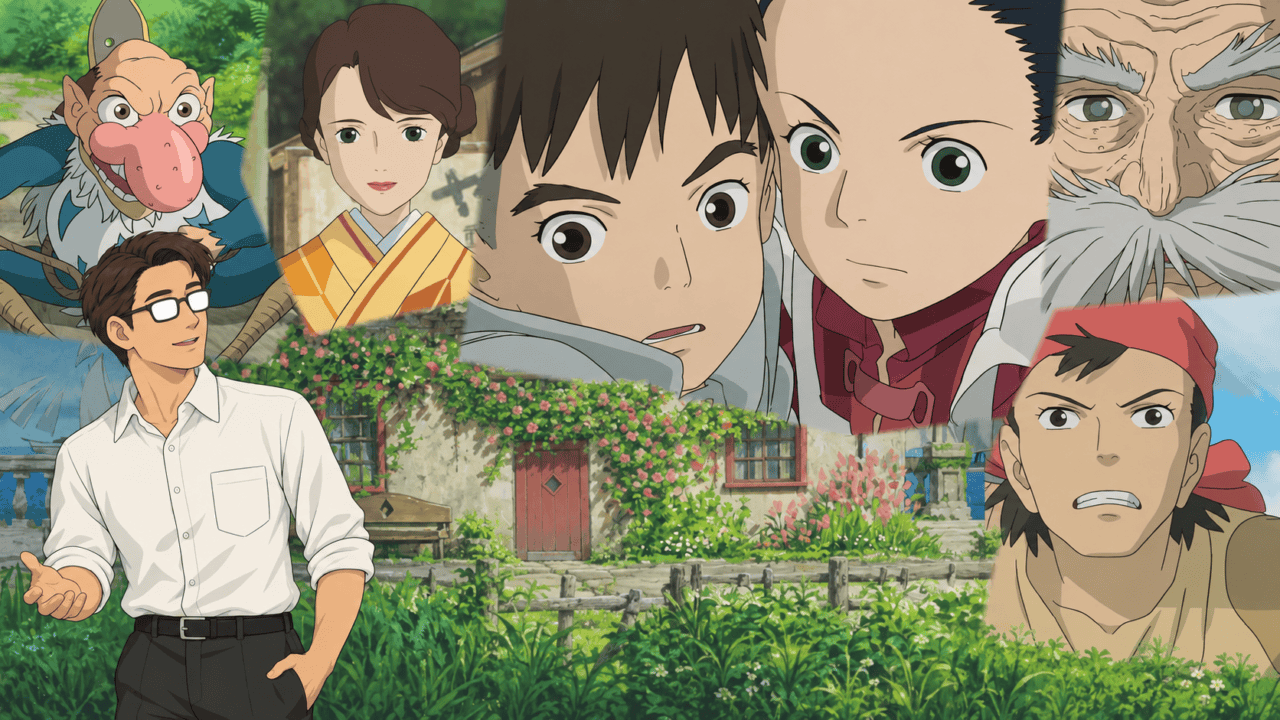
The Boy and the Heron is an autobiographical work whose characters often suggest people in Miyazaki’s life, including Isao Takahata as the Granduncle and, more tentatively, Michiyo Yasuda as Kiriko. Here, I want to look back at the resourceful career of producer Toshio Suzuki, the model for the Gray Heron—or Heron Man. By the end, I hope you will agree that the name suits him rather well.
A Japanese Play on Words: Heron and “Fraud”
There is a Japanese play on words behind this article. The word for “heron” is sagi (サギ).
The same sound, sagi, also means “fraud” (詐欺). That gives us a playful way to read Suzuki’s appearance as the Heron Man (Sagi Otoko): the producer whose bold bluffs helped keep Ghibli going. It is this double meaning I have in mind when I call these his “sagi” stories.
Suzuki has been identified as the model for the Gray Heron in several media accounts, including the production documentary Hayao Miyazaki and the Gray Heron and…(宮崎駿と青サギと…, in Japanese). In an interview in SWITCH Vol.41 No.9 Special Feature: The Adventure Surrounding Ghibli(SWITCH Vol.41 No.9 特集 ジブリをめぐる冒険, in Japanese), he recalls this exchange:
Anyone can see that the Heron Man is me. Once he had drawn him, there was nothing to be done; the question was how to bring it up with Miya-san. I finally said, “Miya-san, the Heron Man is a great character, isn’t he?” When I asked, “Does he have a model?”, Miya-san replied, “No!” The way he said it was something else. “No, no. No model! It isn’t you, Suzuki-san!” That is Hayao Miyazaki for you.
(Original Text in Japanese)
サギ男は誰がどう見たって僕なわけですよ。それでね、描いてしまったものはしょうがない、どうやって宮さんに言うかですよね。もう仕方なく「宮さん、サギ男って良いキャラクターですよね」と言った。「モデルがいるんですか?」と訊ねると「いないよ!」と宮さんは答えた。そのもの言い、すごかったですよ。「いない、いない。いないよ!鈴木さんじゃないよ!」と。これがね、宮崎駿なんです。
The Heron drawing Mahito into the tower brings to mind Suzuki persuading Miyazaki to make a film. We might also see Suzuki protecting Miyazaki the creator from public criticism and those interested only in money in the Heron’s rescue of Mahito from the parakeets—and in the muddy water he gets covered in along the way.
That relationship becomes especially poignant at the end of the film, when the Heron finally calls Mahito “friend.” I look more closely at that farewell—and the slight difference in the English dub—in my analysis of The Boy and the Heron’s memorable quotes.
Running Studio Ghibli and working alongside gifted filmmakers such as Miyazaki and Takahata is no ordinary undertaking. It calls for some extraordinary decisions.
Here, I will introduce some decisions that almost make me want to call them “sagi.” These stories alone may help explain why Suzuki seems so at home as the Heron Man.
*This is a translated version. The original (Japanese) is available here.
-
Toshio Suzuki’s “Sagi” Stories: Ghibli’s History of Bluffs
From claiming that the Nausicaä manga had sold ten times as many copies to keeping quiet about uncolored scenes, printing a false release date on posters, and announcing a title without the director’s consent, we revisit the bluffs Suzuki used to bring films to the screen. -
The Spirited Away DVD’s Red Tint: A Controversy over Color
The red-tinted image on the Spirited Away DVD released in 2002 was officially described as a way of expressing Chihiro’s feelings. No exchange was offered, and the issue led to confusion among viewers and litigation.
On this pageContents
Toshio Suzuki’s “Sagi” Stories: The Man Behind the Gray Heron
Stories about production and collaboration offer another context for the Heron Man. The discussion connects those stories with the roles people have played in Ghibli’s history.
The Nausicaä Bluff: 500,000 Copies Instead of 50,000
After graduating from university in 1972, Toshio Suzuki joined Tokuma Shoten, initially working on Weekly Asahi Geino. In the spring of 1978, he became closely involved in launching the animation magazine Animage.
He approached Isao Takahata for an interview about The Little Norse Prince (1968). Takahata spent an hour on the phone explaining why he would not do it; Miyazaki then took over and spent another thirty minutes turning him down. An exhausting introduction, certainly, but it was their fateful first encounter.
Through later interviews for Lupin the 3rd: The Castle of Cagliostro and Chie the Brat, Suzuki grew closer to both Miyazaki and Takahata.
“If You Don’t Have an Original Story, Draw One”
At the urging of Tokuma Shoten president Yasuyoshi Tokuma, Suzuki consulted Miyazaki and proposed a film called “Sengoku Majo” (Warring States Demon Castle) in 1981. Unfortunately, the proposal was rejected.
The reason was that it “had no source material.” At the planning meeting, someone from Daiei, a film company in the Tokuma group, said, “A film without source material could never be a hit.” When Suzuki passed this on to Miyazaki, the response was, “Then let’s draw the source material ourselves.” Work began on the manga Nausicaä of the Valley of the Wind, serialized in Animage.
This is remarkable in itself. I would probably have looked for something to adapt rather than created it myself. The important decision was to make what did not yet exist—though perhaps Miyazaki simply wanted to draw a manga, too.
The 10x Lie That Secured the Movie Deal
That was the beginning of the “why don’t we just make the source material?” strategy. But having the Nausicaä manga was not enough. Anyone thinking about the commercial prospects of a film would naturally ask how popular that manga was.
In his book Shigoto Doraku, Suzuki recalls:
When the idea of making “Nausicaä” into a film came up, Hakuhodo asked how many copies of the manga were in circulation. The actual figure was fifty thousand, but after a moment’s hesitation, I said, “Five hundred thousand.” It crossed my mind that fifty thousand might make them reluctant to finance the film. I plainly fudged the numbers, and a lie like that stays with you.
(Original Text in Japanese)
『ナウシカ』の映画化案が浮上したとき、博報堂から原作本の部数を聞かれた。実際は五万部だったんですが、一瞬逡巡して「五〇万部」と言ったんです。五万部では映画化を渋るかもしれないという考えが頭をよぎったんです。はっきり数字を誤魔わしてますから、こういう嘘はあとに残る。
We did, in the end, get to see Nausicaä of the Valley of the Wind. In that sense, Suzuki’s lie did us as filmgoers a considerable favor.
Nausicaä was also a commercial success. According to Ghibli no Nakamatachi(ジブリの仲間たち, in Japanese), its distribution revenue was 740 million yen: the box-office takings after the cinemas’ share had been deducted.
A substantial sum consequently came Miyazaki’s way, and Suzuki had a hand in that too. In Ghibli Textbook 2: Castle in the Sky(ジブリの教科書2 天空の城ラピュタ, in Japanese), he explains:
When we made “Nausicaä,” I had drawn up the contract so that the director, Hayao Miyazaki, would receive a share of the profits, including the box-office revenue.
~Omitted (Discussion about “work for hire (wiki)”)~
Coming from publishing, I had respect for creative works and wanted to protect them. I also knew how the people who made them were treated. So I did a little research and arranged for the director to have his own copyright on this occasion.
(Original Text in Japanese)
じつは『ナウシカ』を作る時、僕は宮崎駿という監督に映画の興行収入その他のものも含めて利益配分があるように契約書を作っておいた。~中略(「職務著作(wiki)」の話がなされてる)~
僕は出版社の人間だったので直鎖物に対する敬意がありそれは守りたかった。作った人がどういう扱いをされているかも知っていたので、ちょっと勉強して、この機会に監督個人の著作権を発生させることにしてあったんです。
This money would cause Miyazaki considerable trouble, but it would also lead to his next masterpiece: Castle in the Sky.
Out of Money? Make Another Film—Miyazaki’s Endless Loop
Miyazaki decided to put his unexpected earnings from Nausicaä into The Story of Yanagawa’s Canals.
Directed by Takahata, the live-action documentary follows the decline of the canals in Yanagawa, Fukuoka, and the local residents’ determined efforts to restore them.
But the money earned from Nausicaä ran out as production stretched on (Reference: The Story of Yanagawa’s Canals | Ji-Movie! Film Information, in Japanese).
Miyazaki went to Suzuki for advice. In Ghibli Textbook 2, Suzuki recalls the conversation:
Miya-san came to me seeking advice.
“I have put time and money into it, but it still isn’t finished. My house is falling apart, but I don’t want to mortgage it just to make a film. Suzuki-san, can you think of anything?”
I answered him immediately.
“It will be hard, but why don’t we make another film? That should get us through.”
(Original Text in Japanese)
宮さんが僕のところに相談に来ました。「時間もお金も費やしたけどどまだできない。僕の家はボロ家だけれど、家を抵当に入れてまで映画を作ろうとは思わない。鈴木さん、なにか知恵はないものだろうか。」
僕は即答しました。
大変だけどもう一本映画を作りませんか。そうすりゃなんとかなりますから。
In the same account, Suzuki says, “Right there, in just five minutes, he told me the whole story of Castle in the Sky.”
The question is, “Why would making another film solve the problem?” Yet this peculiar situation is hardly confined to filmmaking.
When money is raised to do something, it rarely seems to produce an immediate surplus. Instead, the resulting deficit gets covered by money raised for another venture.
“Robbing Peter to pay Paul” makes it sound bad, but that is how businesses expand. You cannot keep expanding and turn a profit every step of the way… can you?
So I would not call Suzuki’s advice fraud. Still, in leading Miyazaki into an endless filmmaking hell, he does seem to earn the name “sagi.” Doesn’t the Gray Heron drawing Mahito toward the “Granduncle’s tower” in The Boy and the Heron bring to mind Suzuki asking Miyazaki, “Why don’t we make another film?”
Unfinished or Artistic Choice? The Uncolored Scenes in Grave of the Fireflies
A few years later, Studio Ghibli had been established and Castle in the Sky released. Work was under way on My Neighbor Totoro and Grave of the Fireflies.
But work on Grave of the Fireflies was progressing slowly. Eventually, Takahata’s request to release it with two scenes still uncolored was accepted. In Ghibli Textbook 4: Grave of the Fireflies(ジブリの教科書 4 火垂るの墓, in Japanese), Suzuki explains:
When it was released in April 1988, two sections had not been colored in time and remained white. As one of those involved, I naturally felt ashamed, but I never publicly said that it was unfinished. Some people said, “You should explain it properly,” but the more you explain, the more complicated it gets. So I resolved that “at a time like this, it is best to keep quiet.”
(Original Text in Japanese)
結局、一九八八年四月に公開さた時点では、二か所の色塗りが間に合わず、シロのままになりました。関係者の一人として、もちろん忸怩たるものがありましたが、表向きにはこれが未完成品であるということは一切、言いませんでした。「ちゃんと言うべきだ」という人もいましたが、説明すれば説明するほど話がややこしくなるから、「こういう時はだまってりゃいいんだ」と腹を括っていました。
The uncolored scene showed Seita stealing tomatoes. Apparently, many viewers took its appearance as an artistic choice, so Suzuki’s strategy of saying nothing seems to have worked: they did not realize it was unfinished.
Not explaining this was unfair to the audience. Yet the result seems to have preserved their satisfaction with the film—or perhaps even increased it.
“Even dishonesty has its uses,” I suppose. Business is a difficult thing.
Before the decision to release those scenes uncolored, the exchanges between Takahata, producer Toru Hara, and Suzuki were fierce. Takahata insisted that the release be postponed. The book describes these confrontations in detail. His uncompromising commitment to quality would continue to give the producers working with him a hard time.
A Poster Made Just to Fool Takahata: Protecting the Release Date
As we have seen, Grave of the Fireflies fell far behind schedule. Takahata’s next film, Only Yesterday, would fall behind too.
With the experience of Fireflies behind them, Miyazaki, serving as producer, gathered the staff, including Takahata, and declared: “If this film is not ready for its release date, we will shelve it. We will never screen it in an incomplete form.” This speech helped them finish Only Yesterday in time. (Reference: Nozomu Takahashi talks about ‘the greatness of Toshio Suzuki’ and ‘the bond between Takahata and Miyazaki’, in Japanese)
Anticipating similar delays on Pom Poko, Suzuki took action in advance. He describes his approach in Ghibli Textbook 8: Pom Poko(ジブリの教科書 8 平成狸合戦ぽんぽこ, in Japanese):
After breaking into a cold sweat on every film over whether we would finish in time, I had finally learned something. This time, I resorted to a little trick. The planned release was summer 1994, but I told Takahata-san, “It is coming out in spring.” To be absolutely sure, I even had posters made with “Spring Release” on them, and asked the people at Toho, our distributor, to go along with it.
(Original Text in Japanese)
毎回、間に合う、間に合わないで冷や汗をかき続けてきて、僕も流石に学習しています。今回はちょっと作を弄しました。公開予定は一九九四年の夏だったんですが、サバを読んで、高畑さんには「春公開です」と伝えておいたのです。しかも、念には念を入れて「春公開」という文字を入れたポスターまで作り、配給の東宝の人たちにも口裏を合わせてもらいました。
When it became clear that they would not meet the false spring deadline, Suzuki told Takahata, “We are postponing it until summer.”
But Takahata being Takahata, that did not settle matters. Work began slipping again, and even the summer release was in doubt.
Perhaps Takahata felt guilty about having already delayed the release once—though, of course, he hadn’t. This time he accepted Suzuki’s proposal to shorten the film by revising the storyboards. Changes to the final section cut ten minutes from its running time, allowing the film to open as planned.
Announcing Princess Mononoke’s Title without Asking: The Lost Ashitaka Sekki
As publicity for Princess Mononoke began, Miyazaki proposed changing the title to Ashitaka Sekki (“The Legend of Ashitaka”). In Japanese, part of “Sekki” was to use a character Miyazaki had invented.
Suzuki could not let go of the impact of the title Princess Mononoke, so he took matters into his own hands. He describes what happened in Shigoto Doraku(仕事道楽, in Japanese):
We still disagreed, but I settled it by taking action. Miyazaki shows no interest in teasers or trailers, so when the first teaser aired on Nippon TV, I put the title Princess Mononoke on it.
(Original Text in Japanese)
意見が対立したままだったんですが、ここでぼくは、実力行使で解決しちゃいました。彼は特報とか予告編とかにまったく興味を示しませんから、日本テレビで特報第一弾というとき、「もののけ姫」のタイトルを出しちゃったんです。
How did Miyazaki react? Rather less dramatically than one might expect. He asked, “Did you put the title out?” Suzuki said, “I did,” and Miyazaki went back to his desk looking exasperated.
It was a decidedly forceful move. But with Princess Mononoke going on to earn 19.3 billion yen at the box office, I suppose Suzuki’s judgment turned out to be right.
The Unused “Godfather” Credit in Tales from Earthsea
Tales from Earthsea was directed by Miyazaki’s eldest son, Goro. I remember the considerable attention it attracted for that reason, and I was very interested myself. Suzuki had chosen Goro from outside the animation world; as a way of generating interest, that was certainly enough.
Suzuki’s publicity policy was not to use Hayao Miyazaki’s name to sell the film. But in The World’s Earliest Tales from Earthsea Interview, in Japanese, he says this about the end credits:
I am struggling with it. In desperation, I have thought up some odd ideas, like “Father: Hayao Miyazaki” (laughs). There is no point in giving him a plausible-sounding credit like “Advisor,” is there? If I had to offer one more possibility, it would be “Godfather: Hayao Miyazaki.”
(Original Text in Japanese)
悩んでいます。苦し紛れに珍案奇案も考えました。「父 宮崎駿」とか(笑)。だって「アドバイザー」とかもっともらしいこと言っても仕方ないでしょう。あえてもう一つ候補があるとすれば「ゴッドファーザー 宮崎駿」。
The idea was not used, but simply thinking of it strikes me as very much in character for Suzuki the Heron Man.
Those are some of the Toshio Suzuki “sagi” stories that I find entertaining. I seem to remember a few more minor ones, and there are probably many that have never been told publicly.
I can present them as amusing stories because I see Suzuki from a distance. Some people who have worked closer to him have expressed intense dislike. Animation director Hiroyuki Kitakubo, for example, posted this on X (formerly Twitter):
俺が鈴木敏夫を嫌いな理由はシンプルな二点。「他人の権威を傘にきて、人を見下して底の浅い説教モードに入る」事と「スタッフもお客さんも含め、その場を取り繕う為なら平気で嘘を吐く」事だなぁ。前者はまだ我慢する事も出来るけど、後者は救いようが無い。
— 佐倉 大 (北久保弘之) (@LawofGreen) September 15, 2012
There are two simple reasons I dislike Toshio Suzuki. First, he uses other people’s authority as a shield to look down on people and lecture them with shallow arguments. Second, he has no qualms about lying to smooth things over in the moment, whether to the staff or to the audience. I can still put up with the first, but the second is beyond help.
From a distance, we can simply enjoy the results of Suzuki’s work. Those closer to him presumably have all sorts of feelings about it.
There was, however, one occasion when I could no longer claim to be at a safe distance. I was affected myself. Let me finish with that memory.
The Spirited Away DVD Controversy: That Summer, You Were Red
Miyazaki’s Spirited Away was released in July 2001. The following year, on July 19, 2002, Buena Vista Home Entertainment released the DVD.
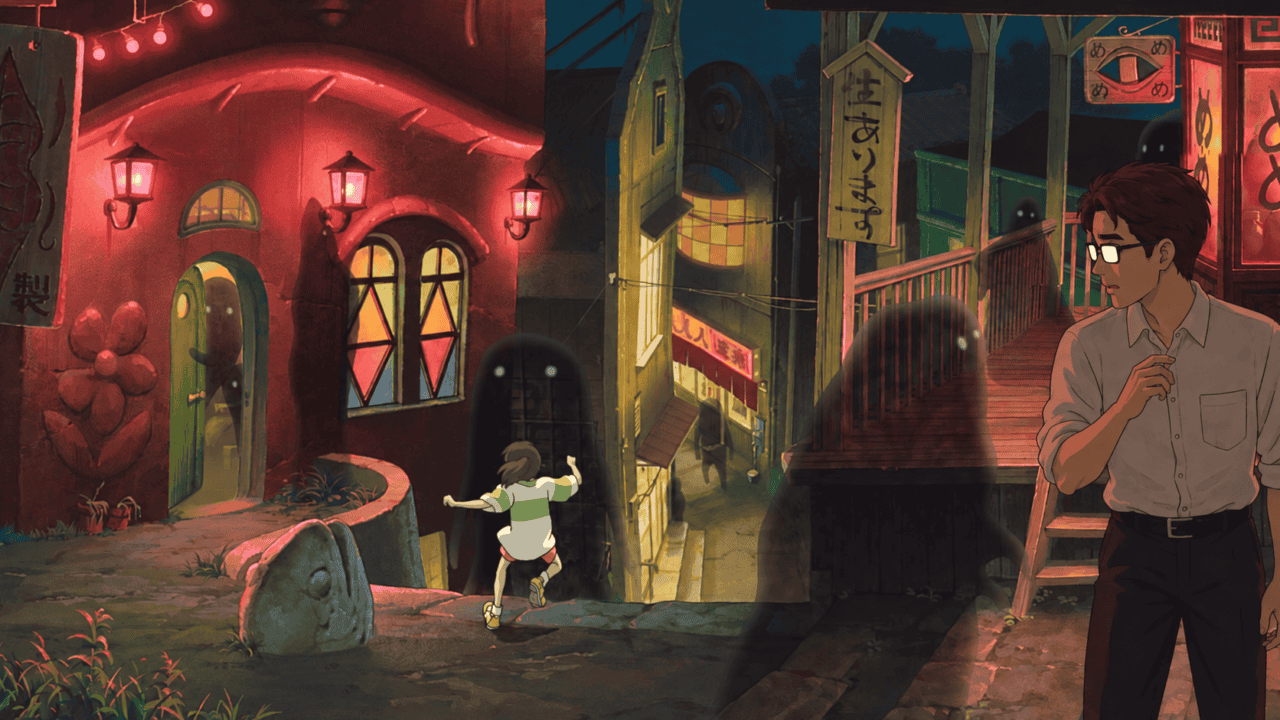
I was a child then. I rented it from TSUTAYA and practically danced my way to the television. But once the film began, something seemed wrong. My brother, watching beside me, put our unease into words:
“…It’s red, isn’t it?”
The image on that DVD really did have a red tint, and the issue even led to litigation. This blog post gives a detailed but concise account of what happened: The Mystery of the Red Spirited Away DVD (in Japanese).
Unaware of all that, my brother and I came to a much simpler conclusion: “It is probably because we are watching it on the PS2.”
We had a PlayStation 2, released in 2000, which served as a DVD player even more than as a games console. Perhaps other households were much the same. Since dedicated DVD players existed, we convinced ourselves that this was what happened when you watched a film using what was essentially an extra feature on a games machine.
Suzuki gave his official explanation in an interview in the November 2002 issue of HiVi, published in October. In short, the answer was: “It is by design.”
His explanation was that the red tint was intentional, not a mistake, and that there was no problem with the product. He said they had “deliberately changed the colors to express Chihiro’s feelings.”
Yet I cannot see how that settles the problem. If it was intentional, they should have made a point of telling us beforehand. If it was really a mistake, they should have said so.
Of course, admitting a mistake would raise the issue of exchanges, returns, and refunds, which they would understandably want to avoid. Whatever the truth, I suspect Suzuki had little room to take any position other than “It is by design.” Reportedly, the version shown on Kinyo Roadshow was red-tinted too—as though to demonstrate that this really was the intended look.
Kitakubo, whose earlier post I quoted above, also commented on this issue on X:
その一手間をキチンとやらなかったせいで、何でお金を払ってDVDを買ったお客さんが「色が赤い」状態で我慢しなきゃならんのか。「◯◯ケルビンが〜」とか元データの数値を拾うだけで「映画と同じ発色になる」訳ないじゃんか。で、鈴木敏夫氏はあちこちで専門知識が無い言い訳をするのだが(続く
— 佐倉 大 (北久保弘之) (@LawofGreen) May 2, 2015
Why should customers who paid for the DVD have to put up with a red-tinted image just because that extra step was not done properly? Simply taking figures such as “XX Kelvin” from the source data will not make the colors look the same as they did in the cinema. Yet Toshio Suzuki keeps offering excuses that reveal his lack of technical knowledge (continued).
As an expert’s opinion, that is more persuasive than our own guesses. Even so, the truth remains unclear.
The incident is now an event from the distant past of 2002, absorbed into our memories. It has even acquired a strange sort of pride: “I saw the red Chihiro that summer!”
Perhaps that is partly because I was a child with little sense of myself as a consumer. Still, “everything loses its subjective charge and becomes a classic in the distance of history.”
Later Blu-ray and DVD editions of Spirited Away no longer have that red tint.
There was also an exchange program for the UHD Blu-ray of The Boy and the Heron: Apology and Notice Regarding a 4K UHD Dolby Vision Video Defect (in Japanese).
The reason given was an error in the data needed to play the Dolby Vision image correctly in different viewing environments. Unlike the red tint on the 2002 DVD, perhaps it was something many viewers would never have noticed if no one had mentioned it. This time, though, an exchange was properly offered. I had my copy replaced too.
Your Take
What is your view? Choose the answer that comes closest to your own response.
Poll results
Does knowing the production background change how you see the Heron Man?
- Yes, it adds another layer to him.0%
- It is interesting, but I keep it separate from the story.0%
- It makes little difference to me.0%
- I’m not sure.0%
The images used in this article are provided by the “Studio Ghibli Still Images” collection.
Can you name the movie before the scene comes into focus?
Put your visual memory to the test with a blurred Studio Ghibli scene.
Reader Comments
Have a thought or interpretation? Leave a comment