
Godzilla Minus One opened in Japan on November 3, 2023. Takashi Yamazaki wrote and directed the film, which grossed ¥7.65 billion in Japan according to the Motion Picture Producers Association of Japan’s 2023 box-office report.
The film was well received from the start and went on to find an audience around the world. At the 96th Academy Awards, it became the first Asian film to win the Oscar for Visual Effects.
I love Operation Wadatsumi, the plan they put into action at the end. This film also gave me a lot to think about, which puts it high on my list of Godzilla movies. The 1954 original is still my favorite. Second place depends on what I’m judging, so let’s just say this one ranks high.
I’ll go through the story and what makes it work, including the two details many of us were still thinking about when the film ended. What are the Godzilla cells on Noriko’s neck doing there? And what are we supposed to make of Godzilla’s body stirring underwater?
*This is a translated version. The original (Japanese) is available here.
On this pageContents
Godzilla Minus One Plot Summary Without Spoilers
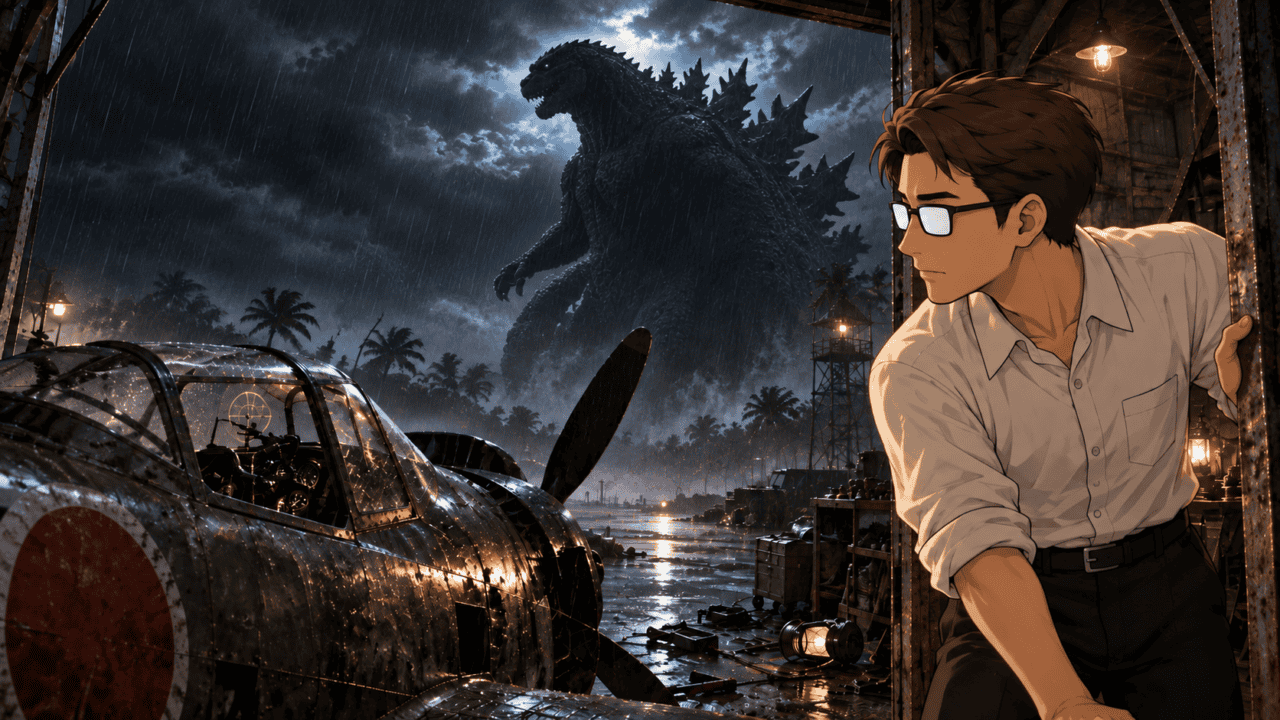
It’s 1945, near the end of the war. Kōichi Shikishima, a kamikaze pilot, abandons his mission and lands at the garrison on Odo Island. That night, a giant creature called Godzilla attacks. Shikishima is too frightened to fire his Zero’s guns. He and a mechanic named Tachibana are the only survivors.
Back in the ruins of Tokyo, Shikishima meets Noriko Ōishi, who lost her family in an air raid, and Akiko, the baby she is raising. The three make an unlikely household. Shikishima takes a dangerous job clearing sea mines, and their life begins to take on a semblance of normality.
Then nuclear testing at Bikini Atoll causes Godzilla to mutate and grow. The creature returns to Japan and lays waste to Ginza. Noriko vanishes in the blast.
Feeling he has lost everything, Shikishima vows revenge. He signs on as a pilot for Operation Wadatsumi, a civilian plan devised by former weapons engineer Kenji Noda. Japan has already lost the war, and Godzilla has pushed it below zero. Now Shikishima puts his life on the line to stop it.
Godzilla Minus One Plot Summary With Spoilers
Shikishima survives the war carrying the memory of the night on Odo Island when he froze and the garrison died. He starts a life with Noriko and Akiko, then watches Noriko disappear when Godzilla attacks Ginza. He flies his Shinden straight at Godzilla during Operation Wadatsumi. The ejection seat Tachibana prepared gives the former kamikaze pilot a way to come back alive.
The Main Events
- The war and the first Godzilla attack
In 1945, kamikaze pilot Kōichi Shikishima lands on Odo Island. He hesitates when Godzilla attacks, and the garrison is wiped out. The incident is covered up. Back in the ruins of Tokyo, Shikishima carries the guilt with him. - Noriko, Akiko, and a home of their own
After losing her family in an air raid, Noriko Ōishi takes in a baby named Akiko, entrusted to her by a stranger. She and Shikishima start living together, and he supports them by clearing sea mines. - Godzilla destroys Ginza
Nuclear tests at Bikini Atoll in 1946 cause Godzilla to grow. The government keeps the approaching danger quiet. Godzilla comes ashore in Tokyo, and Shikishima tries to get Noriko to safety. The blast sweeps her away. - Operation Wadatsumi
The civilian team drives Godzilla down into deep water and then brings it rapidly back to the surface. When the pressure changes fail to kill it, Shikishima flies his Shinden into Godzilla’s mouth, destroying its head. - Two survivors and an unsettling last shot
Shikishima ejects, and Noriko turns up alive. There’s a black mark on her neck, and Godzilla’s sunken body is still moving.
Character Map
Shikishima’s life with Noriko and Akiko and his history with Tachibana both shape his part in Operation Wadatsumi. The map also shows how the crew of the Shinsei Maru connects his postwar job to the plan against Godzilla.
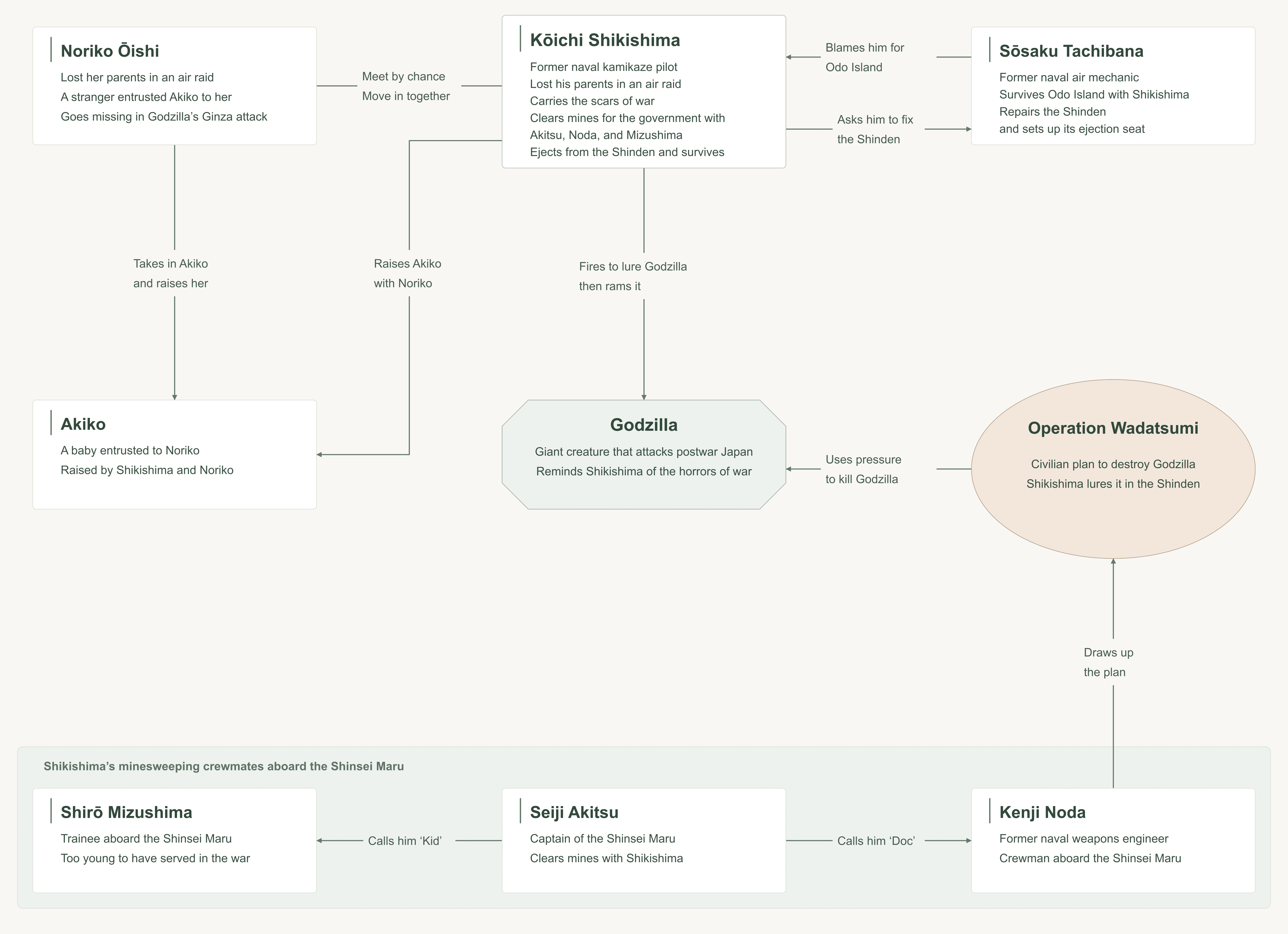
Here’s how those relationships develop over the course of the film.
The Full Story
Odo Island
In 1945, as the war draws to a close, Kōichi Shikishima lands his Zero at the garrison on Odo Island. He claims the plane has developed a fault. The ground crew sees through him immediately. Sōsaku Tachibana, one of the mechanics, lets Shikishima know he knows.
That night, Godzilla, a creature long spoken of on the island, attacks the garrison. The men stay quiet and watch until Tachibana suggests that Shikishima use the Zero’s guns. Shikishima climbs into the plane. He’s too terrified to pull the trigger.
One of the mechanics can’t stand it any longer and shoots at Godzilla. The creature goes berserk and wipes out the garrison. Only Shikishima and Tachibana survive. Tachibana lays into him for failing to fire, and the accusation lodges in Shikishima just as firmly as the memory of that night. The deaths are put down to a military operation, keeping Godzilla’s existence out of the record.
An Unlikely Household
Shikishima returns to Tokyo in the winter of 1945 and learns that his parents are dead. With his house gone too, he lives hand to mouth among the ruins.
He meets a woman who introduces herself as Noriko Ōishi. She also lost her parents in an air raid, during which a stranger entrusted her with a baby named Akiko. Shikishima and Noriko start living together to raise Akiko, close enough to share a household and still unsure what they are to each other.
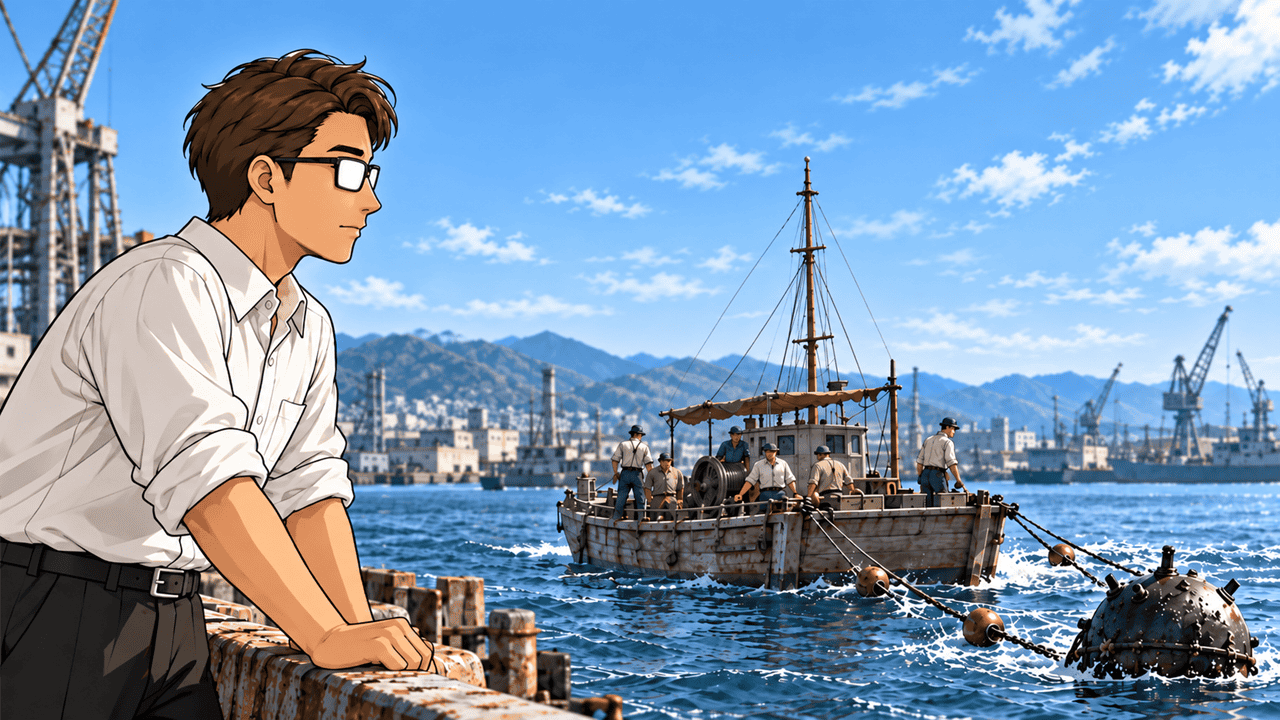
To support the household, Shikishima takes a job clearing mines. It pays well because it’s dangerous. On the minesweeper he meets Captain Seiji Akitsu, trainee crewman Shirō Mizushima, and Kenji Noda, a former naval technical officer who developed weapons during the war. Akitsu calls Noda “Doc.”
The minesweeping pay lets Shikishima build a tidy little house, barely bigger than a shack. The country is still in turmoil, but he and Noriko are getting their daily lives back.
Godzilla Returns
In the summer of 1946, the U.S. military conducts nuclear tests at Bikini Atoll. Exposed to the blasts, Godzilla mutates and grows to more than 50 meters.
In May 1947, the Americans learn that a huge creature is headed toward Japan. With tensions rising between the United States and the Soviet Union, the U.S. is reluctant to operate near Japan, leaving Japan to respond on its own.
Japan has almost no military force to speak of. Shikishima and his crewmates head out in their minesweeper with two mines and a machine gun mounted at the stern. Then Godzilla appears. It destroys the other minesweeper in an instant, and Shikishima’s crew decides to pull back.
The first mine leaves Godzilla’s skin unmarked, so Noda decides to detonate the second inside its body. The plan works, and Godzilla is badly wounded. Its wound closes almost at once, and it comes at them again.
The heavy cruiser Takao, which has returned from Singapore to face Godzilla, hits the creature with its guns. For a moment the crew thinks the cruiser can finish the job. Godzilla sinks it with its heat ray, then slips underwater, spent.
The Attack on Ginza
Shikishima and the others know they’ve encountered a threat on a scale they’ve never seen. The authorities keep the creature’s approach from the public, ostensibly to prevent panic.
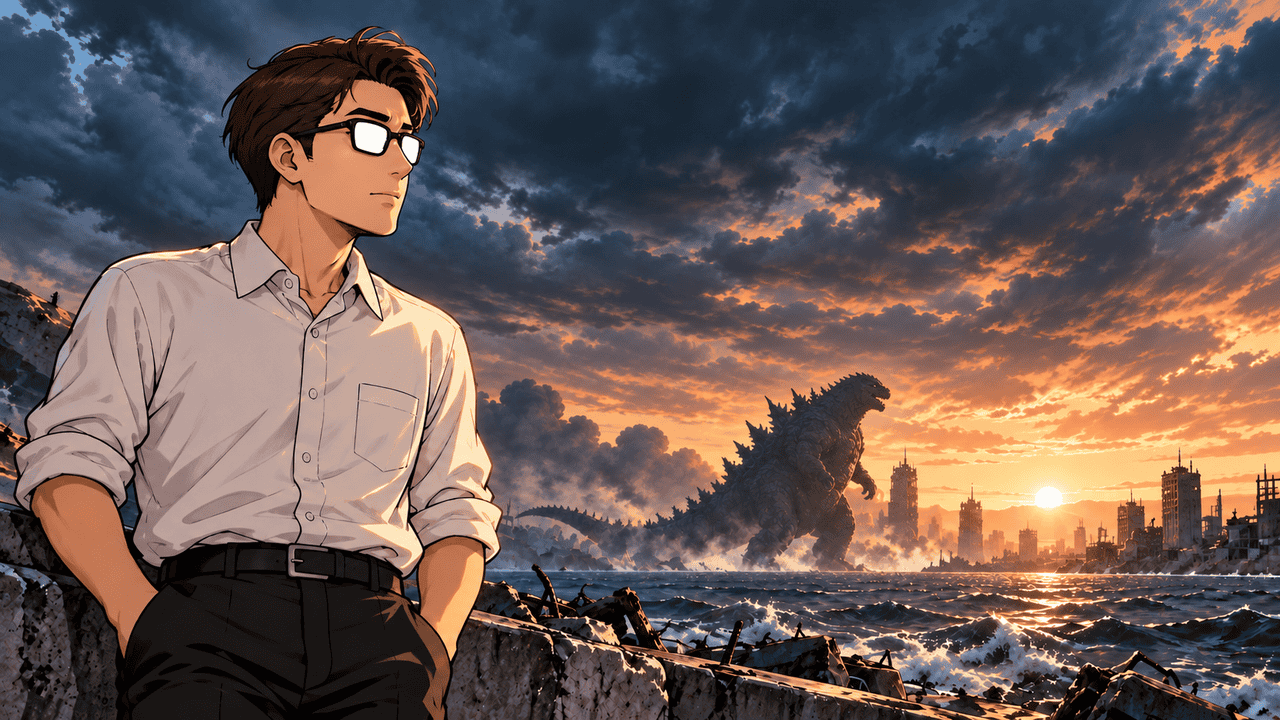
Godzilla comes ashore in Tokyo and heads toward Ginza. Shikishima goes after Noriko, who has started working there as a clerk. The Japanese government tries to fight back with the few forces it has. Godzilla’s heat ray wipes them out, and the shock wave sweeps Noriko and the fleeing crowds away.
Godzilla returns to the sea. The attack leaves some 30,000 people dead or injured. Shikishima never finds Noriko’s body. He holds a funeral for her anyway.
Operation Wadatsumi
After the losses in Ginza, civilians put together a plan to stop Godzilla. Noda has devised it himself. As soon as Noda tells him about it, Shikishima decides to take part.
Operation Wadatsumi calls for sinking Godzilla rapidly to a depth of 1,500 meters in Sagami Bay. The pressure would do the work, with a rapid ascent and the sudden drop in pressure as the fallback if the descent failed to kill it.
First they have to lure Godzilla to the trap. Noda proposes playing the roar recorded during the land attack through underwater speakers. Shikishima wants a way to bring Godzilla back if it comes ashore again. He offers to draw it out by firing at it from a plane. After what he saw on Odo Island, he’s sure it will come after him.
Through his contacts, Noda tracks down a Shinden interceptor, developed late in the war to defend the Japanese mainland. They need an excellent mechanic to make it fly. Shikishima contacts Tachibana, the ground crewman who survived Odo Island with him.
Tachibana makes his contempt for Shikishima plain when they meet again. Faced with Godzilla, he agrees to put the Shinden back in flying order. The plan is ready.
The Battle in Sagami Bay
Noda’s team spots Godzilla approaching Japan and uses the recorded roar to lure it to Sagami Bay. Godzilla moves faster than expected and comes ashore again. Shikishima draws it back out to sea.
His flying keeps Godzilla where the team needs it. They manage the rapid descent and ascent at the heart of the plan. The pressure changes injure Godzilla, but it survives. As the people taking part lose hope, Shikishima flies the Shinden straight at the creature.
He had anticipated this and asked Tachibana to load the plane with explosives for a suicide attack. The Shinden plunges into Godzilla’s mouth. Its head is blown apart. Operation Wadatsumi has succeeded.
Alive
Shikishima survives. He’d only told Tachibana about his plan to fly into Godzilla, but Tachibana had also set up the ejection seat and made sure it worked. In the end, the man who had hated Shikishima wanted him to live.
More good news follows. Noriko, whom everyone thought had died in the attack, was found and taken to a hospital. Shikishima and Akiko see her again.
Then we catch sight of a strange black mark on Noriko’s neck. Beneath the sea, Godzilla’s body begins to move.
Godzilla Minus One Analysis
What happens to Shikishima and Noriko worked on me in ways I only recognized afterward. The film teaches us how Godzilla behaves on Odo Island, brings that knowledge back in the last battle, and makes us want these people to come home alive. Then the very last shots make that relief feel complicated.
- Godzilla’s behavior and the film’s setups
Godzilla leaves still targets alone, which helps explain why Shikishima and Tachibana survive Odo Island. The same behavior helps Shikishima lure it in the last battle. Its attack patterns and regeneration give the encounters a logic of their own. - Noriko and the joy of finding someone alive
Noriko’s disappearance gives Shikishima another reason to fight. Learning she is alive makes us feel how much it matters that people survive, even as the mark on her neck raises a new question. - The horror and promise of Godzilla cells
The cells may have kept Noriko alive. That possibility suggests a use for them in regenerative medicine within the story and raises a harder question about where we draw the line between human and monster. - Why Operation Wadatsumi is so satisfying
The plan uses buoyancy and pressure in a way that feels plausible within the film. Given how little postwar Japan has to work with, it’s an especially inventive plan and my favorite attempt to take down Godzilla.
What Odo Island Tells Us About Godzilla
What happens on Odo Island stays with Shikishima and Tachibana and gives both men a reason to face Godzilla again. The scene also shows us something important about the creature itself. Why did either man get out alive?
Shikishima’s success luring Godzilla in the final battle gives us a clue. Godzilla leaves things alone when they stay still.
Shikishima keeps getting blamed for failing to fire. If he had opened up with the Zero’s guns, I suspect Godzilla would have tossed the entire plane aside and killed him. The mechanics might have panicked and shot, and the garrison would have died all the same. I understand why Tachibana is so furious. By staying his hand, Shikishima lived and was there to do something heroic when they finally took Godzilla on.
Godzilla probably hadn’t developed the extraordinary regenerative ability it shows later. Even then, could the Zero’s guns really have killed it? I’m doubtful. The fact that neither man can ever know for certain is part of what keeps that night lodged in both of them.
That’s what makes the opening work so well. It gives the two men their motives, and it shows a pattern in Godzilla’s behavior that the film keeps coming back to.
There’s another clue when the much larger Godzilla sinks the Takao and immediately disappears beneath the surface. One shot leaves it with nothing in the tank. Noda knows that getting through that one shot is the biggest obstacle to Operation Wadatsumi. After it fires, they have a chance. By the time the plan gets underway, an attentive viewer can even work out what the mysterious third ship is there for.
So many little pieces fall into place. It’s a fair film in that sense. The clues are all there.
How Good It Feels to Find Someone Alive
Like the disaster on Odo Island, Noriko’s disappearance does two things. It gives Shikishima a reason to fight. He didn’t die as a kamikaze pilot, he couldn’t fire on Odo Island, and now he’s lost Noriko.
Just before the operation begins, Sumiko, played by Sakura Andō, receives a telegram. We realize that Noriko is alive. And all I could think was, “Shikishima, don’t die.”
That’s why it felt so good to see him eject, and why I was so glad Noriko had made it. The Japanese tagline was “Live and fight back.” What stayed with me was simpler. It feels good when someone you care about is alive.
Noriko’s disappearance pushes Shikishima into the fight, then makes us desperately want him to come back. The film got me completely.
When Noriko shoves Shikishima out of the way, I doubt I was the only person thinking, “Couldn’t you tackle him and save yourself too?”
That shove says a great deal about how she feels about him. It also sets up everything I’ve just described. Even so, the story puts Noriko through something awful. Many people in Godzilla Minus One die because the story needs them to. Even with Noriko alive at the end, I think you could say that the story sacrifices her too.
What Godzilla’s Cells Mean for Noriko
I tend to think a film’s last moments carry something central to what it’s saying. What are we left with here? Noriko is alive, with a dark mark on her neck. The Godzilla we thought had been destroyed is stirring again.
The first time I saw it, my reaction was something like, “Oh, come on.” I think of Godzilla as a force you can’t get rid of. It stands for things outside our control, like earthquakes and typhoons. The 1954 film is the one magnificent exception. I wrote about that idea in my piece on why Godzilla couldn’t be killed in Shin Godzilla.
I’d have been happier at first with the clarity of Shin Godzilla, which tells us plainly that Godzilla couldn’t be killed. I wanted a cleaner ending. After sitting with the film, I changed my mind a little. The ending started to feel as though it was doing more than dangling something in front of us. It came down to the mark on Noriko’s neck.
That mark is made of Godzilla cells. Yamazaki said as much at Godzilla Fest Osaka. IGN Japan and Netflix Tudum reported his remarks.
What does the film gain from showing it? My first answer was that Godzilla’s cells took hold in Noriko’s body and kept her alive. That was what interested me more than the possibility of a sequel.
Update, November 2, 2024. Another Godzilla film by Yamazaki is in the works. At the time of this note, we don’t know whether it’s a sequel, but the last scene may end up setting one up after all.
Didn’t you wonder whether Shikishima searched for her? I imagine he looked everywhere. He found nothing, and that’s why he held a funeral.
Perhaps the blast threw her an almost unbelievable distance. Or perhaps her injuries left her unrecognizable. Either way, I imagine her body was badly damaged. Yet there she is, alive in the last scene. After seeing how fast Godzilla heals earlier in the film, I can imagine those cells making the difference.
That’s body horror. It also opens up another possibility. What if the cells could give people hope for regenerative medicine? Once you think of them that way, the last shot underwater changes too. I could see the mass regenerating as a vast new supply of cells that people could study.
Godzilla has always been a source of dangerous radiation, including in this film. I wonder if the ending asks us to look at something we’ve learned to fear and consider what else it could be.
Imagine what happens after the credits. The mark is plain to see. Sooner or later, someone will realize what Noriko is carrying. What would you do when that happened?
That’s where I think the film’s question lies. What does life mean to you?
The whole film has been pleading with its characters to live. Its tagline tells them to live and fight back. That moved me. Then we find ourselves rejoicing that someone is alive who, by the end, may no longer fit our definition of human. And she’s bound to the very creature we’ve spent the film fearing.
Can you still see Noriko as human after Godzilla’s cells have taken hold in her?
That, to me, is the question the film has kept hidden until the end.
In Godzilla Minus Zero, the cells that kept Noriko alive change the lives of all three of them again. I wrote about the choices they make in the sequel in my piece on why Murakami takes Akiko at the end.
My Second-Scariest Godzilla and My Favorite Plan
After all that, the most important thing about Godzilla Minus One is how frightening it is.
When Godzilla turns up in a country that’s just lost a war, I had one immediate thought. “Oh, we’re done for.” There have been plenty of Godzilla films since the original, and some part of me usually assumes they’ll figure something out. Here Godzilla arrives at full strength just after the war. I’m sure I wasn’t the only one who spent the film wondering how on earth they were going to stop it.
Yamazaki’s answer was buoyancy. In the film the plan falls short. I’d have been satisfied if it had worked and the battle ended there.
Unfortunately, the plan wouldn’t work in the real ocean, as this video explains. The physical idea they seized on was still inspired. I hadn’t seen a Godzilla film try anything quite like it.
It’s my favorite plan anyone has ever come up with to take down Godzilla.
Poll results
What did you feel most strongly when the film showed the black mark on Noriko’s neck?
- I was glad she was alive, and then the mark unsettled me.0%
- I felt hopeful that whatever caused the mark might have kept her alive.0%
- Whatever was happening, I was just glad Noriko had come back.0%
- I wondered what the mark was setting up for the story to come.0%
- I felt several of these things at once.0%
- I had a different reaction.0%
Shikishima’s minesweeping job really existed in postwar Japan. The fighting had ended, but mines were still in the water, and some demobilized servicemen made a living doing the dangerous work of clearing them. See the real minesweeping jobs of 1946.
My relief at seeing Shikishima come back alive also makes me wish Serizawa had come back in the original film. Comparing the original, Shin Godzilla, and Minus One brings out the differences in how each story ends for the people carrying that burden. See the return Serizawa was denied.
Godzilla Minus One Cast and Crew
The credits below cover the lead actors, the Odo Island ground crew, the sailors and veterans, and the people behind the film’s look and sound. Takashi Yamazaki directed, wrote, and supervised the visual effects.
| Director | Takashi Yamazaki |
|---|---|
| Screenwriter | Takashi Yamazaki |
| Visual effects | Takashi Yamazaki |
| Music | Naoki Satō, Akira Ifukube |
| Visual effects production | Shirogumi |
| Sound effects | Natsuko Inoue |
| Kōichi Shikishima | Ryūnosuke Kamiki |
|---|---|
| Noriko Ōishi | Minami Hamabe |
| Shirō Mizushima | Yūki Yamada |
| Kenji Noda | Hidetaka Yoshioka |
| Sōsaku Tachibana | Munetaka Aoki |
| Sumiko Ōta | Sakura Andō |
| Seiji Akitsu | Kuranosuke Sasaki |
| Akiko | Sae Nagatani |
| Tatsuo Hotta | Miō Tanaka |
| Tadamasa Saitō | Yūya Endō |
| Akio Itagaki | Kisuke Iida |
| Announcer Tokuda | Kunihiro Suda |
| Veteran Taniguchi | Shōta Taniguchi |
| Veteran Wanibuchi | 鰐渕将市 |
| Mechanic Tomita | Tsutomu Osabe |
| Mechanic Hiraoka | Yūji Komatsu |
| Mechanic Eijirō Inagaki | Yōsuke Minokawa |
| Mechanic Sadakichi Kajiki | Chitarō Kusakabe |
| Mechanic Tani | Yūya Ōshima |
| Mechanic Shigeharu Yamagata | 赤妻洋貴 |
| Boat captain | Takumi Matsui |
| Train driver | Seitarō Chiba |
| Train conductor | Itsuki Oguma |
| Takao crew member | 持永雄恵 |
| Takao crew member | Daiki Ichikawa |
| Veteran | Ryūta Dobashi |
| Fujita, Yukikaze navigation officer | Keisuke Fujita |
| Veteran Wakabayashi | Yūta Wakabayashi |
| Karita | Yūsuke Karita |
| Veteran Matsumoto | Makoto Matsumoto |
| Toyo Balloon employee | Atomu Itō |
| Tachibana’s assistant | Shōhei Abe |
| Aircraft mechanic | 嶋田彥 |
| Captain of the Fujimaru | 俵木藤汰 |
| Captain of the Yukaze | 原田悅嗣 |
| Captain of the Keyaki | 仲城煎時 |

Reader Comments
Have a thought or interpretation? Leave a comment