
Godzilla Minus Zero, directed by Takashi Yamazaki, opened in Japanese theaters on November 3, 2026. It is the sequel to Godzilla Minus One.
The sequel continues the story of Shikishima, Noriko, and Akiko and introduces Professor Murakami. After losing his wife and grandchild in Hiroshima, Murakami has been looking for a way to use Godzilla’s power to take revenge on America. The man who lost his family and the people whose life together is again under threat end up involved in the same operation.
How does Murakami’s revenge connect with the choice Shikishima and Noriko make at the end? The relationship between Murakami and Godzilla helps explain why the two decide to take Akiko with them.
This article discusses the endings of Godzilla Minus Zero, Godzilla Minus One, and the original Godzilla (1954). If you haven’t seen the new film, you can start with my spoiler-free review of Godzilla Minus Zero.
*This is a translated version. The original (Japanese) is available here.
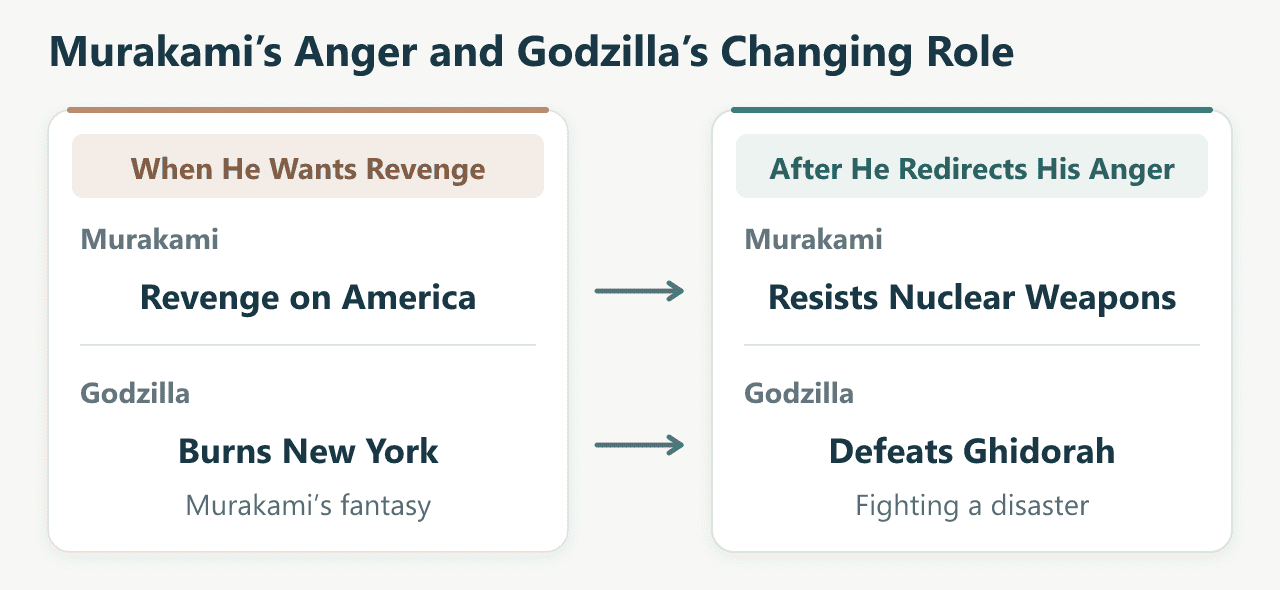
- Murakami’s revenge. By redirecting his anger at America toward nuclear weapons themselves, Murakami stops punishing himself for surviving and allows himself to want a future.
- Godzilla’s changing role. Murakami’s change of heart is reflected in Godzilla’s fight with Ghidorah, who embodies disaster. Once Godzilla feels like someone we can count on to win, he loses some of what makes him frightening.
- The family’s choice. Shikishima and Noriko hold on to the family life Murakami lost. Taking Akiko with them shows that, whatever they face, they will never become Godzilla.
On this pageContents
A Brief Plot Summary Through the Ending
Professor Murakami has been studying a chrysalis that arrived from space. When Ghidorah hatches and attacks Matsumoto, he survives and brings his findings to Noda. “I survived again,” he says. Murakami lost his wife and grandchild in the atomic bombing of Hiroshima. Ever since witnessing Godzilla’s power in Ginza two years earlier, he has thought about using it to take revenge on America.
With fighter planes and other supplies from the U.S. military, Noda and his team launch Operation Narukami to eliminate Ghidorah. The operation fails. Ghidorah eventually evolves into the three-headed King Ghidorah, and Godzilla reappears.
As Noda and the others run out of options, Murakami proposes pitting Godzilla against King Ghidorah so that humans can defeat the weakened winner. He plans to draw Godzilla in with a resonance amplifier he built. For that, he needs Noriko, who survived because her body adapted to Godzilla cells. Murakami also intends to use the operation as a chance to send Godzilla against America.
When Shikishima finds out, he tries to flee with Noriko. After seeing the devastation Ghidorah has left behind, Noriko decides to join the operation herself. Meanwhile, Noda persuades Murakami to give up his plan for revenge on America. Murakami chooses to take on Godzilla and Ghidorah with what human beings can do themselves.
Godzilla defeats Ghidorah, but the U.S. military orders the capture of the weakened Godzilla and the people involved in the operation. Murakami burns his laboratory with the blueprints inside and destroys the amplifier. He and his assistant are captured while trying to escape. Noriko, who can draw Godzilla to her, is now being hunted too.
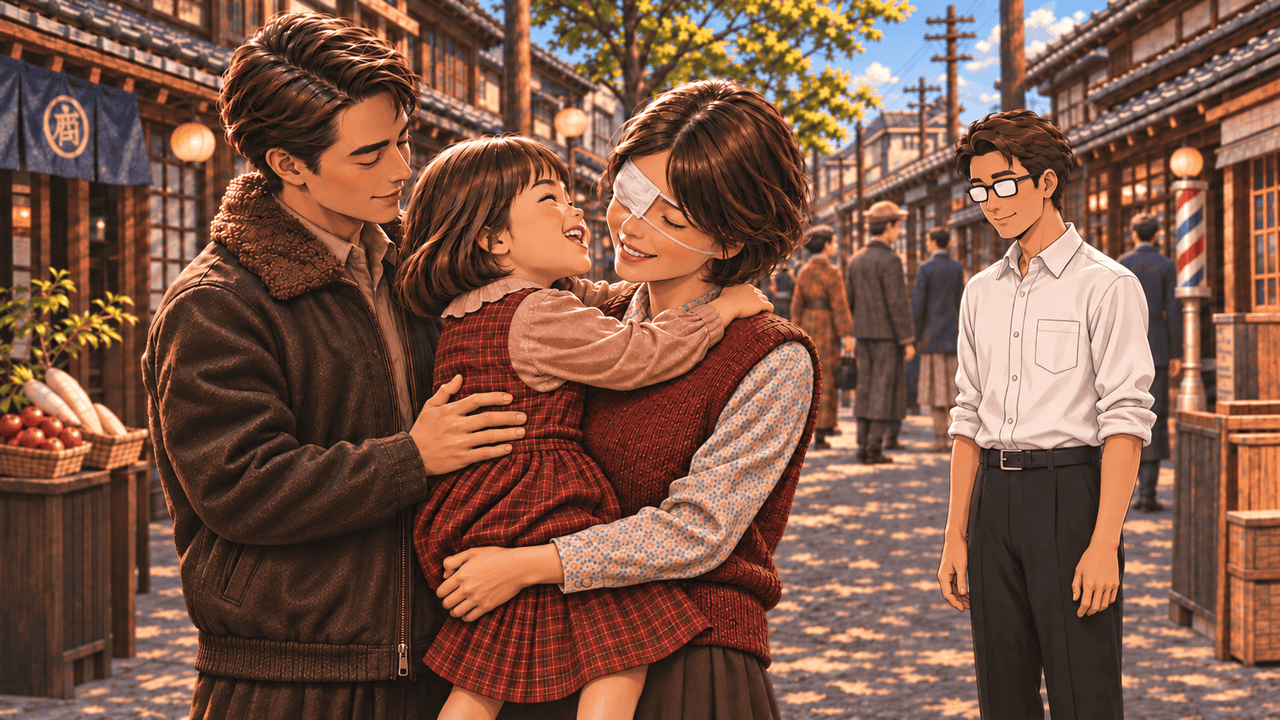
To keep Akiko out of danger, Shikishima and Noriko plan to leave her at the orphanage and flee on their own. They say goodbye and turn to leave, but they can’t bear it. They embrace Akiko again and decide to flee together.
Akiko had been staying at the orphanage Sumiko founded, called 淸澄園.
“I Survived Again”: The Years Murakami Spent on Revenge
After Ghidorah attacks Matsumoto, Murakami brings his findings to Noda and mutters, “I survived again.” Many people died in Matsumoto. In Hiroshima, he lost his wife and grandchild. Both times, he lived. That one word, “again,” tells us how little comfort he takes in surviving.
Two years earlier, Murakami witnessed Godzilla’s overwhelming power in Ginza. He kept thinking about unleashing it on America because he was furious at having his family taken from him. He may also have wondered whether he had any right to live peacefully after his wife and grandchild had died. Spending his life on revenge had itself become a way of punishing himself for surviving.
In the previous film, Shikishima could work to provide for Noriko and Akiko, yet hesitated to let himself be happy as a member of their family. I saw his willingness to take dangerous work as a way of punishing himself for surviving. Murakami punished himself by spending the rest of his life pursuing revenge for his family.
Ghidorah gives Murakami his chance. Faced with a monster humans can’t stop, Murakami proposes calling Godzilla in to fight it and letting the two wear each other down. The resonance amplifier already exists, and Noriko carries the Godzilla cells that can help him summon the monster. The plan to stop Ghidorah is also Murakami’s opportunity to turn Godzilla’s power toward revenge.
The Godzilla Murakami Sees in the Mirror
In his laboratory, Murakami clutches a photograph of his wife and grandchild and can hardly contain his joy. At last he has a chance for revenge. The look on his face frightened me as much as Godzilla does. Then he catches sight of his reflection and comes to his senses. He has spent years hating the power that took his family, and here he is taking pleasure in imagining using that same power to burn people alive. Is this the moment Murakami realizes there is a Godzilla within him?
Why Seeing New York Burn Felt So Satisfying
In Murakami’s imagination, Godzilla destroys New York with his heat ray. I felt for Murakami, who had lost his family and wanted revenge with all his heart. That’s why seeing the city burn felt so satisfying. Yet people who had nothing to do with the atomic bombing live there too. In feeling that satisfaction, I caught sight of the same Godzilla in myself that Murakami had seen in the mirror.
There’s a streak of cruelty in the way the film does this. It shows what revenge would look like as the very sight Murakami has been longing to see. I took pleasure in it too, and that left me feeling guilty. I could no longer see his desire for revenge as his problem alone.
It’s almost as if Yamazaki were asking me, “Can you really condemn Murakami for wanting revenge?”
To me, Godzilla gives gigantic form to human grief, suffering, and the urge to destroy. In Godzilla Minus One, he was an enemy who caused Shikishima pain, and I also saw in him Shikishima’s urge to punish himself for surviving. This time I see that connection in Murakami’s expression and in the Godzilla who sets the city ablaze. I explored the idea in my comparison of the original Godzilla, Shin Godzilla, and Godzilla Minus One.
Why Noda’s Words Got Through to Murakami
It is Noda who finally persuades Murakami to change course. The people who would die in his revenge are somebody’s family too, Noda tells him, desperately pleading with him to stop the same thing from happening again.
On their own, Noda’s words might sound like a familiar appeal.
By then, Murakami has already seen how happy the thought of revenge made him. His family was taken from him, and now he is about to do the same to other people. Seeing the horror of his own revenge in the mirror is what allows Murakami to recognize that Noda’s appeal applies to him.
Murakami’s decision to rein in his revenge and give his anger a different purpose is a crucial turn in the film. It feels convincing because we see both the moment he recognizes what he is doing and the appeal that finally changes what he does.
Revenge on Nuclear Weapons: The Future Murakami Allows Himself
As satisfying as Murakami’s fantasy felt, I didn’t want him to carry it out. I also expected the film to turn away from that outcome. At the same time, I didn’t want his anger over the atomic bombing to disappear, or for him to lose what he felt for his wife and grandchild. Where could he go with all that anger still inside him?
For Murakami, facing Godzilla means taking revenge on the nuclear weapons that killed his family. Godzilla embodies nuclear destruction for him. Murakami had wanted to turn that power against America, but in the end he resolves to resist Godzilla and Ghidorah by human means. The anger that had driven him to imagine burning people who bore no responsibility now gives him the resolve to confront the very thing that took his family.
If devoting his life to revenge was Murakami’s way of punishing himself for surviving, perhaps finding a new direction for his anger freed him a little from that punishment. He could go on thinking of his wife and grandchild and still allow himself some peace. The relief he finds in forgiving himself reminds me of Shikishima in Godzilla Minus One.
When I Was Glad Godzilla Had Come
The moment Godzilla appeared before King Ghidorah, my first thought was, “Now he’ll beat Ghidorah for us.” Maybe that’s because I’ve seen so many Godzilla movies. Still, somehow I’d come to count on the same power that caused so much destruction and grief in the previous film. If he beat Ghidorah, he could become a threat to humanity all over again.
As Murakami Redirects His Anger, Godzilla’s Power Changes Course
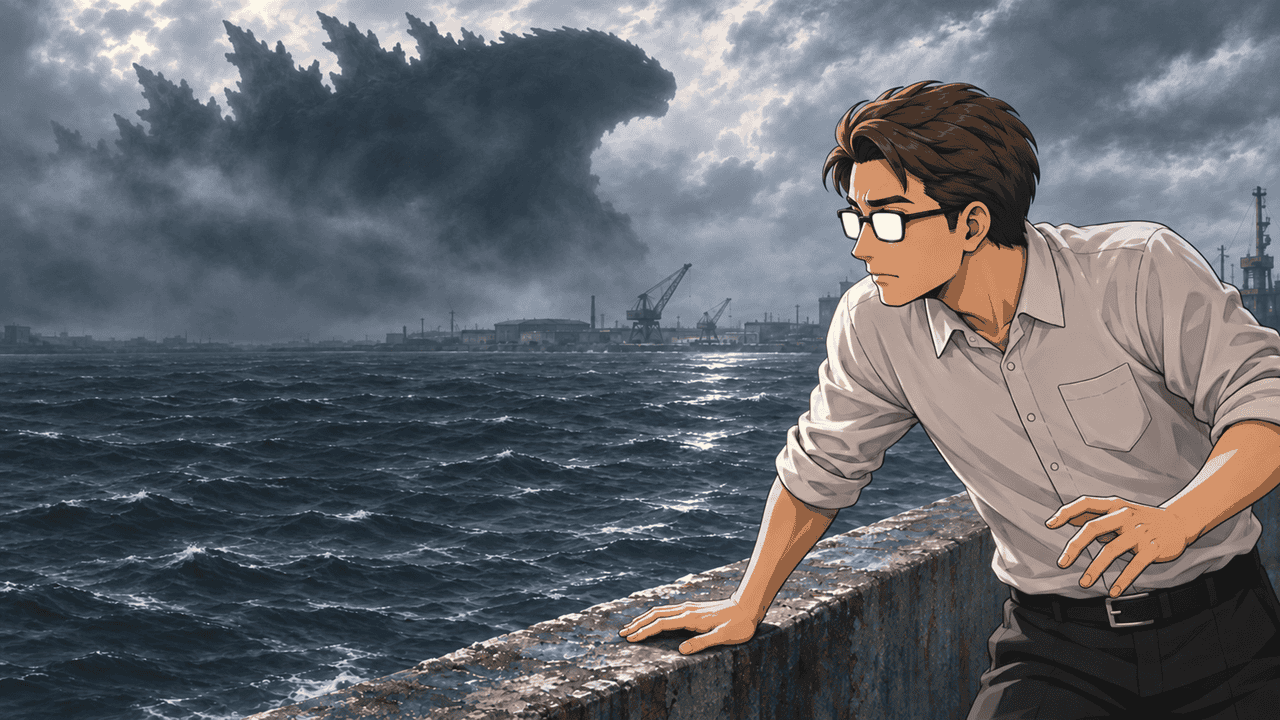
King Ghidorah, tearing across Japan with thunderclouds around him, looks like a natural disaster on an enormous scale. After Murakami redirects his hatred, Godzilla stands in the path of that disaster. The power that was going to burn New York now turns on the thing ravaging people’s lives. The clash between the monsters gives visible form to the change that has taken place in Murakami.
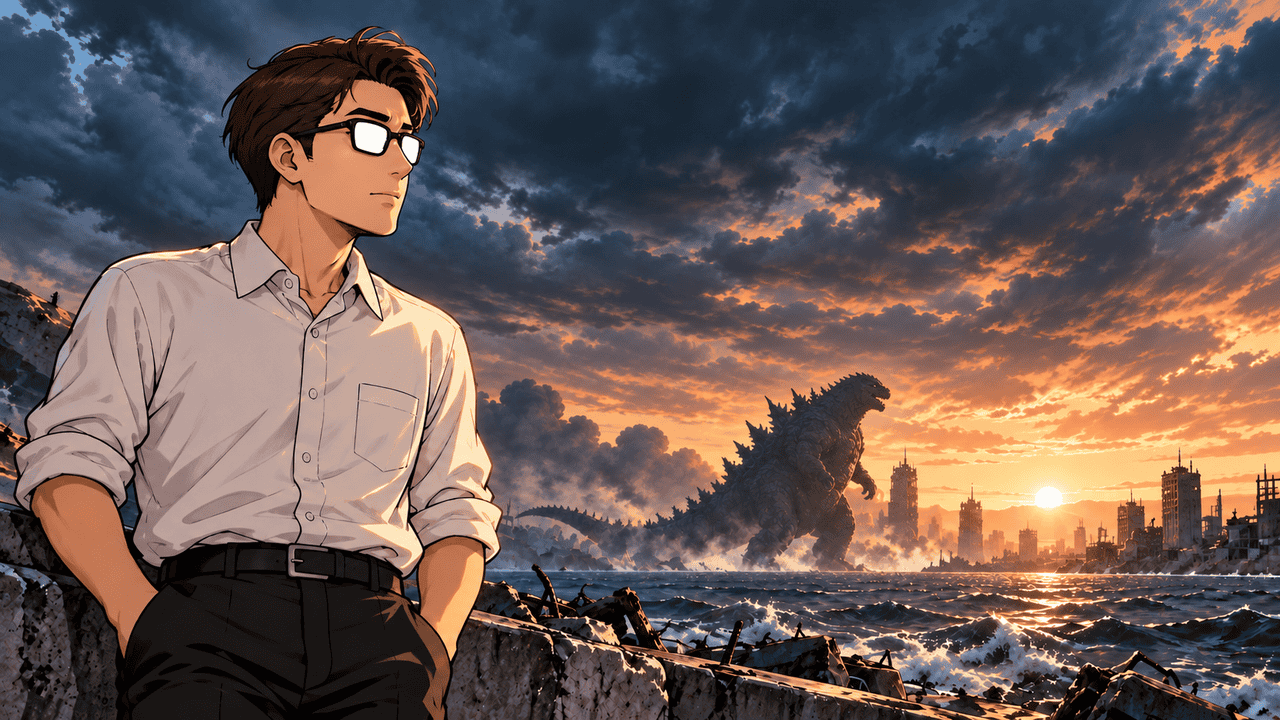
Could that also explain why Godzilla has so little screen time? If this Godzilla reflects Murakami’s inner life, then the monster couldn’t appear until Murakami got past his desire for revenge. I think Godzilla appears when he does because Murakami has faced the Godzilla within himself and redirected his anger.
That was the moment I counted on Godzilla, the monster I’d once feared, to beat King Ghidorah. And he did. Whatever Godzilla’s intentions, the moment the audience hopes he’ll win, he starts to feel like a hero. I think my own hope that he would come through for us made him less frightening to me, even more than his limited screen time did.
When Godzilla reflects a human being, a change in that person changes what the monster means. I felt strongly for Murakami when he held back the urge to burn people alive. So it felt right that the Godzilla who reflects his anger would defeat the disaster. Yet the more that victory makes sense and the more I feel I can count on him, the less frightening Godzilla becomes. The same thing happened in the Shōwa films as rival monsters appeared and audiences began to root for Godzilla. I don’t think this film could avoid that shift either. I can appreciate it and still prefer the Godzilla who scares me.
Did It Have to Be King Ghidorah?
King Ghidorah gives Murakami a pretext to use Godzilla. He also gives the power that hurt so many people in the previous film a disaster to confront. I understand what Ghidorah does for the story. But another monster could have played the part of a disaster humans couldn’t contain and Godzilla ultimately defeats.
We see a chrysalis from space hatch, but I wanted a better sense of how a creature like King Ghidorah fits into this world. Coming from space makes me all the more curious about his origins and how he lives.
With Godzilla already such a strange presence, I wanted a more convincing reason for a second giant creature to exist in this world. Ghidorah’s narrative role is clear. What left me wanting more was how the film established him as a creature.
I suspect the biggest reason was simply that King Ghidorah is Godzilla’s greatest rival. I understand that choice. If they were going to bring Ghidorah into this world, though, I wanted another reason that made it feel right, or a scene so bold it made the question beside the point.
Perhaps a sequel, if there is one, will explore that in more depth.
Murakami Burns His Invention, and I Think of Serizawa
Murakami develops a way to summon Godzilla, then burns his laboratory and blueprints and destroys the amplifier. I couldn’t help thinking of Dr. Serizawa in the original Godzilla. To keep his invention from being used as a weapon, Serizawa sinks to the bottom of the sea with Godzilla. I see his death as the moment a scientist buries a dangerous discovery, and also as the moment a man deeply wounded by war seals away his own urge to destroy forever.
I have deep respect for Serizawa’s decision. I cry every time I watch the original Godzilla. That’s also why I’ve always wished he could have lived and found happiness. Serizawa stands for the people who carried the wounds of war, kept their hatred in check, and left us the world we live in today. They kept their pain to themselves, and Serizawa, too, disappeared beneath the sea.
Murakami finds a way past his hatred and survives. I sense the same deliberate choice by the filmmakers that brought Shikishima home alive in the previous film.
Ironically, having chosen a future for himself, Murakami is then captured by the U.S. military.
It’s a bitter moment that brings home the imbalance of power between Japan and the United States that continues to this day. Even so, his decision to stay alive and carry on still matters.
Why Shikishima and Noriko Didn’t Leave Akiko Behind
At first, Shikishima and Noriko intend to flee without Akiko. Now that they’re being hunted, they plan to leave her at the orphanage to keep her safe. They are parents preparing to part with their child for her own protection. When they arrived at the orphanage to say goodbye, I told myself I would have to bear that ending.
The World Noriko Wanted to Protect for Akiko
Shikishima tries to take Noriko away. But no matter where they escape to, leaving King Ghidorah free would cost Akiko the chance to grow up in peace. When Noriko sees what has happened in the stricken areas, she takes on the part of the operation that only she can carry out. Thinking of Akiko’s future, she probably felt she had no other choice. Noriko makes the decision to fight for Akiko herself.
The Godzilla cells that kept Noriko alive in the previous film give her a way to protect the world Akiko will live in. They also put her in a position where she may have to leave Akiko. It brought back how frightening and hopeful it had felt to see that power save Noriko’s life.
The Look They Share at the Orphanage
After saying goodbye and turning away, Shikishima and Noriko can’t bear to leave and embrace Akiko again. Shikishima and Noriko exchange a look and decide to flee with Akiko. The three met amid the ruins of postwar Japan and lived through the threat of Godzilla together. They aren’t related by blood, but they have become a family that can’t bear to be apart.
If they leave Akiko at the orphanage, she could of course be taken hostage to lure them out. They have a practical reason to flee together. Even if the orphanage had been perfectly safe, though, I wanted them to take Akiko. And they did.
After seeing how much Murakami had lost, I didn’t want the three of them to lose their life together here.
What, then, does that choice mean for the ending?
What Murakami Lost, and What the Three Hold On To
Murakami lost his wife and grandchild, and with them the quiet days they should have had together. That loss drove him to dream of burning America with Godzilla’s power and pushed him to the point of nearly doing it. If Shikishima and Noriko give up Akiko, they too will lose the days they could have spent with someone they love, this time by their own choice. After seeing Murakami’s loneliness and the madness it drove him to, wouldn’t their parting suggest that they, too, might one day find a Godzilla within themselves?
The ending is there to close off that possibility.
The three will probably be hunted for some time. Shikishima and Noriko choose to face that hardship and live with Akiko. Whatever they have to endure, Shikishima and his family will never become Godzilla. That is what I see in the three of them taking each other’s hands and running away together.
As in Godzilla Minus One, there is something about this insistence on surviving that feels like a welcome answer to the original Godzilla. In both films, a figure like Serizawa gets to come back alive.
Murakami, clutching that photograph of his wife and grandchild, must once have had days like those too. When Shikishima and Noriko held Akiko tightly again, the joy of knowing the three could stay together brought home the beauty of the days Murakami had lost.
Takashi Yamazaki’s Godzilla films are family stories through and through. What makes this film so good is how completely that family story belongs in a Godzilla movie.
After all that, what I come back to is simple. I enjoyed Godzilla Minus Zero.
That’s where I landed. What did you make of the film?
Poll results
Voting closedHow did you feel about Shikishima and Noriko taking Akiko with them at the end?
- I was glad they chose to stay together, even with the danger.0%
- I understood their choice, but I still worried about Akiko’s safety.0%
- They should have left Akiko behind for her safety.0%
- I’m still torn about which choice was better.0%

Reader Comments
Have a thought or interpretation? Leave a comment