
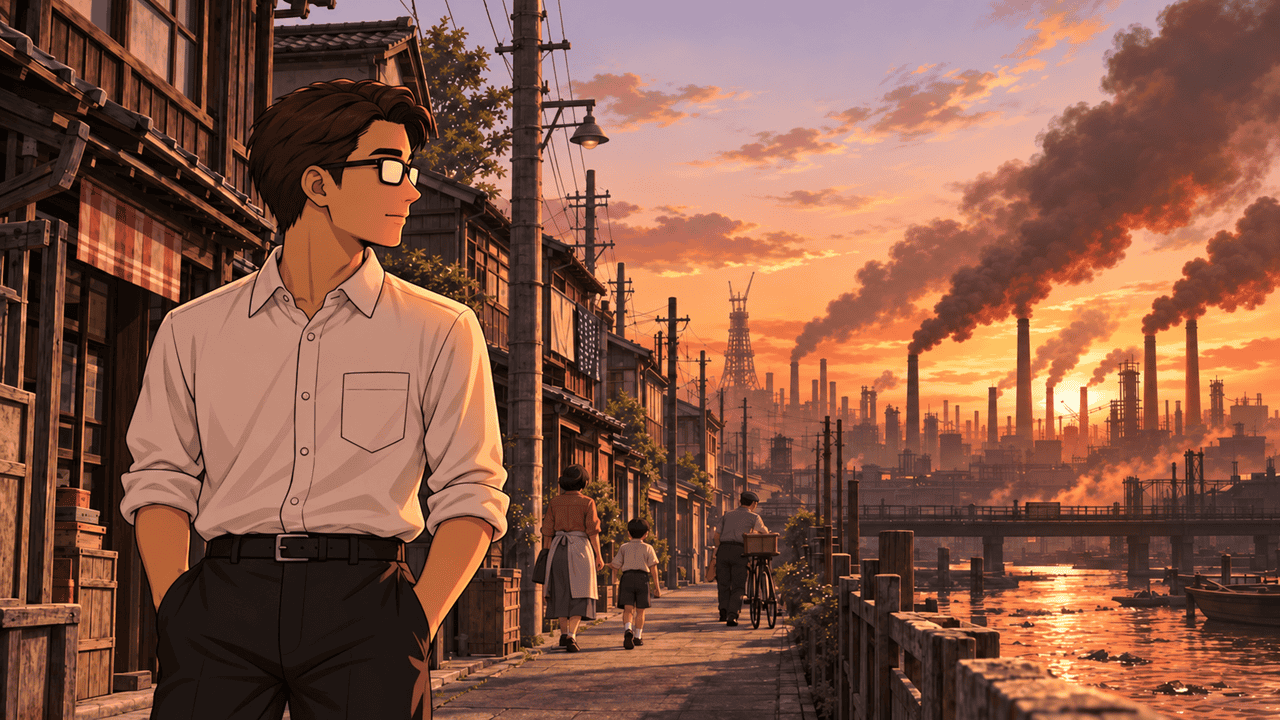
ALWAYS: Sunset on Third Street depicts Tokyo during Japan’s Shōwa era, recovering from the war and gradually becoming more prosperous. Tokyo Tower is under construction, neighbors gather around a newly purchased television, and cars travel through the streets. As conveniences multiply and the city changes, the film conveys a sense that life will keep getting better.
Yet across Japan, this era of development also brought pollution and other social problems. Factory effluent killed fish, and smoke made people ill. Housing shortages and waste disposal became serious urban concerns, while growing car ownership brought more traffic accidents.
Many of these problems worsened during the subsequent years of rapid economic growth, eventually prompting major legal and institutional changes in the 1970s. Protests and lawsuits by those affected challenged corporate responsibility and changed the responses of national and local government. Even after environmental conditions improved, however, the consequences for health and the question of compensation remained.
Starting with the period depicted in ALWAYS: Sunset on Third Street, I want to examine the problems Japan faced and how they later changed society.
*This is a translated version. The original (Japanese) is available here.
On this pageContents
The Prosperity Factories Created and the Pollution Behind It
Industrial development, especially manufacturing, sustained postwar recovery and rapid economic growth. Factories employed large numbers of people and produced goods that made everyday life more convenient. But factory smoke and effluent also increasingly damaged the surrounding environment. Before adequate pollution controls were in place, how did affected communities make themselves heard, and how did society respond?
From the 1958 Edo River Incident to the Sumida’s Recovery
In April 1958, the water of the Old Edo River, between Tokyo and Chiba, turned black and murky, killing large numbers of fish and shellfish. Effluent from the Edogawa mill of Honshu Paper caused the damage. Fishing communities downstream in Urayasu protested to the company and sought enforcement from the authorities, but the damage continued to spread.
According to Urayasu City’s account of the Honshu Paper mill incident, around 800 representatives of the fishing communities petitioned Parliament and the Tokyo Metropolitan Government on June 10 that year before heading to the mill. The company refused to meet them, and amid the escalating dispute the fishers entered the grounds, leading to clashes with riot police. Among the fishers, 105 suffered injuries of varying severity, and eight were arrested.
People whose livelihoods had been threatened by river pollution protested the factory’s operations, and the dispute escalated into a major confrontation. The incident helped spur government action. In December that year, two laws were enacted: one on conserving water quality in public waters and another regulating factory effluent. Together, they became known as the two water quality laws.
Enacting laws did not immediately clean up rivers nationwide. The 1969 Environmental White Paper explains that although the two laws took effect in 1959, regulation depended on the designation of particular water areas, so implementation took time. The Edo River did not become the first designated area until 1962.
Meanwhile, household sewage was adding to factory effluent in Tokyo’s rivers. Population growth and more convenient urban living outpaced the expansion of sewerage. According to Tokyo’s history of urban development, Tokyo’s sewerage area coverage rate was just 19.8% in 1958.
The Sumida River illustrates the problem. Water pollution became so severe that its fireworks festival was cancelled in 1961. According to the Tokyo Metropolitan Government’s sewerage history, sewer coverage in the twenty-three wards stood at 22% at the time. Expansion subsequently brought it to 70% in 1978. The river’s water quality improved, and the fireworks festival resumed.
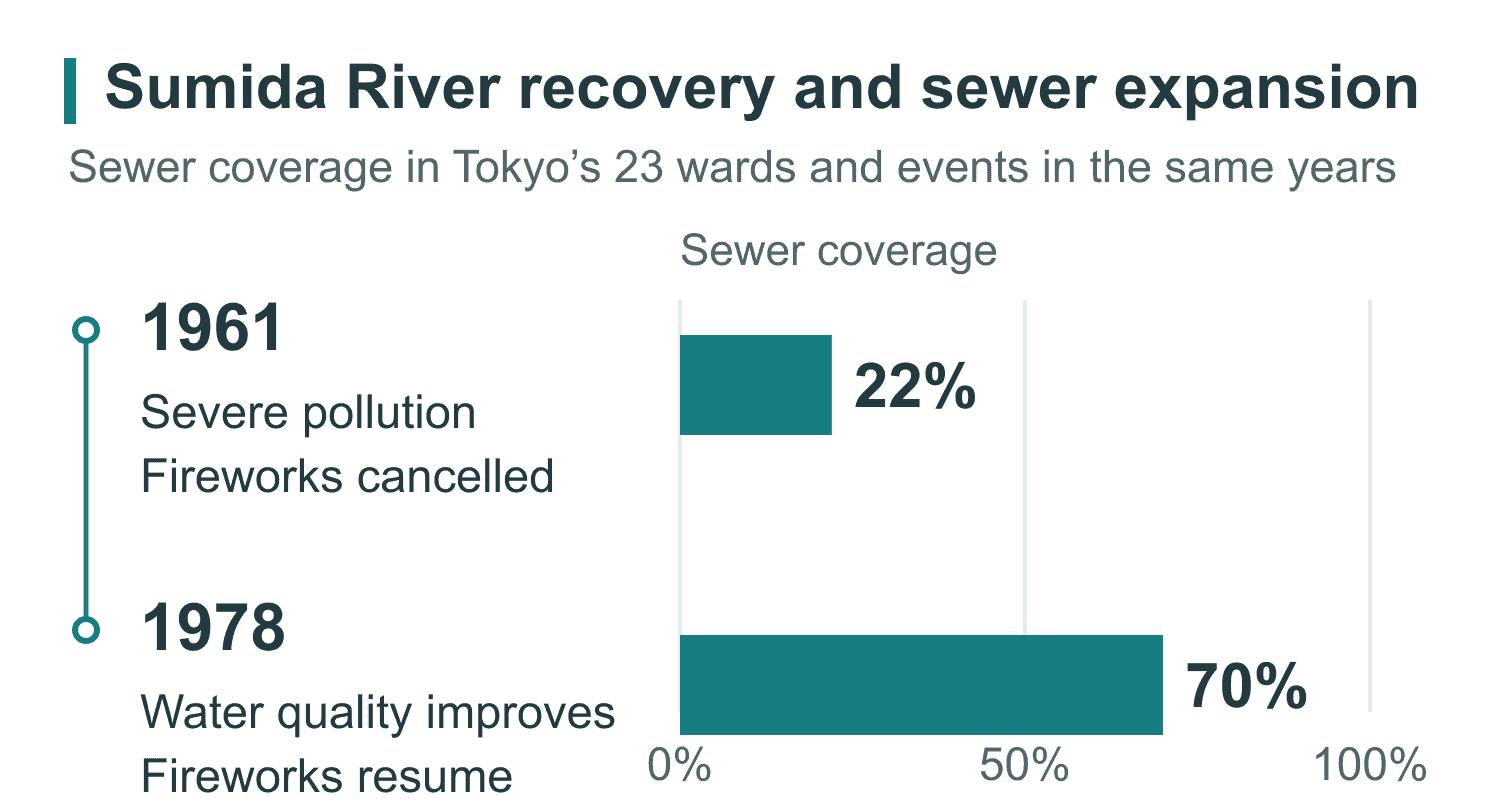
Source: Tokyo Metropolitan Government Bureau of Sewerage, history of sewerage. Prepared from the source’s figures and descriptions.
Water pollution legislation was also revised. The Water Pollution Control Act was enacted in 1970, introducing a framework based on nationwide effluent controls rather than the earlier two-law system, and strengthening enforcement against violations. Water pollution increasingly became something to prevent through national regulation, rather than address only in selected areas.
Twenty years passed between the fishers’ protests on the Edo River in 1958 and the return of the Sumida fireworks in 1978. Restoring rivers damaged by urban development required sewer infrastructure as well as controls on factory effluent.
References: Environment Agency, Environmental White Paper 1975, history of water pollution; Ministry of the Environment, Toward the Conservation of Clean Water.
How Factory Smoke Became a Threat to Health
Air pollution was another serious problem. Burning fuel in factories, thermal power stations, and building heating systems released soot, smoke, sulfur oxides, and other pollutants. In industrial areas and large cities, these emissions increasingly affected everyday life.
Tokyo had experienced air pollution problems for some time. The 1975 Environmental White Paper reports that in a 1960 government opinion survey, 56% of residents in Tokyo’s ward area said that noise, smoke and soot, vibration, air pollution, or similar conditions regularly bothered them. This was not a question about air pollution alone, but it shows widespread dissatisfaction with the urban environment.
One notorious example of industrial air pollution causing serious illness was Yokkaichi asthma in Mie Prefecture. As the petrochemical complex expanded, more residents began reporting asthma and related symptoms from around 1960. The Environmental Restoration and Conservation Agency’s account of Yokkaichi pollution states that in 1964, when pollution was especially severe, the annual average sulfur dioxide concentration in the Isozu district reached 0.075 ppm. The incidence of respiratory disorders was two to three times that in less polluted areas, or even higher.
Affected residents sued six companies operating in the complex in 1967. The 1972 judgment recognized their responsibility and ruled for the victims. The court made clear that companies conducting industrial operations have a responsibility to take adequate measures to avoid harming the lives and health of neighboring residents.
Air pollution controls were subsequently strengthened, with measures including lower-sulfur fuels and flue-gas desulfurization equipment. According to the Environmental Restoration and Conservation Agency, annual average sulfur dioxide concentrations at stations measuring continuously since fiscal 1965 peaked at 0.059 ppm in fiscal 1967, then fell to around 0.02 ppm by about 1975.

Source: Environmental Restoration and Conservation Agency, SO₂ environmental standards and measures to achieve them. Prepared from the source’s figures and descriptions.
As controls on sulfur oxides from factories progressed, nitrogen oxides and suspended particulate matter from vehicle exhaust became important urban air pollution concerns. Some problems improved as industrial emissions fell, while the expansion of a car-dependent society made others more serious.
Factory smoke may have appeared to signal vigorous industrial activity. The same smoke, however, threatened the health of people nearby. The history of pollution control shows a changing understanding of how to protect residents’ health alongside industrial development.
Reference: Environmental Restoration and Conservation Agency, overview of air pollution litigation.
Why Did Minamata Disease Remain Unresolved for So Long?
Among the pollution problems associated with rapid economic growth, Minamata disease caused especially severe health damage. Patients with an unexplained neurological illness were officially reported in Minamata, Kumamoto Prefecture, in May 1956. Subsequent investigation established that some had already developed symptoms in 1953.
Minamata disease resulted from methylmercury discharged by a chemical factory accumulating in fish and shellfish, then poisoning people who ate them. Patients developed sensory and movement disorders, among other symptoms. Many suffered severe illness, and some died. The National Institute for Minamata Disease explains that young children were among the patients officially identified in 1956.
Crucially, exposure continued long after the damage was recognized. In 1956, a Kumamoto University research team reported that the illness might be poisoning caused by eating seafood contaminated with heavy metals. Yet measures such as a ban on catching contaminated fish and shellfish were not introduced. According to the institute’s account of the investigation into the cause, Chisso knew by 1959 that its wastewater was responsible, but continued discharging it.
The disease was not confined to Kumamoto. In 1965, Minamata disease caused by methylmercury in factory effluent was officially confirmed along the Agano River in Niigata Prefecture. In 1968, the government announced its unified findings that, in both Kumamoto and Niigata, the cause was methylmercury compounds generated in factory production processes.
Victims subsequently brought lawsuits to establish corporate responsibility, winning in Niigata in 1971 and Kumamoto in 1973. Yet identifying the cause and winning judgments against the companies did not settle the question of relief for the victims. Disputes over who should be officially recognized as a Minamata disease patient, and what compensation should be provided, continued for decades.
A political settlement was proposed in 1995. In 2004, the Supreme Court recognized the liability of the national government and Kumamoto Prefecture. A special measures law for further victim relief was enacted in 2009, but litigation has continued. The National Institute for Minamata Disease’s account of countermeasures shows how long the issue has persisted.
Minamata disease demonstrates that industrial harm to health cannot be resolved simply by stopping a factory’s discharges. Identifying the cause, preventing further exposure, establishing corporate and administrative responsibility, and supporting affected people’s lives all required responses. Those responses took a very long time.
What Did More Convenient Urban Living Cost?
Factories were not the only things transformed by rapid growth. Incomes rose, goods were mass-produced, and new homes and roads appeared in cities. As life became more convenient, however, waste disposal, housing shortages, and road accidents also grew more serious. Beyond industrial pollution, we need to consider how urban life itself was changing.
Yumenoshima’s Waste Heaps and the Tokyo Garbage War
Population growth and expanding consumption kept increasing Tokyo’s waste. Deciding where to dispose of refuse from households and businesses became a pressing metropolitan issue.
In 1957, Tokyo began disposing of waste in Tokyo Bay’s Landfill Site No. 14, now Yumenoshima. According to the history on the official Yumenoshima Park website, food waste and other refuse were buried without adequate incineration. Much of Tokyo’s waste was taken to Kōtō Ward, where garbage truck traffic, odors, flies, and rats increasingly threatened local living conditions.
In 1965, huge numbers of flies bred at Yumenoshima and descended on residential neighborhoods in Kōtō. Schools suffered disruption serious enough to interfere with classes. Insecticide spraying and other measures proved insufficient, and Tokyo eventually resorted to burning the heaps of waste.
This was more than a sanitation problem. It also reflected the concentration of much of Tokyo’s waste in particular neighborhoods. People elsewhere enjoyed convenient urban lives, while the communities receiving their rubbish bore the odors and traffic problems.
This imbalance developed into what became known as the Tokyo Garbage War in 1971. Kōtō resisted continuing to receive refuse from other wards, while residents in Suginami opposed a planned waste incinerator. According to Suginami Ward’s account, Kōtō blocked waste deliveries from Suginami in 1972 and took similar action the following year.
The conflict made the location of waste treatment facilities and the protection of residents matters for the city as a whole. Kōtō’s incinerator was completed in 1974. After negotiations and a settlement with residents, Suginami’s was completed in 1982.
Yumenoshima itself was later redeveloped, opening as Yumenoshima Park in 1978. A place once notorious for odors and flies became a green public park.
Its history shows that an affluent consumer society has to consider more than making and using goods. It must also decide what happens to them afterward. Urban convenience depended on people somewhere bearing the burden.
From a Housing Shortage to Questions of Housing Quality
Postwar Japan also faced a severe housing shortage. War had destroyed large numbers of homes, and demobilized soldiers and repatriates returned after it ended. Continued migration into cities left some people unable to find adequate accommodation even when they had jobs.
According to the Ministry of Land, Infrastructure, Transport and Tourism’s account of housing policy, Japan had approximately 17.93 million housing units and 18.65 million households in 1958. There were fewer homes than households.
Public housing provision and apartment developments by the Japan Housing Corporation expanded to address the shortage. Established in 1955, the corporation built housing and developed large residential sites in metropolitan areas, playing a major role in postwar supply.
Housing numbers continued to grow. In 1968, the national total exceeded the number of households. By 1973, housing units outnumbered households in every prefecture.
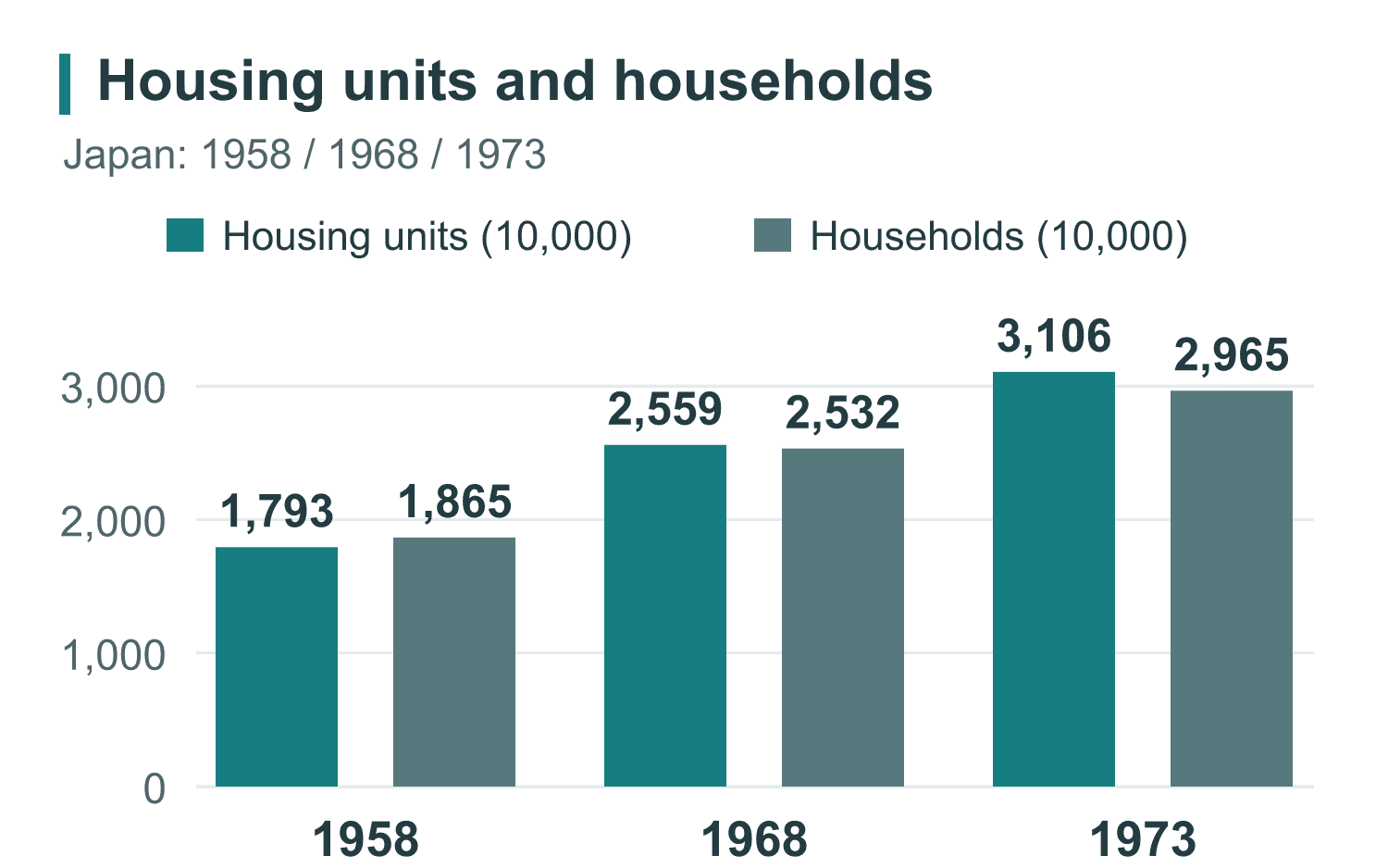
Source: Ministry of Land, Infrastructure, Transport and Tourism, policy review on revitalizing the existing housing market, historical housing policy chart, printed page 4. Prepared from the source’s figures and descriptions.
More housing than households did not mean that everyone had a home with adequate space and facilities. Some areas still had shortages. Some families lived in aging, cramped homes with poor amenities.
Housing policy also shifted from increasing numbers toward improving housing quality and the living environment. The Statistics Bureau’s account of the Housing and Land Survey explains that from the 1970s onward, better housing standards became an important policy concern alongside the quantity of homes.
The small houses lining Shōwa-era streets evoke a time when families lived close together. They also reflect an era when housing itself was scarce and adequate living space was hard to obtain. The history of housing supply reveals postwar changes not only through the spread of appliances, but through improvements in homes and their surroundings.
The Arrival of a Car Society and Rising Traffic Casualties
Cars spread rapidly during the high-growth period too. They made it easier to move people and goods over long distances, transforming urban transport and distribution. As their numbers grew, however, traffic accidents became a serious social problem.
According to the Cabinet Office’s Traffic Safety White Paper, Japan recorded 16,765 road traffic deaths in 1970, the worst toll in the statistics available at the time. Cars supported more convenient lives and economic activity, but more people were dying on the roads.
Rising traffic casualties prompted the enactment of the Basic Act on Traffic Safety in 1970. The first Basic Traffic Safety Plan followed in fiscal 1971. Measures included safer roads, traffic signals and other safety facilities, vehicle safety improvements, and traffic safety education.
Deaths subsequently fell, reaching 8,760 in 1980. They rose again during parts of the 1980s, however, and road safety remained an ongoing challenge.

Source: Cabinet Office, Traffic Safety White Paper 2019, Figure 1-1, using National Police Agency data. Prepared from the source’s figures and descriptions.
A safe road system required more than producing cars and making them widely available. It also needed ways to limit the dangers their use created. The progression from motorization to rising casualties and stronger safety measures shows how the spread of a convenient technology can demand new social responses.
Morinaga’s Arsenic-Contaminated Milk: Who Was Responsible for Food Safety?
The 1950s also brought a serious product safety incident, distinct from factory effluent and smoke: the Morinaga arsenic-contaminated milk poisoning of 1955.
Arsenic contaminated powdered milk made at Morinaga Milk Industry’s Tokushima plant. An ingredient used to stabilize the milk during production contained the toxic substance. Babies and young children who drank the milk were poisoned.
According to the Consumer Affairs Agency’s material on the incident, more than 12,000 people nationwide were affected, and over 100 died. Some survivors continued to suffer health problems.
Here too, the immediate aftermath did not resolve everything. Questions remained about how to investigate lasting effects on the children’s health and provide relief over their lifetimes.
In 1969, “A Visit Fourteen Years Later,” a report examining affected children fourteen years after the incident, brought renewed attention to its lasting consequences. Parents’ campaigns expanded, leading to negotiations with the government and the company.
According to Hikari Kyōkai, a public-interest foundation, a three-party agreement was reached in 1973 between the Ministry of Health and Welfare, a victims’ organization, and Morinaga Milk Industry. Hikari Kyōkai was established in 1974 to provide permanent relief. It has continued supporting health management, medical care, and daily life.
Infant formula is meant to sustain young children’s lives and health. The failure to ensure its safety harmed large numbers of children. Supporting those children’s lives after the poisoning remained a responsibility long after the incident itself.
Unlike river or air pollution, this was a product safety disaster. Nevertheless, it was important to the question of how a society producing goods on a mass scale should ensure safety, and what responsibilities companies and authorities should bear when harm occurs.
How Did Pollution Victims Change Japanese Society?
None of these problems ended with the initial damage. Fishers and residents protested; patients and families went to court and continued campaigning for relief. Their actions forced renewed scrutiny of corporate responsibility and the role of government, helping bring major institutional reforms in the 1970s.
The Victims’ Claims and the Four Major Pollution Lawsuits
People whose health had been damaged by pollution began using the courts to hold companies responsible. This was an important turning point in pollution control. In the early 1970s, judgments repeatedly favored plaintiffs in what became known as Japan’s four major pollution lawsuits.
According to the Environmental Restoration and Conservation Agency’s overview, victims won the Itai-itai disease and Niigata Minamata disease cases in 1971, the Yokkaichi pollution case in 1972, and the Kumamoto Minamata disease case in 1973.
The Itai-itai disease case in Toyama concerned illness caused by cadmium discharged from a mine. The Niigata and Kumamoto Minamata cases involved methylmercury poisoning from factory wastewater. In Yokkaichi, the issue was illness caused by emissions from multiple factories.
The courts examined causation and corporate responsibility, and upheld the claims of the victims. In Yokkaichi, they held that companies operating neighboring factories could share liability even when each company’s individual contribution to the pollution could not be established separately.

Source: Environmental Restoration and Conservation Agency, explanation of the four major pollution lawsuits. Prepared from the source’s figures and descriptions.
Through these cases, pollution came to be treated as more than a nuisance of smoke and dirty water: it threatened lives and health and could give rise to legal responsibility for companies. It also mattered that victims themselves spoke out, using litigation and local campaigns to seek changes in corporate and government responses.
What Changed at the 1970 Pollution Diet?
As pollution worsened and public campaigns spread, the government strengthened its response. The Basic Law for Environmental Pollution Control was enacted in 1967 to coordinate policy. Its original provisions, however, required the protection of the living environment to be balanced with sound economic development.
That clause reveals how environmental protection and economic development were understood at the time. As pollution caused increasingly serious illness across Japan, the idea of placing the protection of the living environment within that balance came under reconsideration.
The extraordinary parliamentary session at the end of 1970 later became known as the “Pollution Diet.” According to the 1975 Environmental White Paper, fourteen pollution-related laws were enacted or revised, including amendments to the Basic Law for Environmental Pollution Control. The law’s so-called economic harmonization clause was removed.
The amendment clearly established protection of the living environment, alongside the protection of public health, as an important aim of pollution prevention. The Water Pollution Control Act and new waste legislation also helped transform the regulatory framework.
The Environment Agency was established in July 1971. The National Archives of Japan’s record of its founding law explains that the agency was intended to coordinate pollution prevention and nature conservation functions previously divided among several ministries.
The Pollution-related Health Damage Compensation Law was enacted in 1973 and took effect in September 1974. Under specified conditions, people suffering pollution-related illness could receive medical expenses and other compensation without bringing individual lawsuits against companies.
The Environmental Restoration and Conservation Agency’s history of the compensation system explains that it aimed to protect victims promptly and fairly. It introduced a mechanism that placed the costs on those responsible, including the polluting companies.
From the Edo River incident in 1958 to the institutional reforms of the 1970s, responses to industrial pollution developed from dealing with particular local disputes toward nationwide regulation and systems of victim relief.
Environmental Improvement Did Not End the Problems Facing Victims
Stronger controls reduced industrial pollutants, and rivers and air quality improved. Fireworks returned to the Sumida River, while sulfur dioxide pollution fell substantially. These changes show the practical effects of stronger regulation, improved industrial equipment, and expanded sewerage.
Cleaner rivers and less factory smoke did not necessarily allow people already made ill to return to their former lives. Minamata disease recognition and compensation remained contested after its cause was established. Those harmed by Morinaga’s contaminated milk also needed long-term support.
In air pollution, too, controls on industrial sulfur oxides progressed while vehicle exhaust and other sources created new concerns. Improving one kind of pollution did not prevent urban and industrial development from bringing other problems.
The history of pollution control does not end when a law is enacted. Preventing harm, restoring damaged environments, and supporting people already affected require different responses. The institutions providing them developed gradually through the actions of victims and local communities.
Another Perspective on the Era of ALWAYS: Sunset on Third Street
The Shōwa-era Tokyo of ALWAYS: Sunset on Third Street represents one side of Japan’s transition from recovery to economic growth. Rising incomes, new appliances and cars, and the construction of homes and roads transformed everyday life.
Behind those changes were people made ill by pollution, families struggling with inadequate housing, and people exposed to the dangers of road accidents. Some communities bore the burden of waste disposal. Others suffered because the safety of manufactured products had not been adequately secured.
These problems did not all have the same cause. Wartime destruction contributed to the housing shortage, while the Morinaga incident involved failures of safety management during production. Factory pollution, waste disposal, and rising road casualties, meanwhile, were closely connected with industrial development and changing urban life.
Japan changed substantially in response. Pollution control legislation, the Environment Agency, and institutions addressing corporate responsibility and victim relief emerged. Housing policy moved beyond simply adding homes toward improving living conditions, and safety measures sought to reduce road casualties.
Government and business did not achieve these changes alone. Protests by fishers and residents, lawsuits by patients and their families, and sustained campaigns for relief were powerful forces moving society.
The era in which Tokyo Tower rose and people anticipated new lives was creating the basis for Japan’s later prosperity. It was also an era when pollution and social problems forced questions about priorities and whose lives should be protected.
Looking beyond the world of ALWAYS: Sunset on Third Street to the history that followed, postwar recovery and rapid growth emerge as both a history of more convenient, affluent lives and a history of confronting the problems within that prosperity and changing society’s institutions.
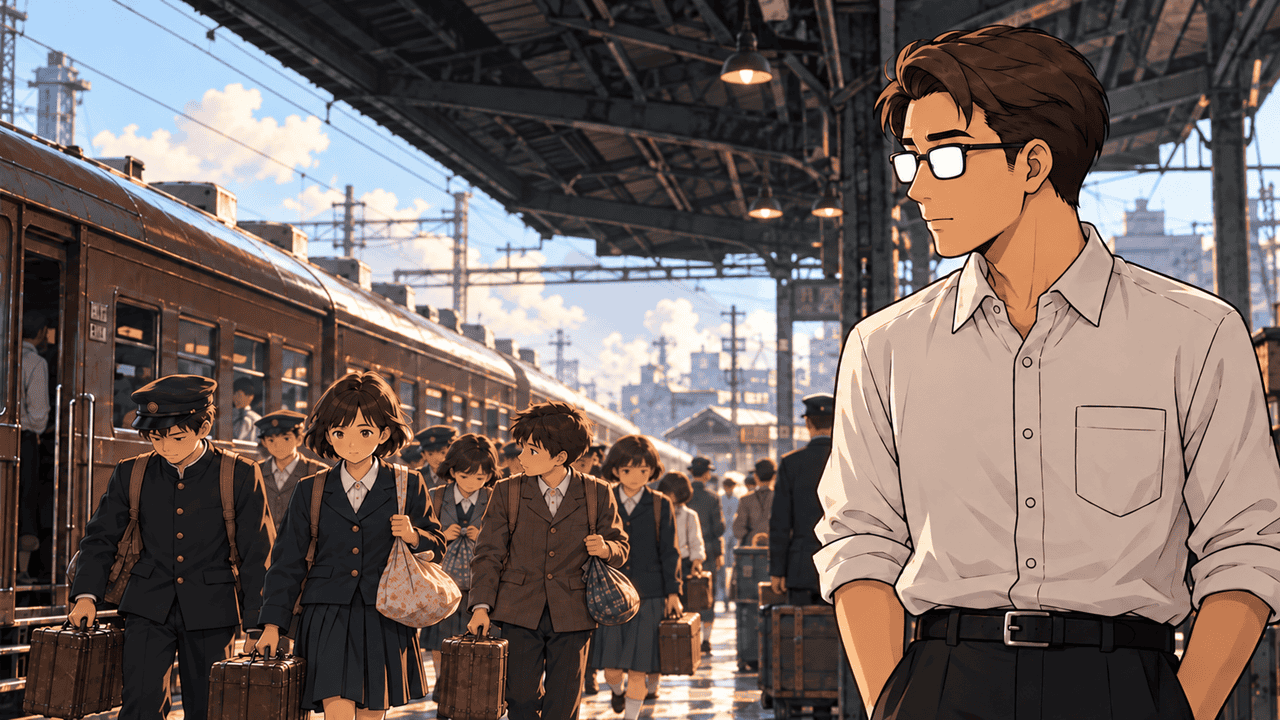
Many young people also left rural areas for city jobs during this period of recovery and growth. I explore Mutsuko’s journey from Aomori to Tokyo and the system of organized group recruitment in a separate article on why she left home at fifteen.




Reader Comments
Have a thought or interpretation? Leave a comment