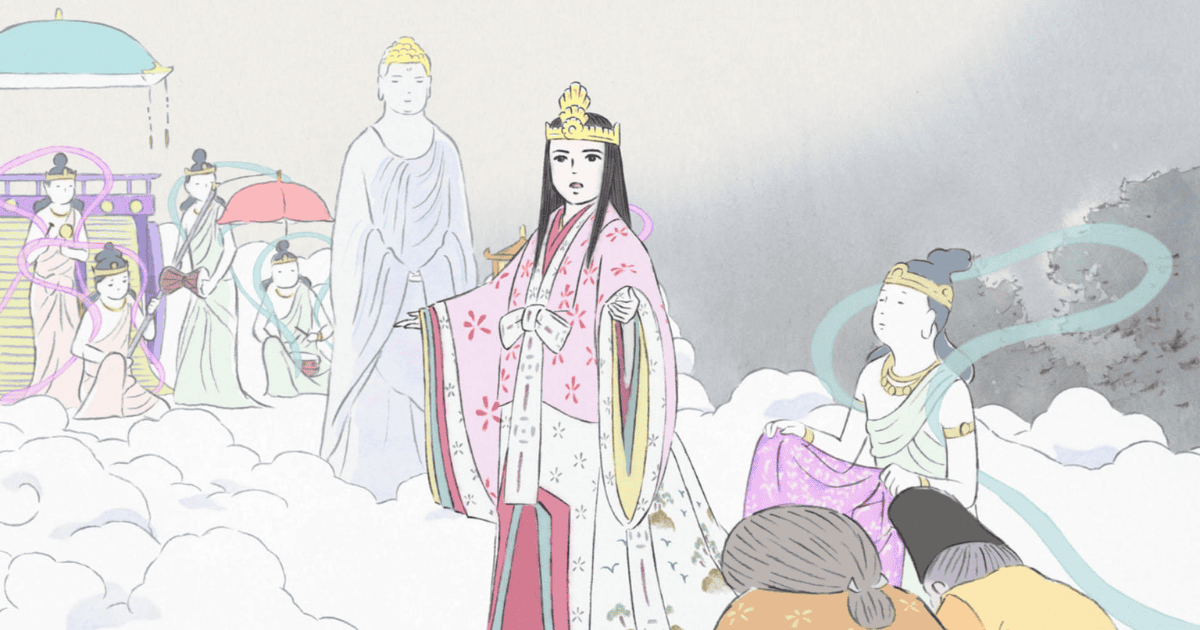
The Tale of the Princess Kaguya (Studio Ghibli Official) is a 2013 animated feature film directed by Isao Takahata.
In this article, I have selected 13 of my favorite quotes from the film.
The dialogue in The Tale of the Princess Kaguya often becomes even more interesting when the original Japanese is compared with its English translation. For each quote, I will look at the Japanese line, its romanization, the English subtitle, a literal translation, and what the dialogue tells us about the characters and the story.
These are not necessarily the 13 most objectively famous lines in the film. This is a personal selection, and several of them are included simply because they have remained strangely fixed in my memory.
The film’s official English title is:
The Tale of the Princess Kaguya
The original Taketori Monogatari is generally known in English as The Tale of the Bamboo Cutter. I find the contrast between the two English titles particularly elegant. Just as the Japanese title changes from 「竹取物語」 to 「かぐや姫の物語」, the shift from The Tale of the Bamboo Cutter to The Tale of the Princess Kaguya makes it immediately clear that the center of the story has moved from the bamboo cutter to Kaguya herself.
Translation note: The English subtitle wording in this article is based on the commercially released Blu-ray available to the author. The English dub is also discussed where its wording creates a meaningful difference. Subtitle and dub wording may vary between releases and territories.
▼ Read the full story and analysis behind these quotes
On this pageContents
Princess Kaguya Quotes in Japanese and English
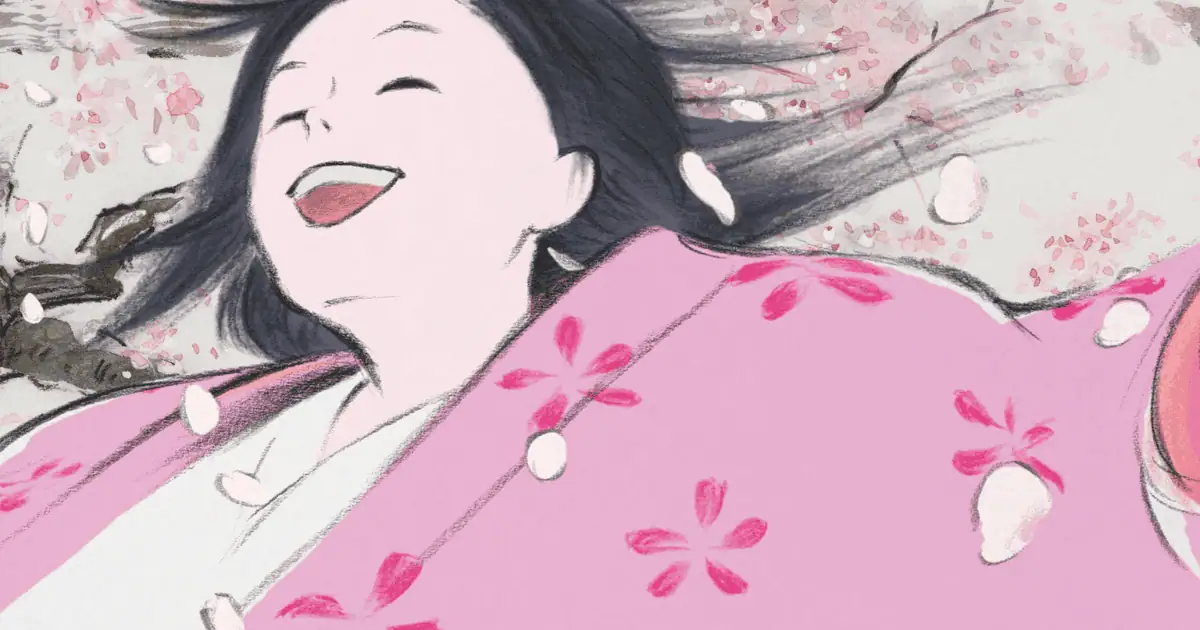
“I’ll always be here with you, forever and ever.”
タケノコは、いつまでも捨丸兄ちゃんと一緒だよ。ずっとずっと捨丸兄ちゃんの手下だよ!
Takenoko wa, itsumademo Sutemaru-niichan to issho da yo. Zutto zutto Sutemaru-niichan no teshita da yo!
I’ll always be here with you, forever and ever. I’ll be one of your gang.
Takenoko will always be with you, Sutemaru. I’ll always, always be your underling!
Read the Commentary and Analysis
Sutemaru makes a desperate leap from a cliff and manages to catch a pheasant while falling. Takenoko climbs down because she is worried about him, only to end up needing help herself.
Immediately afterward, Takenoko undergoes yet another sudden growth spurt. Sutemaru looks at her and says that he has the feeling she is going to disappear somewhere.
As far as I understand it, this is also around the point where Aki Asakura takes over as Takenoko’s voice actor. In other words, her growth at this moment seems to have crossed some kind of threshold.
It may also be the moment when Sutemaru becomes most strongly aware of Takenoko as a member of the opposite sex rather than simply another child in the group.
And at precisely that moment, the answer he receives from her is:
“I’ll always be your underling.”
All I could hear in my head was: “No, no, that’s not it.”
The gap between their feelings at this moment is not finally corrected until much later, after Takenoko has become known as Princess Kaguya and her return to the Moon has already been decided.
If we take the charcoal burner’s comment later in the film literally, more than ten years have passed by then.
And even when the two of them finally meet again, for Sutemaru the experience ultimately ends as a “dream.”
But perhaps life is often like this. Maybe simply being fortunate enough to experience this kind of emotional misunderstanding is itself a form of happiness.
The English expression worth noting here is “forever and ever.” Its basic meaning is the same as “forever,” but adding “and ever” strengthens the expression and makes it sound more emphatic.
The dub also uses the same phrase:
“Your little bamboo will always be here with you forever and ever. And I’ll always be a part of your gang forever and ever too.”
“Then a noble princess isn’t human!”
高貴の姫君は人ではないのね!
Kōki no himegimi wa hito de wa nai no ne!
Then a noble princess isn’t human!
So a noble princess isn’t a human being!
Read the Commentary and Analysis
Kaguya says this to Lady Sagami as Sagami prepares her for her formal debut and attempts to remove her eyebrows.
Immediately before this, Kaguya points out that if she removes her eyebrows, sweat will run into her eyes. She understands perfectly well why eyebrows exist in the first place.
At the same time, she clearly expresses what is being taken away from her in the process of turning her into a “noble princess.”
I think this scene brings the “punishment” side of the film’s famous idea of Kaguya’s “crime and punishment” sharply into focus.
Even the original The Tale of the Bamboo Cutter states that Kaguya had committed some kind of “crime.” But what exactly was her crime?
I discuss that question in detail here:
What do you think?
The English word worth noting here is noble. It can mean high-born, aristocratic, or socially distinguished. It is not an especially difficult word, but because it does not appear constantly in everyday conversation, it can be surprisingly easy to forget.
The dub uses essentially the same expression.
“I don’t want to go back to the Moon!”
私月へなんか帰りたくない!
Watashi, tsuki e nanka kaeritakunai!
I don’t want to go back to the Moon!
I don’t want to go back to the Moon!
Read the Commentary and Analysis
Near the end of the story, Kaguya receives an unwanted embrace from the Emperor. In that moment, she remembers that she belongs to the Moon and instinctively wishes to return there.
The Old Woman notices that something is terribly wrong, and Kaguya finally cries out that she does not want to go back.
Because we watch the film already knowing the basic story of The Tale of the Bamboo Cutter, it is easy to overlook how shocking this line actually is.
This is the moment when the people in the world of the film finally learn that Princess Kaguya really is a person from the Moon.
The Old Man, the Old Woman, Sutemaru, Inbe no Akita, the five noble suitors and the Emperor had all sensed that there was something extraordinary about her.
Now they finally learn what that extraordinary thing is.
Still, one might wonder why everyone is so ready to believe a statement as unbelievable as “people are coming from the Moon to take me away.”
I discuss that question as part of my analysis of Kaguya’s “crime and punishment” here:
Why were they able to fight so desperately against something that should have sounded impossible?
There is nothing especially unusual about the subtitle itself.
The dub, however, changes the focus of the sentence:
“They’re coming to take me back to the moon.”
The subtitle emphasizes Kaguya’s refusal to leave. The dub emphasizes the beings who are coming to take her.
“There’s joy, there’s grief…”
喜びも悲しみも、この地に生きるものは、みんな彩りに満ちて、鳥、虫、獣、草、木、花、人の情けを・・・
Yorokobi mo kanashimi mo, kono chi ni ikiru mono wa, minna irodori ni michite, tori, mushi, kemono, kusa, ki, hana, hito no nasake o…
There’s joy, there’s grief… All who live here feel them in all their different shades! There’s birds, bugs, beasts, grass, trees, flowers… and feelings.
Joy and sorrow alike—everything that lives on this earth is filled with color: birds, insects, beasts, grass, trees, flowers, and human compassion…
Read the Commentary and Analysis
Near the very end of the film, Kaguya once again makes absolutely clear what it was that she loved about the Earth.
Looked at from the opposite direction, we might say that her “punishment” was not being sent into the diverse world she loved, but being trapped specifically inside the restrictive structures of human society.
The fact that this becomes a punishment is itself part of the film’s modern reinterpretation—and criticism—of the old tale.
I discuss my interpretation in greater detail here:
When we think seriously about Kaguya’s “crime and punishment,” the painful structure of this story begins to come into view.
The English word worth noting here is grief. It generally means extremely deep sadness, often connected with death or profound loss.
English also has words such as sadness and sorrow, and the differences between them are not always easy to explain.
- sadness — a general feeling of unhappiness
- sorrow — deep or serious sadness
- grief — very intense sadness, especially after a death or major loss
I looked through a number of examples, but I still could not find a perfectly satisfying line separating sorrow from grief.
For learners like us, using sadness may sometimes be the safest choice, even if it can sound a little less literary.
Interestingly, sorrow can also be used as a verb. For example, someone can “sorrow over” the loss of another person.
The dub says:
“There is grief and sorrow here. There is also joy and happiness. All who live on this earth experience them in different shades. All feel compassion.”
It deliberately uses both grief and sorrow, which certainly suggests that there is some difference between them.
Perhaps the following pair, joy and happiness, offers a clue.
But I admit it: I still cannot explain the distinction perfectly. If anyone can, please tell me.
▼ Read more about Princess Kaguya’s character, background, and analysis
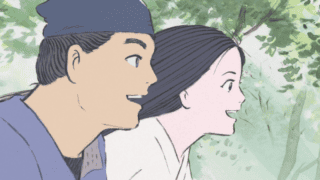
Okina Quotes in Japanese and English
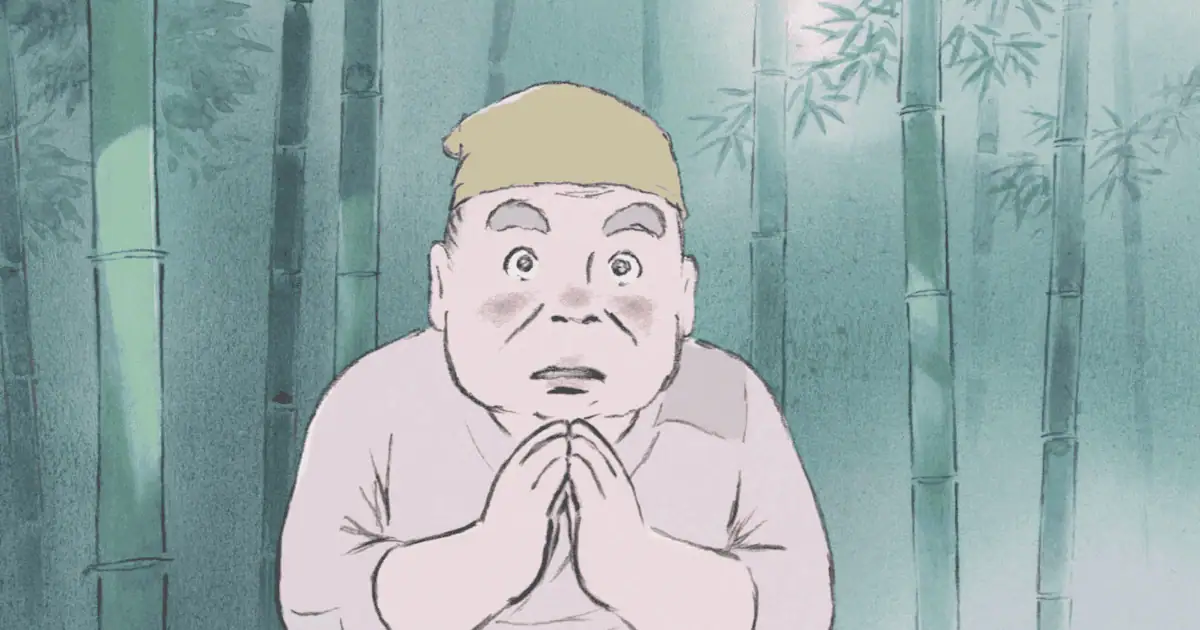
“Heaven must have sent her to me as a blessing.”
これはきっと天がわしに授けてくださったものに違いないぞ。
Kore wa kitto ten ga washi ni sazukete kudasatta mono ni chigai nai zo.
Heaven must have sent her to me as a blessing.
This must surely be something Heaven has bestowed upon me.
Read the Commentary and Analysis
I think this is something shared by many old folktales: the story starts moving when someone sees something mysterious in front of them and decides that it is theirs.
Both The Tale of the Bamboo Cutter and The Tale of the Princess Kaguya begin with precisely that thought on the part of Okina.
In other words, perhaps human beings are fundamentally greedy creatures.
There are moments when, if something does not appear to belong to anyone else, we cannot help thinking of it as our own.
That is the sort of animal we are… right?
The important English word here is blessing.
It can mean a divine favor, a gift from Heaven, or simply something for which one should be deeply grateful.
One might be tempted to use gift here, but because Okina specifically regards Kaguya as something granted by Heaven, blessing feels more appropriate.
The dub likewise says:
“This must be a blessing from heaven. I’m sure of it.”
“It wants us to give her a life that suits these robes.”
この衣にふさわしい暮らしを姫にさせよ。高貴の姫君に育てよ。そう天がお命じになっている
Kono koromo ni fusawashii kurashi o hime ni saseyo. Kōki no himegimi ni sodateyo. Sō ten ga omeiji ni natte iru.
It wants us to give her a life that suits these robes. To make her a noble princess.
Let the princess live a life befitting these robes. Raise her as a noble princess. That is what Heaven is commanding us to do.
Read the Commentary and Analysis
Many viewers probably came away from The Tale of the Princess Kaguya with an extremely negative impression of Okina.
I did too.
As long as we identify emotionally with Kaguya, almost every major decision Okina makes appears to be wrong. The story is structured that way.
But I do not think we have fully digested the film unless we at least try to understand what Okina himself believed he was doing.
If the fine robes had never emerged from the bamboo, Okina probably would have continued raising Takenoko normally in the countryside.
Remember that when he first discovers the gold, he hides it.
Receiving gold does not immediately make him think that he should transform his child’s entire life.
But then the robes appear.
At that moment, his interpretation changes.
He seems to think:
“Ah, I understand. The message was not simply ‘Use this money to raise the child.’ It was ‘Raise the child into someone worthy of these robes.’”
In other words, from Okina’s perspective, this has become a command from Heaven.
The people of the Moon are the ones at fault.
That is how I think we should look at it.
There is nothing especially unusual about the subtitle itself.
The dub says:
“To give princess a way of life that is appropriate to this robe. Raise their princess of noble rank. That is what heaven expects of us.”
“After your coming-out banquet, you’ll be a true princess!”
年が明けたらすぐに、髪上げと名付けの儀式。そのお披露目の宴を催せば、姫様は晴れて高貴の姫君ですぞ。いやっははーっ、めでたい、めでたい。
Toshi ga aketara sugu ni, kamiage to nazuke no gishiki. Sono ohirome no utage o moyōseba, hime-sama wa harete kōki no himegimi desu zo. Iyahhahā, medetai, medetai.
We’ll have the naming ceremony after New Year’s. After your coming-out banquet, you’ll be a true princess! This is wonderful!
As soon as the New Year begins, we’ll hold the hair-raising and naming ceremonies. Once we hold your formal presentation banquet, you will finally be a noble princess. Ah, how wonderful, how wonderful!
Read the Commentary and Analysis
This may be the highlight of Okina’s seemingly endless series of mistakes throughout The Tale of the Princess Kaguya.
By this point, we can see more clearly exactly how he is getting things wrong.
After witnessing both the enormous quantity of gold and the fine cloth emerging from the bamboo, Okina has come to believe that turning the child before him into a noble princess is his mission.
To put it another way, he has begun treating the transformation of Takenoko into a princess as a job.
Okina is no longer organizing his decisions around “What do I think?” or even “What does Kaguya want?”
He is organizing them around “What does society say a princess should be?”
Because, in his mind, this is his mission.
Seen this way, The Tale of the Princess Kaguya is also depicting a man who has subordinated himself to a social structure.
Can we really say that Okina himself is simply evil when he is trapped inside that structure?
I do not want to say that.
The problem is not simply Okina.
The problem is the social structure.
We should not mistake the person for the system that shaped his actions.
Which means that ultimately we are the ones who have to change.
There is nothing especially unusual about the subtitle.
The dub says:
“This banquet will make you a truly noble princess. So right after the new year, we’ll have a celebration of the putting up of hair and the naming ritual. This is wonderful!”
The word ritual means a formal ceremony or a prescribed ceremonial act.
▼ Read more about Okina’s character, background, and analysis
Ouna Quotes in Japanese and English
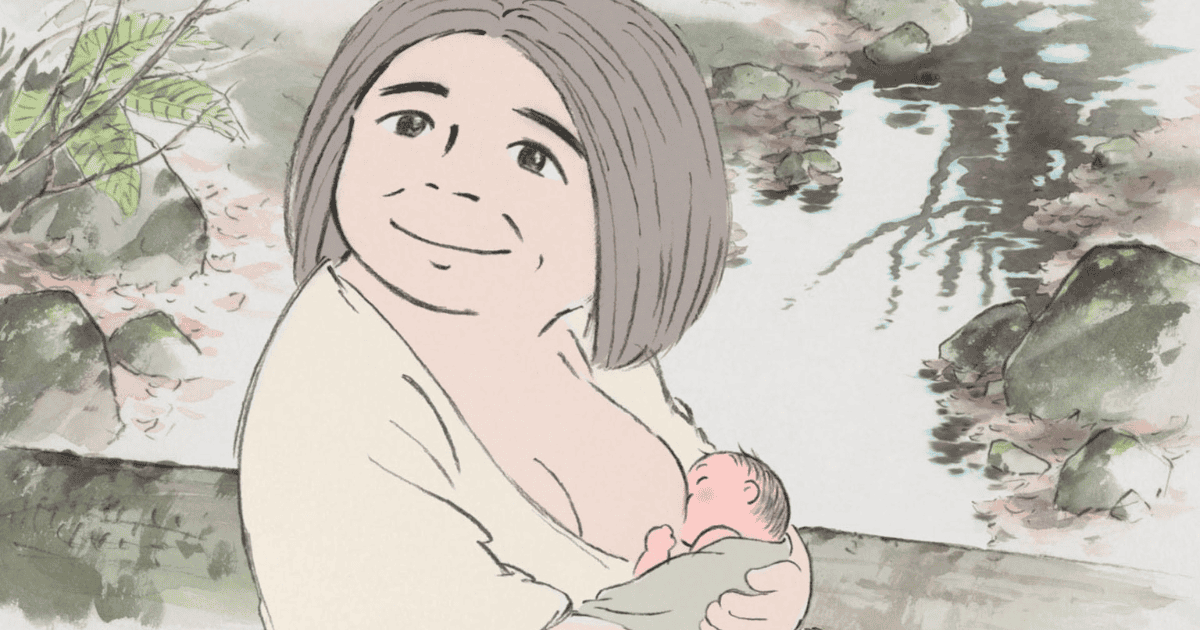
“That was Heaven telling us who she’ll grow into.”
あんな美しい娘になるよって、天が前もって見せてくださったんでっすよ、きっと。
Anna utsukushii musume ni naru yo tte, ten ga maemotte misete kudasatta n dessu yo, kitto.
That was Heaven telling us who she’ll grow into.
Surely Heaven showed us beforehand that she would grow into such a beautiful young woman.
Read the Commentary and Analysis
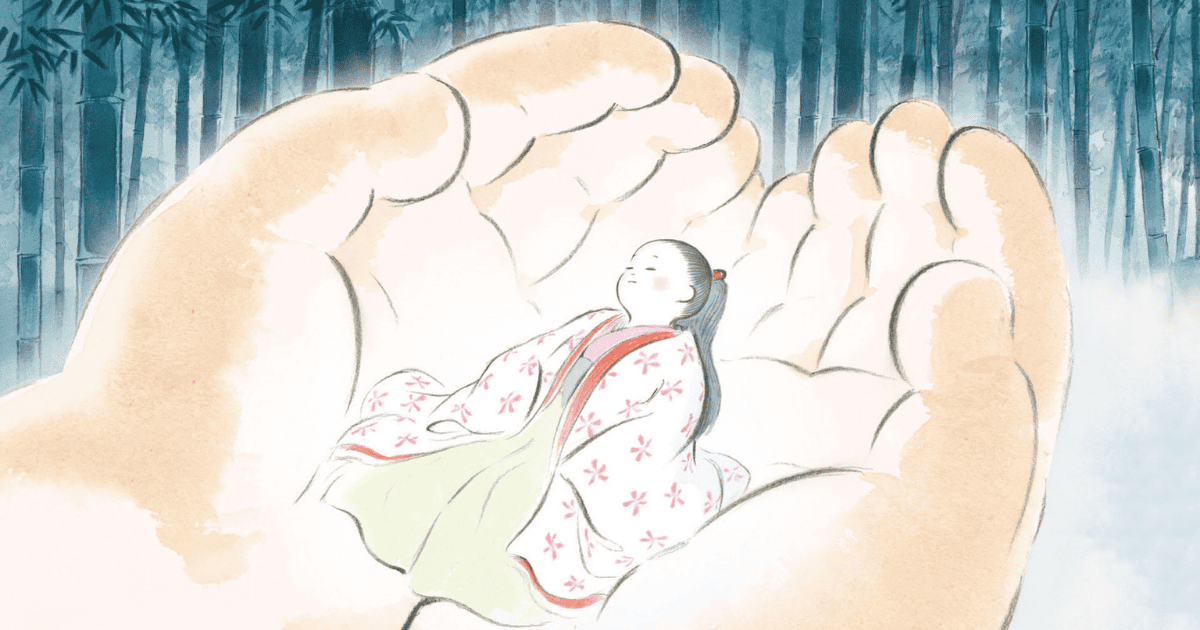
When Kaguya is first discovered in the bamboo grove, she is extraordinarily tiny but already has the appearance of a fully formed princess.
The instant Ouna takes her into her arms, however, she transforms into a baby.
Okina is understandably bewildered by what he has just witnessed, and Ouna offers this explanation.
Perhaps she meant it as nothing more than a reassuring remark.
But for Okina, it may have been an extremely useful way of rationalizing the situation.
It may even have been one of the first small triggers that made him strongly believe that this baby had to be raised as a “princess.”
I am not trying to blame Ouna.
No ordinary person could possibly imagine that an innocent remark like this might help produce Okina’s spectacular series of mistakes later in the story.
But perhaps many things that happen in this world begin with similarly tiny events—events whose consequences nobody could possibly imagine.
The world is chaos.
Perhaps it is nothing more than an accumulation of infinitely many butterfly effects.
Nobody can see where they will lead.
Maybe The Tale of the Princess Kaguya is also a story about that.
From the English-language side, the dub is particularly interesting because of how much information it places after the verb:
“I have to believe that’s Heaven showing us what a beautiful princess she’s going to become someday when she’s all grown up.”
English often postpones a long or complicated part of a sentence until later, which helps keep the beginning easier to process.
“But it’s not your fault.”
そうよね、でもあなたのせいじゃない
Sō yo ne, demo anata no sei janai.
Of course not. But it’s not your fault.
That’s true, but it isn’t your fault.
Read the Commentary and Analysis
Kaguya appears to have successfully dealt with the proposals of the five noblemen, only to find herself forced to confront the elaborate lies they have spent three years constructing.
That alone causes her enormous emotional strain.
Then, after the death of Middle Counselor Isonokami, she begins blaming herself deeply.
Ouna responds with this simple sentence:
“It’s not your fault.”
All kinds of things happen to Kaguya throughout the film.
Perhaps every time something happened, Ouna was silently repeating the same words in her heart:
“It’s not your fault.”
Meanwhile—although there is certainly room to sympathize with him—Okina spends much of the film continuing his spectacular one-man struggle against problems he has largely created for himself.
At times I almost want to make him drink an infusion made from the scrapings of Ouna’s fingernails, as the Japanese expression goes.
Still, Ouna’s feelings and Okina’s feelings come from the same place.
They are both the feelings of parents.
I only wish Okina had looked less at the “situation” surrounding Kaguya and more directly at Kaguya herself.
Perhaps that is simply difficult for fathers.
There is nothing especially unusual about the subtitle.
The dub says:
“And maybe true but it still doesn’t make it your fault.”
▼ Read more about Ouna’s character, background, and analysis
Sutemaru Quote in Japanese and English
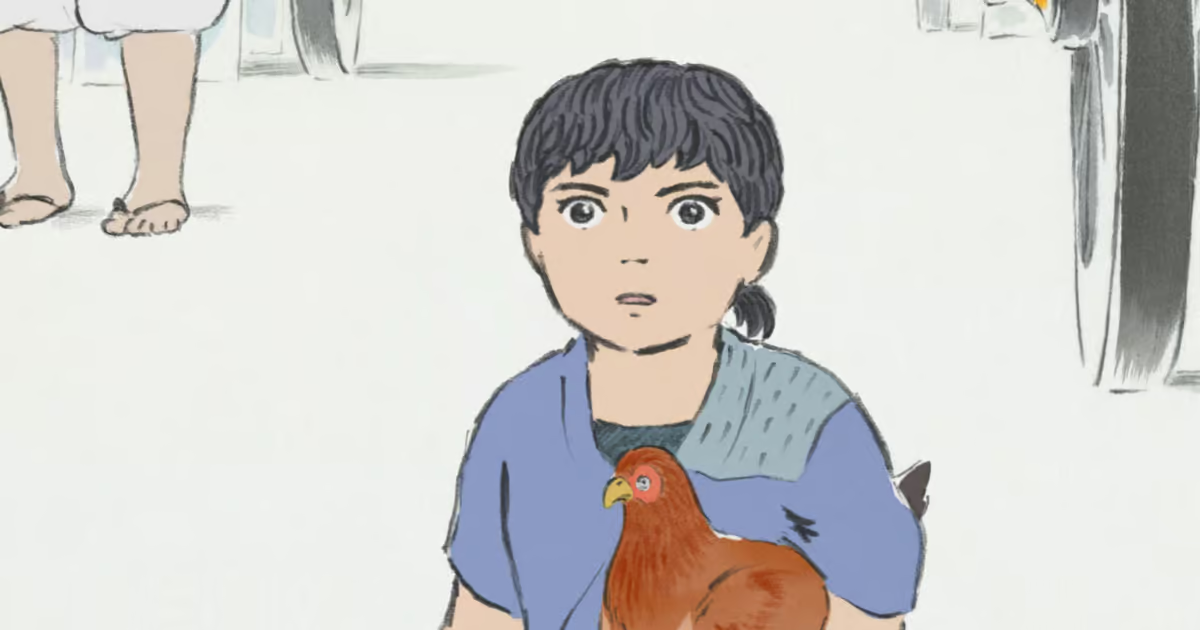
“So you’ve been found. So what?! Who cares?”
いいじゃないか、見つかってても!それがなんだ。そんなことどうだっていい。俺はおまえと逃げたいんだ!
Ii janai ka, mitsukattete mo! Sore ga nan da. Sonna koto dō datte ii. Ore wa omae to nigetai n da!
So you’ve been found. So what?! Who cares? I want us to run away!
So what if you’ve been found! What does that matter? I don’t care about any of that. I want to run away with you!
Read the Commentary and Analysis
Once it becomes certain that the people of the Moon are coming to retrieve Kaguya, Ouna helps her return once more to the mountain village of her childhood.
There she experiences a miraculous reunion with Sutemaru and effectively confesses her love to him.
This is Sutemaru’s answer.
On the surface, it is wonderfully romantic.
It would have been even more romantic if he did not already have a wife and child.
As a result, Sutemaru has earned some rather dishonorable nicknames among Japanese viewers, essentially painting him as a man prepared to abandon his family.
Still, if we look only at Kaguya’s pursuit of personal happiness, his decision was not necessarily wrong.
And when he finally wakes up alone and mutters, “A dream…?” I think he has received more than enough punishment.
Sutemaru experiences what may have been the happiest moment of his life, only to be returned immediately to an unchanged everyday reality.
Worse still, he must accept that “dreamlike time” as nothing more than something imagined inside his own mind.
Perhaps afterward Sutemaru spends the rest of his life dreaming about “somewhere else”—somewhere Takenoko is still waiting for him.
Even though Takenoko is no longer there.
If we think of that as his punishment, perhaps we can forgive him just a little.
The key English expression is “So what?”
It means something like “Why does that matter?” or “What difference does that make?”
It is generally quite confrontational, so it is probably not something we should throw casually into ordinary conversation.
But in this scene, that confrontational expression becomes extraordinarily romantic.
The dub likewise says:
“So what even if you have been found? So what! I don’t care about that. I want to run away with you!”
▼ Read more about Sutemaru’s character, background, and analysis
Prince Ishitsukuri Quote in Japanese and English
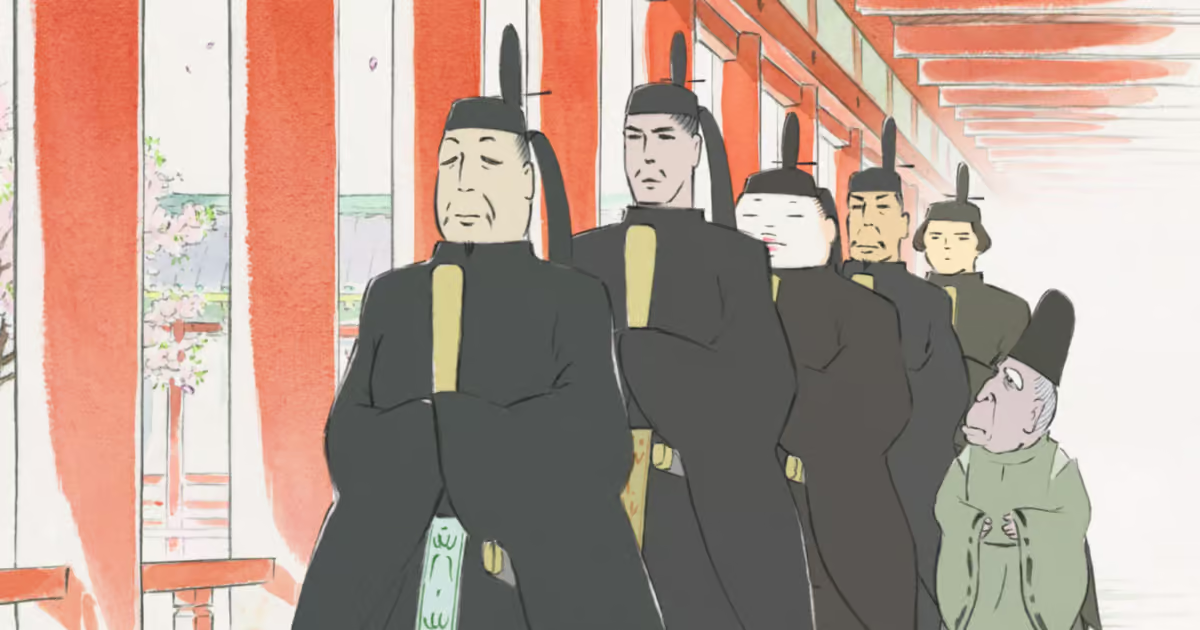
“Princess, come with me to some place that is not this one.”
姫、私と共に参りましょう。ここではないどこかへ!
Hime, watashi to tomo ni mairimashō. Koko de wa nai dokoka e!
Princess, come with me to some place that is not this one.
Princess, come away with me. To somewhere that is not here!
Read the Commentary and Analysis
Most of the five noble suitors who seek Kaguya’s hand at least go to the trouble of producing some kind of object, even if those objects ultimately turn out to be fake.
The playboy Prince Ishitsukuri chooses another strategy.
He tries to win Kaguya through the power of words alone.
And astonishingly, he very nearly succeeds.
Fortunately, the resentment of another woman who has already fallen victim to his eloquence arrives at precisely the right moment and ruins everything.
This line ultimately exposes just how unreliable a man he is.
At the same time, however, it also gives voice to one of the most important phrases in the entire film:
“Somewhere that is not here.”
Ever since arriving in the capital, Kaguya has been searching for “somewhere that is not here.”
During the banquet held in her honor, she races desperately toward that imagined elsewhere, only to discover that the place she remembers is no longer the “somewhere” she was looking for.
Then Prince Ishitsukuri appears and offers her another “somewhere that is not here.”
For a moment, the words make it seem possible that an entirely new place might exist.
He has found exactly the weak point in her heart.
Perhaps that is what a successful ladies’ man really is: someone who knows exactly what the other person wants to hear.
I would like to learn from him in that respect.
Unfortunately, I cannot do it, which is why I am not a ladies’ man.
Let us love ourselves anyway. Amen.
There is nothing especially unusual about the subtitle.
The dub says:
“Princess, I want you to come with me to that place.”
▼ Read more about Prince Ishitsukuri’s character and analysis
Inbe no Akita Quote in Japanese and English
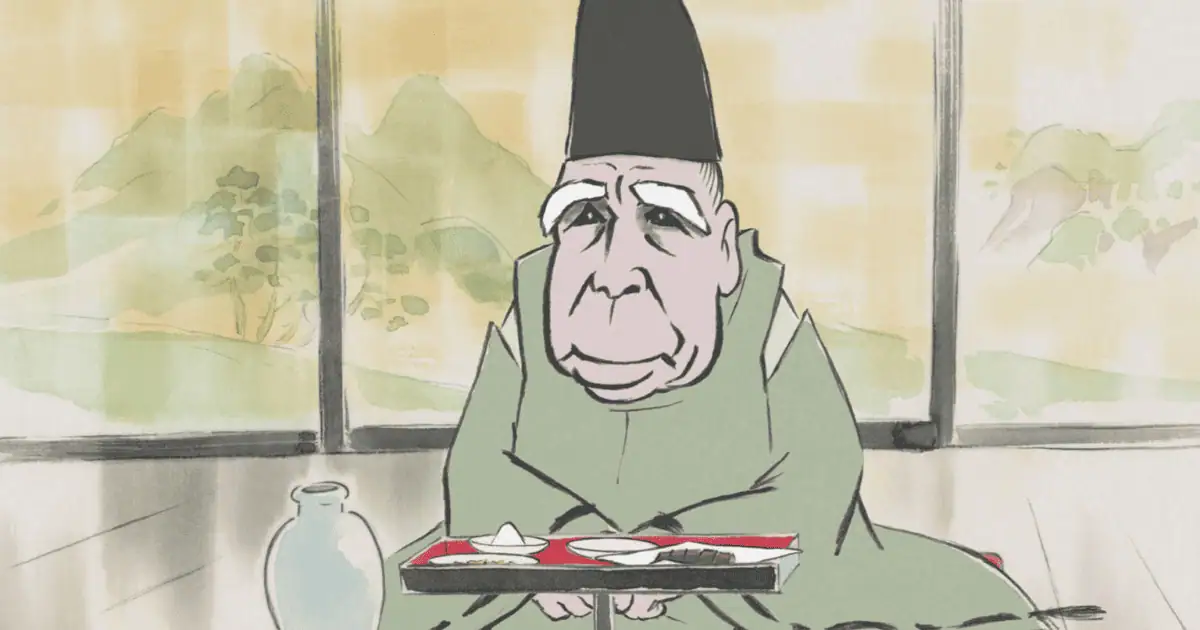
“This aged body began to tremble…”
かぐや姫様に対面いたしたその瞬間、老いたるこの身すらブルルと震え、さながら枯れた泉がよみがえったかのよう
Kaguyahime-sama ni taimen itashita sono shunkan, oitaru kono mi sura bururu to furue, sanagara kareta izumi ga yomigaetta ka no yō.
The moment I stood before her… this aged body began to tremble…as if a dry fountain had come back to life.
The moment I stood before Princess Kaguya, even this aged body began to tremble, as though a dried-up spring had come back to life.
Read the Commentary and Analysis
Inbe no Akita says this while describing his first meeting with Princess Kaguya to the five noble suitors.
But think about it for a moment.
Would a man really react this way merely because a woman was extraordinarily beautiful?
When the film actually shows Akita meeting Kaguya, his reaction really is this extreme.
That suggests that there may be something unusual about Kaguya’s “beauty” itself.
I explore that question in more detail here:
Why did Inbe no Akita literally begin to tremble?
The useful English word here is tremble.
It is one of those words many learners have encountered before and vaguely remember, but which can still disappear from memory when it suddenly appears in an actual sentence.
It means “to shake” or “to shiver.”
Another potentially unfamiliar word is fountain, which can refer to a fountain or, in some contexts, a natural spring.
The dub says:
“I must confess that the moment I stood before Princess Kaguya, this old man’s body began to tremble. As if a dry fountain had come flowing back to life.”
▼ Read more about Inbe no Akita’s character and analysis
The Emperor Quote in Japanese and English
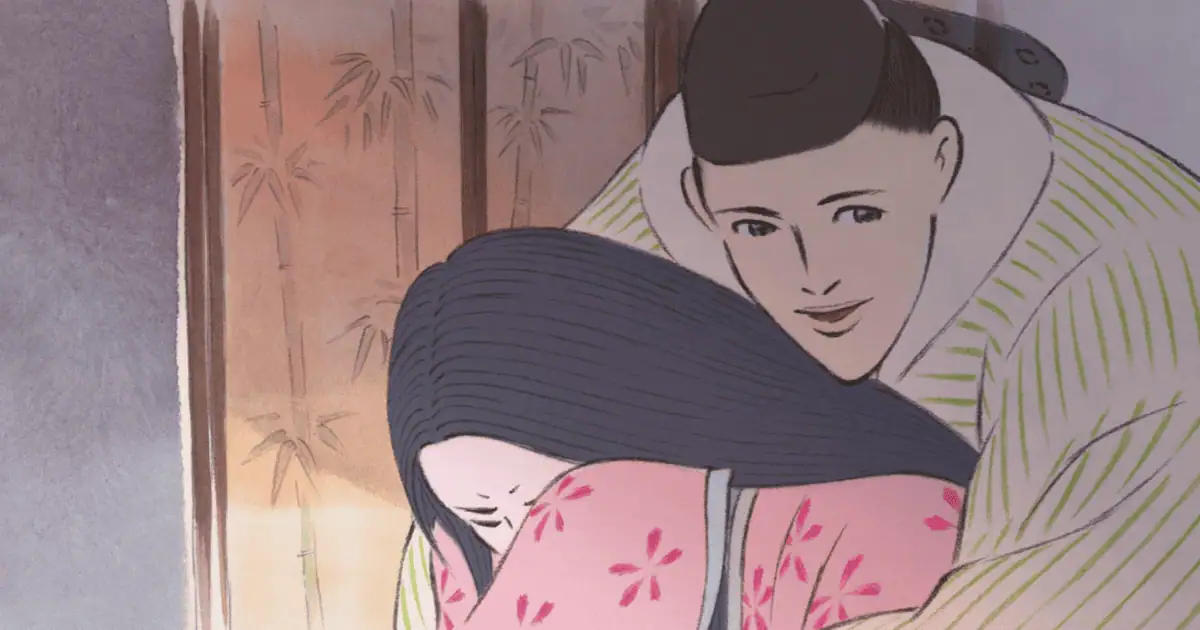
“I never dreamed a woman would ever turn me down.”
よもや私の申し出を断る女がいるとは思わなかった。おもしろい。ますます会いたくなったぞ
Yomoya watashi no mōshide o kotowaru onna ga iru to wa omowanakatta. Omoshiroi. Masumasu aitaku natta zo.
I never dreamed a woman would ever turn me down. Fascination. I wish to meet her all the more.
I never imagined there could be a woman who would refuse my offer. Interesting. Now I want to meet her even more.
Read the Commentary and Analysis
There is not much that needs to be said about this line.
But if I am completely truthful, perhaps my first reaction is simply:
I would have liked to experience a life in which I could say something like this once.
What follows, of course, is an extremely humiliating experience for Kaguya.
Considering the social structure of the historical period, the fact that the Emperor behaves this way may not have been particularly surprising by the standards of that world.
That does not make his actions right.
From a modern perspective, they are both wrong and disturbing.
But ordinary life begins from almost exactly the opposite assumption.
Nearly every proposal you make can be rejected, and you somehow keep living anyway.
I would like to believe that the Emperor suffered from difficulties created by his extraordinary position.
But within The Tale of the Princess Kaguya, he is simply irritating.
Perhaps the only consolation is that his chin is sharpened to an almost impossible degree.
Let us focus on that.
There is nothing especially difficult about the English expression.
The dub says:
“No woman has ever turned me down before. Very interesting. Now I truly want to meet her all the more.”
▼ Read more about the Emperor’s character and analysis
My Three Favorite Quotes from The Tale of the Princess Kaguya
Those are the memorable lines from The Tale of the Princess Kaguya that I personally selected.
My own three favorites are:
- “I’ll always be one of your gang.”
- “I never dreamed a woman would ever turn me down.”
- “I want us to run away!”
What are your favorite quotes from The Tale of the Princess Kaguya?
The images used in this article are from the Studio Ghibli Works Still Image Collection.
Can you name the movie before the scene comes into focus?
Put your visual memory to the test with a blurred Studio Ghibli scene.
Reader Comments