
Released on March 3, 2007, 5 Centimeters per Second (official website, in Japanese) is an animated feature directed by Makoto Shinkai. It follows his earlier works Voices of a Distant Star and The Place Promised in Our Early Days, but differs from them in an important way: it has no science-fiction premise.
The film consists of three connected stories: “Oukasho” (“Cherry Blossom”), “Cosmonaut,” and “5 Centimeters per Second.” They follow one protagonist, Takaki Tono. I have never heard anyone simply say they love 5 Centimeters per Second without qualification. What kind of story is it, then?
*This is a translated version. The original (Japanese) is available here.
- Detailed Synopsis and Character Map
Takaki Tono and Akari Shinohara carry their childhood feelings with them as time and distance separate them. They grow into different lives, still moved by memories. Even without a reunion, each begins walking toward a separate future. The detailed synopsis and character map follow. - Points for Analysis
I consider the opening scene of the third chapter and the meaning of the speed in the title, with links to more detailed discussions.
On this pageContents
5 Centimeters per Second (2007): Synopsis (Spoilers Ahead)
The three chapters follow Takaki from childhood through the losses and changes of adult life.
A Quick Summary and Character Map
Here are the main points of 5 Centimeters per Second:
- The protagonist is Takaki Tono. Three short stories follow him: “Oukasho,” “Cosmonaut,” and “5 Centimeters per Second.”
- “Oukasho” follows Takaki in middle school and his love for—and separation from—Akari Shinohara, whom he met in elementary school.
- “Cosmonaut” is told through Kanae Sumida, who loves Takaki after he moves to a school in Kagoshima. Her feelings do not reach him, but she grows through the experience.
- “5 Centimeters per Second” follows Takaki as a working adult, from his unfulfilling days to his decision to leave his job and become a freelancer.
- The story has a deeply melancholy atmosphere.
Character Map
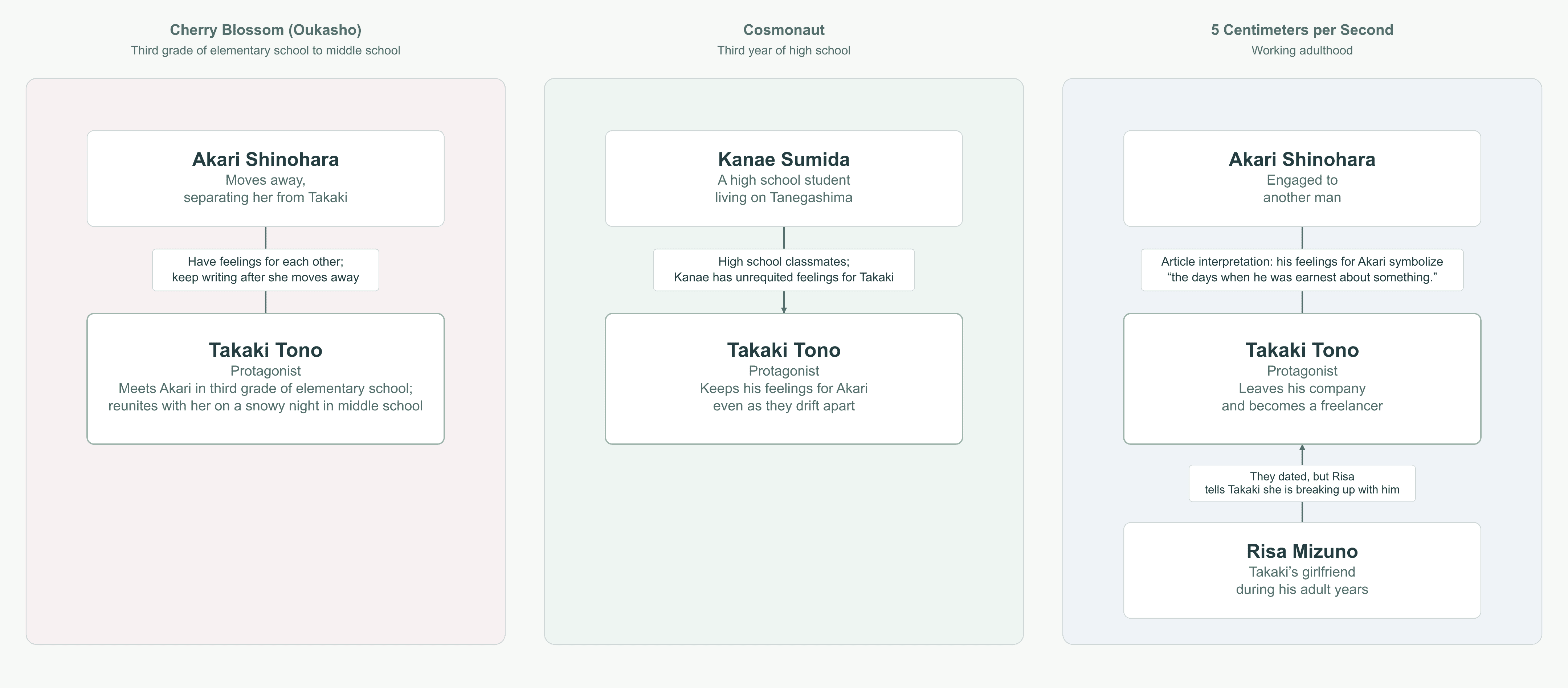
The character map labels Takaki’s feelings for Akari in the third chapter as “a symbol of the days when he was earnest about something.” This is entirely my interpretation. Watching the film, he can still look hung up on her. But within the story, I find it more natural to see her as a symbol of beautiful days for an adult Takaki who feels something is wrong with his working life.
Why Does the Film Feel So Depressing?
From beginning to end, 5 Centimeters per Second emphasizes loss, unattainable desires, and dissatisfaction with the present. I think that is why people often call it depressing. Takaki’s unfulfilled first love, the distance between people, and his empty working life all leave viewers feeling helpless—perhaps partly because many recognize those experiences.
That is only one aspect of the story, though. We can also read each chapter as a period of struggle that prepares its characters to move into a new stage of life.
Takaki’s final decision is especially important. He ends his unfulfilling life as a company employee and chooses to work freelance. Perhaps this reflects Shinkai’s own experience of leaving a game company and taking a major step with his independently produced animation. Read this way, the film becomes a message of encouragement to people facing similarly unfulfilling days.
Shinkai worked at the game company Nihon Falcom before leaving to make his own animation. His independent project, Voices of a Distant Star, appeared in 2002.
If your days feel stagnant, perhaps they are a run-up to a larger leap. Reading that message into 5 Centimeters per Second may change how we receive its melancholy atmosphere.
With that reading in mind, let’s look back at the story.
The film opens on a gentle spring day. A girl says that five centimeters per second is the speed at which cherry blossom petals fall. A boy follows her as she runs ahead, but a railway crossing separates them. Opening a pink umbrella, she says she hopes they can watch the blossoms together again next year. With her umbrella open, she looks like a cherry blossom herself.
Detailed Synopsis
Episode 1: Oukasho (Cherry Blossom)
Takaki Tono is a middle school student in Tokyo, reading letters from Akari Shinohara, who has moved to Tochigi. They have known each other since elementary school but have not met since graduation. Her letters express nostalgia for Tokyo—perhaps really for Takaki himself. He, too, finds his unforgettable days in her words.
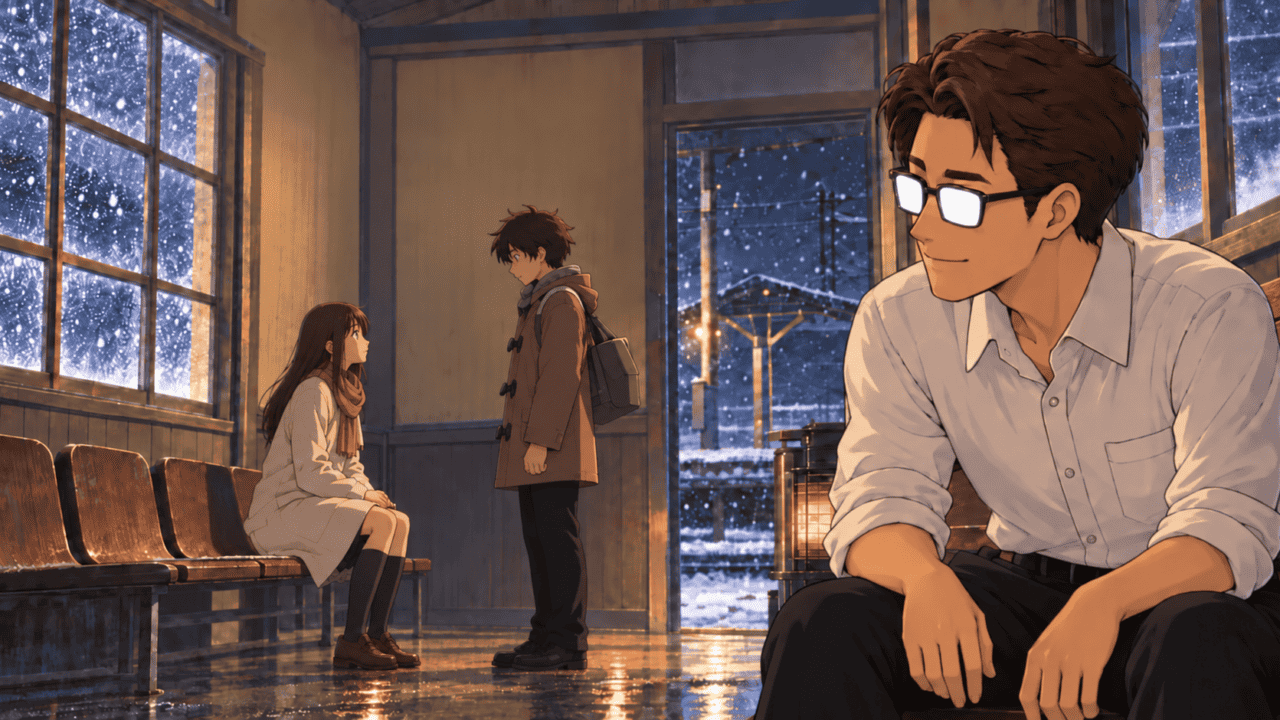
Takaki is about to move to a school in Kagoshima. Thinking this may be their last chance, the two arrange to meet. He skips club activities that day and hurries toward Akari, but heavy snow halts the train, as though trying to separate them.
He changes trains and struggles to reach her station. Along the way, a gust of wind carries away the letter he meant to give her.
Why include the lost letter? In my reading, it lets Takaki blame something external for his failure to express himself. But he is still a middle school boy. Perhaps he wants to blame the wind for the approaching separation because he already senses what lies ahead.
Even without the letter, he keeps going. This is not an age when he can send a message on a smartphone. He has to trust her and continue.
He finally reaches the station late at night. Akari is still there, waiting for him.
Takaki reaches the station at around 11:15 p.m. Surely a middle school girl waiting there should have been sent home much earlier, even with a station attendant present. Did the attendant decide to accommodate the plot?
They eat the boxed meal Akari has made. The last train has gone, so they leave the station together and eventually come to a cherry tree that lost its blossoms long ago. Yet to them, it seems to be in full bloom.
They kiss beneath it. The moment is unforgettable, but it also makes their coming separation painfully real. Feeling Akari’s warmth directly, Takaki realizes that physical distance will take that warmth away. He is still a child, unable to do anything about it.
They spend the night in a barn near the cherry tree.
Spending a snowy night in a wooden barn hardly seems possible. Yet that is what they do. What they need at that moment is a world of their own; even a ramshackle barn will do if it hides them from everyone else. In short, a private love hotel for two. So what exactly happened that night?
The next morning, they say goodbye on the platform. Looking somewhat anxious, Akari tells him she is sure he will be all right. While she offers him encouragement, he can only thank her, wish her well, and promise to write.
Watching his train leave, Akari takes out the letter she could not give him. She had written one too. Like Takaki, she senses that their childhood story has reached its end.
On the train home, Takaki strongly wishes for the strength to protect her. At the same time, that chapter of their childhood closes.
Episode 2: Cosmonaut
The second chapter follows Kanae Sumida, a third-year high school student on Tanegashima. Two things matter especially to her: surfing, which she took up through her sister, and Takaki Tono.
She surfs early every morning. But it is also an excuse to get to school early and see Takaki, who practices archery alone before classes.
The students must submit their plans for after graduation, but Kanae cannot decide. As though reflecting that uncertainty, she has also become unable to stand on her surfboard.
She does not only find reasons to see him in the morning; she waits for him after school too, trying desperately to tell him how she feels.
Kanae’s flashback suggests that she fell for Takaki almost as soon as he transferred to her middle school. She then studied hard to enter the same high school, drinking plenty of Estaron Mocha along the way. I know it works, but a middle schooler should not be drinking so much of it. I know it works, though.
She arranges for them to go home together. Riding alongside Takaki, each on their own scooter, makes that time special. Yet whenever she looks away, he takes out his phone and checks his messages. She wants to know whom he is writing to, but cannot ask.
Amid these unsettled days, Kanae still cannot choose her future path. She is the only student who has not submitted the form, and she cannot recover her surfing either. She blames herself for leaving everything half done.
One day, she cannot find Takaki after school. Giving up and riding home, she spots his scooter. He is sitting on a hill beyond it, looking at his phone as though exchanging messages with someone. Still wondering about the recipient, she tells him her worries about the future. Surprisingly, he says he is always worrying too. That makes her feel a little better.
Until this point, the monologue has been Kanae’s; here it suddenly becomes Takaki’s. His school is near a JAXA facility, and he is deeply interested in space development. He connects its endlessness with his own life. Perhaps his parents work in that field. From here, the role of protagonist returns to him.
The messages Kanae worries about have no recipient. Takaki writes them night after night, but they are more like a story than correspondence. He puts his feelings into a novel in the form of emails addressed to no one.
Takaki shares Kanae’s frustration, but she is the first to break out of it. Coming to terms with her uncertainty gives her back a sense of freedom, and she regains her ability to surf.
As Kanae recovers, Takaki remains closed within himself, unable to grow. Having moved forward on her own, she decides to confess her feelings. But his kindness has not changed at all, and she cries. She realizes that he is standing still, that her feelings will not reach him, and, above all, that she has overtaken him.
A rocket cuts through the sky as though blessing their separation. They are going to live entirely different lives.
Kanae concludes that Takaki was never looking at her in the first place. Perhaps that is another way of saying that the person before her has changed meaning: he now belongs to her past. Still, she cries in bed, as though holding a final farewell ceremony, telling herself she will always be able to love him.
Episode 3: 5 Centimeters per Second
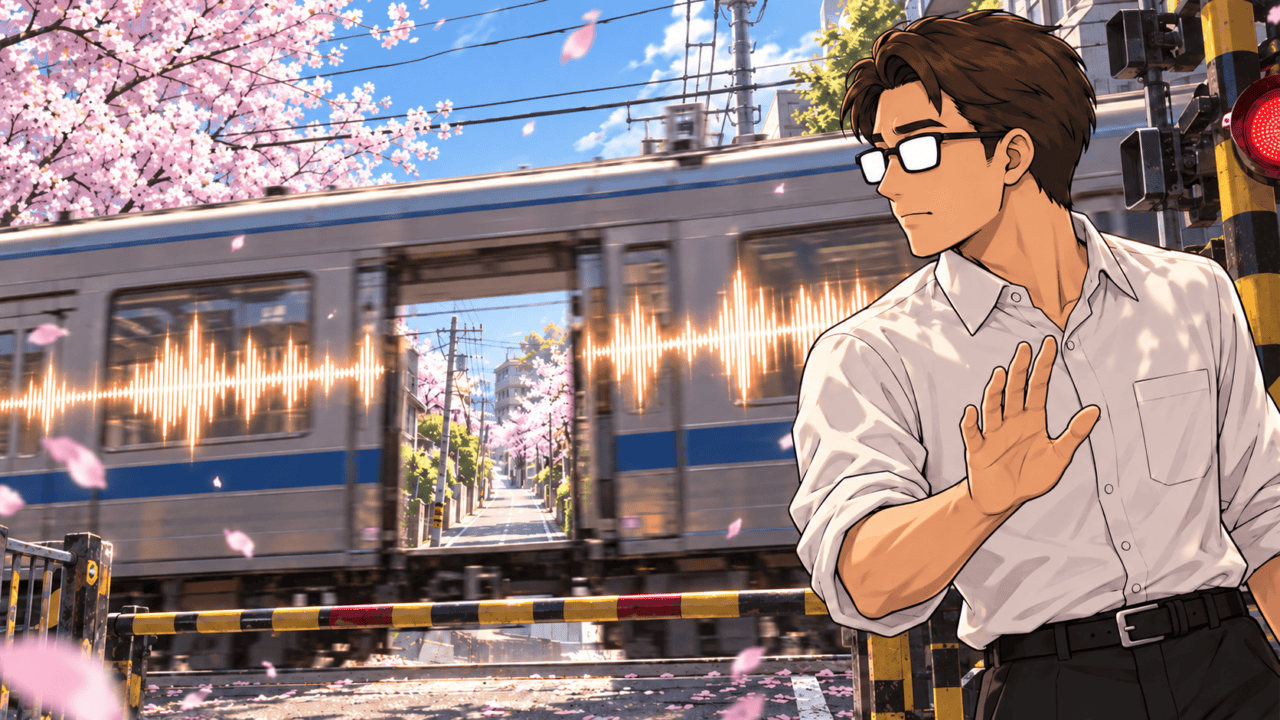
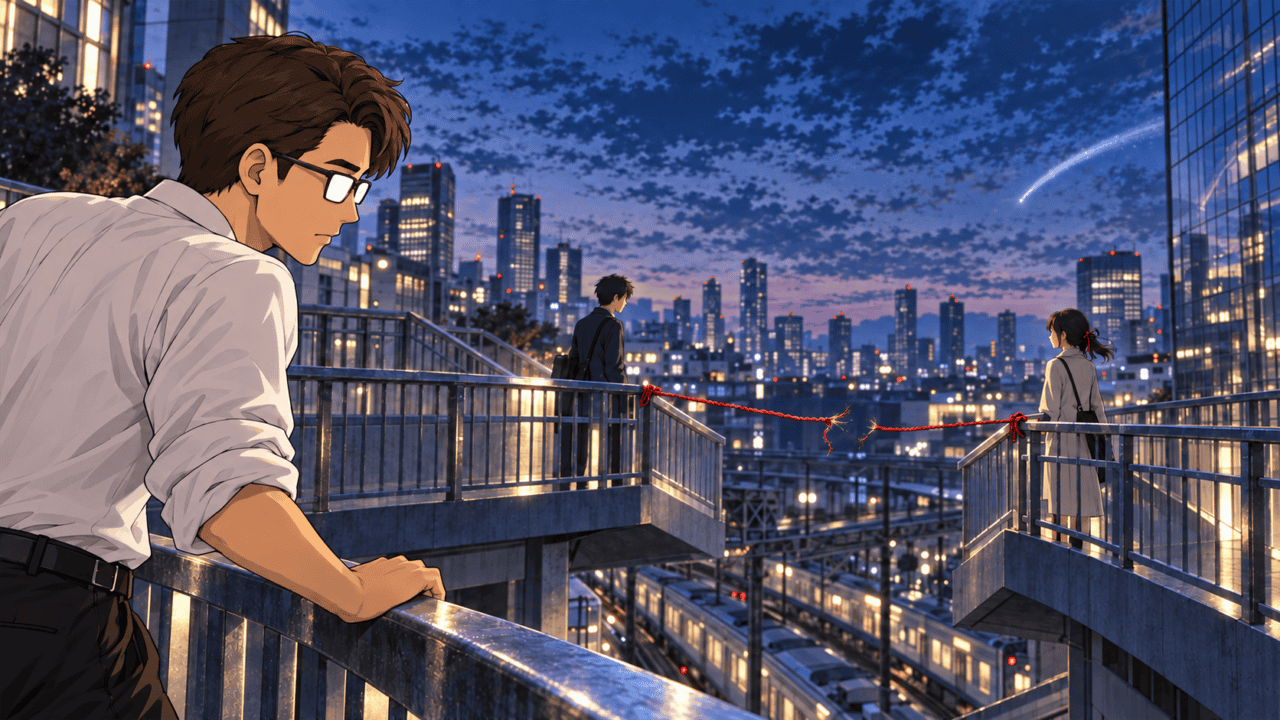
On a spring day, with cherry blossoms falling, the adult Takaki works at home. Drawn outside by the breeze, he goes for a walk and passes a woman at a railway crossing. Instinctively feeling that she is Akari, he turns, but a train blocks his view. Memories return to him.
After taking a job in Tokyo, Takaki has lived through unfulfilling days. He works hard within the company’s logic, but finds that life painful. At the same time, his relationship with his girlfriend deteriorates. He feels trapped.
Akari, meanwhile, is busy preparing for her wedding. Visiting her parents, she finds the old letter she never gave Takaki and recalls their past. She dreams of him.
Takaki’s girlfriend eventually ends their relationship by email.
His girlfriend’s message says that despite exchanging a thousand emails, their hearts have moved only about a centimeter closer. It is such a literary expression that I always laugh a little. Takaki’s next monologue is literary too. I want to tell him, “If you can write a monologue like that, you’ll be all right.”
These two passages are perfect examples of how unusually literary the dialogue in this film can be. I examine Risa’s “1 centimeter” message and Takaki’s monologues in more detail in 13 5 Centimeters per Second quotes in Japanese and English.
He looks back over the four years since he began working. A vague desire to move forward has driven him almost compulsively, yet he has ended up merely getting through each day. Realizing that the desire has disappeared, he decides to quit his job. He, too, dreams of Akari.
Akari takes a new step through marriage; Takaki does so by leaving his job. The cold, snowy winter of their youth gives way to a gentle spring.
At the crossing, Takaki turns to look at the woman who seems to be Akari. The train blocks his view. When it passes, she is gone.
He feels a little lonely, but takes a firm step toward his new days. That is my account of the story, though some of my own interpretation has slipped into the synopsis. You may feel a discrepancy when you watch the film; so it goes.
5 Centimeters per Second (2007): Points for Analysis
Having followed the story, I want to consider a different reading of 5 Centimeters per Second: through the opening of the third chapter and the speed suggested by its title.
Why the Third Chapter’s Opening Matters
Near the end, Masayoshi Yamazaki’s “One more time, One more chance” plays alongside the film’s title.
Loading video...
With the song’s yearning for someone who is gone, Takaki looks like a grown man still chasing Akari. Meanwhile, she is steadily preparing to marry someone else. The contrast can make us feel miserable for him. But we do not have to watch the film that way.
Instead, look back at the timeline.
For me, the key is the opening scene of the third chapter.
I understand why the ending feels depressing. But the spring day at the start of the third chapter shows Takaki’s most recent life, after he has left his job. Passing the woman at the crossing prompts him to remember those earlier days. If we keep that gentle opening in mind, 5 Centimeters per Second no longer has to feel like a depressing film.
He does not collapse when the woman is gone. He smiles and walks on. In 5 Centimeters per Second, I see that step as a movement toward a new life, rather than proof that he is trapped in his past.
What Does the Speed in the Title Mean?
The opening tells us that “5 centimeters per second” is the speed at which cherry blossom petals fall. But it also names the third and final chapter. That deserves attention.
At five centimeters per second, someone moves three meters a minute. Walking at that pace would look almost like standing still. In my reading, the speed is a metaphor for life’s slow but real progress.
Even in days that seem stagnant, we change and move forward little by little. Those small steps make up a life. Perhaps the title’s real message is to affirm them.
I explore that interpretation in more detail in the companion article below.
Read the detailed interpretation: A Positive Reading of 5 Centimeters per Second
Watch the film for yourself and see whether this reading makes sense to you.
Your Take: The Ending of 5 Centimeters per Second
The final scene can feel like a loss, a new beginning, or both. What did it leave you with?
Poll results
How does the ending of 5 Centimeters per Second feel to you?
- A sad ending about love that didn’t last.0%
- A hopeful ending about moving forward.0%
- Both sad and hopeful.0%
- I see it differently.0%
- I’m not sure.0%


Reader Comments
Have a thought or interpretation? Leave a comment