
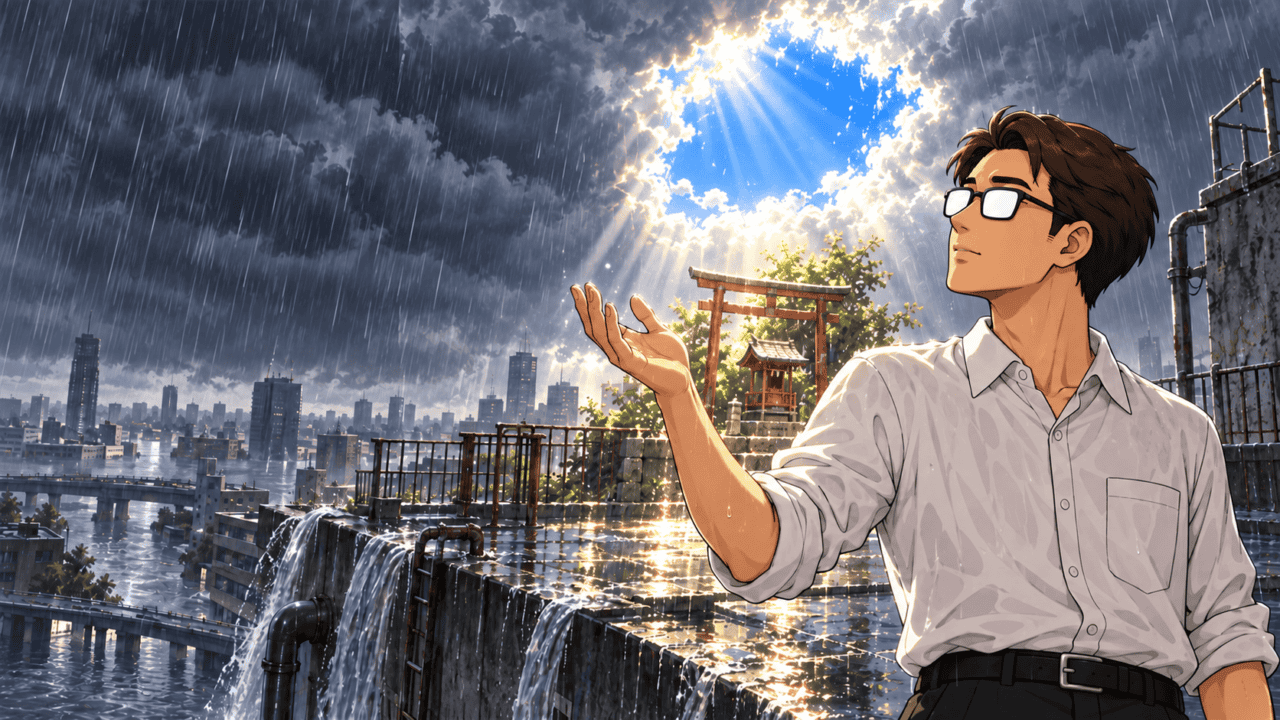
Weathering with You (Official Website) is Makoto Shinkai’s 2019 animated feature. It arrived amid high expectations after the extraordinary success of Your Name. Although it did not match the box office of Your Name., its 14.1 billion yen gross in Japan made it a major hit. Shinkai became the second director after Hayao Miyazaki to have two consecutive films exceed 10 billion yen there.
By then I was already a fan of Shinkai’s work, and I remember going on opening day. The ending divided opinion, but what story does the film tell?
Here I recount Weathering with You and consider three of its mysteries. The synopsis covers the whole story, so if you want to avoid spoilers, stop partway through and see the film first.
*This is a translated version. The original (Japanese) is available here.
- Detailed Synopsis and Character Map
Runaway Hodaka meets Hina, a sunshine girl, in Tokyo. Her power brings people joy, but exacts a heavy price. Saving her requires a decision that changes the world. Years later, the reunited pair declare that they will be okay. Below are a detailed synopsis and a character map. - Points for Interpretation
I explore the weather maiden’s powers, the meaning of “We’re gonna be OK,” and Hodaka’s cheek wound, with links to longer discussions of each.
On this pageContents
Weathering with You (2019): Synopsis (Spoilers Ahead)
The synopsis follows Hodaka and Hina from their meeting in Tokyo through the choices that shape the ending.
A Quick Summary of the Plot
The main events of Weathering with You are as follows:
-
A Runaway Arrives in Tokyo
Sixteen-year-old Hodaka Morishima leaves his island home and arrives in rainy Tokyo without a job or a place to live. -
Meeting Hina, the Sunshine Girl
Hina Amano, a girl working at McDonald’s, helps the hungry Hodaka. He later discovers that her prayers can clear the weather. -
Living and Working with Keisuke Suga
Magazine writer Keisuke Suga takes Hodaka in. Through odd jobs and reporting work, he begins to make a life in Tokyo. -
The Sunshine Girl Business
Hodaka and Hina start a service that brings clear skies to customers’ events. Their work delights people across Tokyo. -
The Cost of Hina’s Power
As the rain continues, Hina begins showing signs of illness. Using her power puts her body in increasing danger. -
The Amano Siblings in Difficulty
Hina supports herself and her younger brother Nagi. As children living without an adult guardian, they face intervention from the authorities. -
Hodaka and Hina on the Run
The police search for the runaway Hodaka, while Hina faces the prospect of being taken into protective care. The two find themselves unable to stay where they are. -
Hina’s Fate as a Sacrifice
According to the legend told within the film, a girl who can clear the weather is destined to be offered to the sky. Hina faces the growing possibility of disappearing. -
A Choice Made in Defiance
Determined to save Hina, Hodaka acts despite Suga and the others trying to stop him. He and Hina confront the truth behind the clear skies. -
Reunion in a Changed World
Hodaka’s decision to save Hina leaves Tokyo under unending rain, transforming its landscape. Three years later, the two meet again in the city.
Character Map
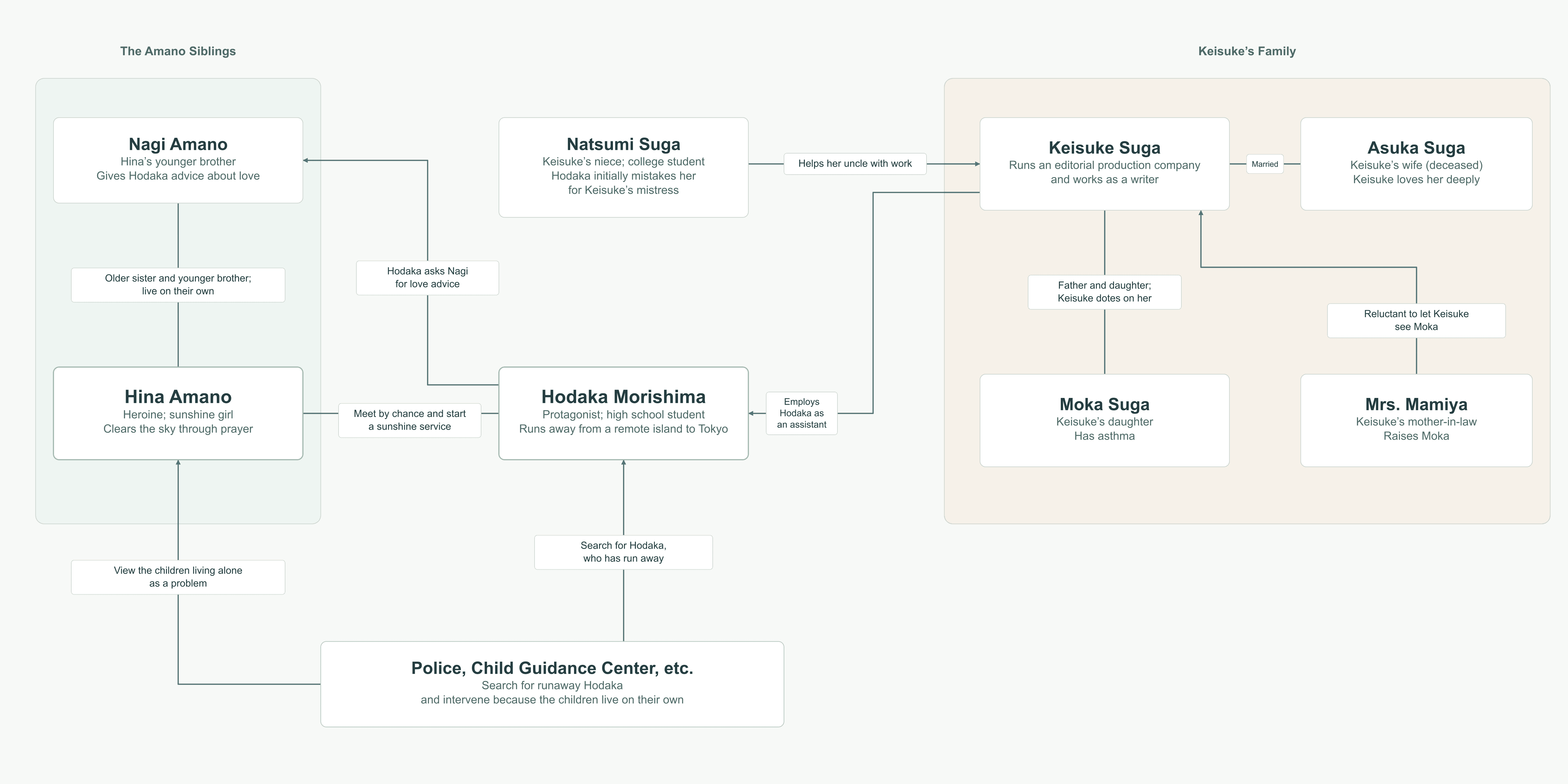
▼ For character profiles and English voice actors, see:
Weathering with You: Characters and English Voice Cast
Detailed Synopsis & Ending (Spoilers Ahead)
Here is the story in detail, from a boy meeting a girl in rainy Tokyo to a choice that changes the world, and the divisive final scene.
Act I: Hodaka Arrives in Tokyo and Meets Hina
Hodaka Morishima, a first-year high school student, is on a ferry to Tokyo after leaving home. He wants to reach somewhere other than where he was. His face, too, bears signs of injury.
As the weather changes, the other passengers go inside, but Hodaka heads out into the rain. Being drenched gives him a sense of freedom. Then a mass of water unlike ordinary rain falls onto the ferry, nearly throwing him overboard. A man catches him and saves his life.
The man is Keisuke Suga, unmistakably middle-aged and not especially respectable-looking. Still, he has saved Hodaka’s life, so the boy treats him to a meal and an expensive beer—a painful expense given how little money he has.
They part on arriving in Tokyo, but Suga leaves him a business card: K&A Planning, CEO Keisuke Suga.
Using an internet café as his base, Hodaka searches for well-paid work available to a minor with no identification or guarantor. Even in Tokyo, that is too much to ask. One night, exhausted, he falls asleep by a building entrance. He wakes to a frightening man staring at him and tries to leave, only to be tripped. He crashes into a trash bin and spills its contents. Among the rubbish he finds what looks like a gun wrapped in paper, and puts it in his bag.
Hodaka has been visiting a fast-food restaurant and ordering only a hot drink for three nights in a row to save money. A young employee notices and gives him a burger. In the loneliness of Tokyo, this small kindness is human warmth at last—the most delicious dinner of his life.
The next morning, with no other prospect, he visits Suga. The title “CEO” had given him a little hope, but the address leads to a shabby former bar rather than much of an office. Suga makes his living providing urban-legend stories to magazines such as Mu, with occasional help from his niece Natsumi, a university student. After barely an interview, Hodaka is taken on provisionally.
Hodaka and Natsumi investigate a sunshine girl rumored about online. A dubious fortune teller tells them that such girls can affect the weather, but disappear if they overuse their powers. Hodaka does not believe it. Once he writes up their findings, however, his job becomes official.
His work consists largely of odd jobs, but he finds his new days fulfilling and continues investigating the sunshine girl. One day in Shinjuku, he sees the girl who gave him the burger being led toward a suspicious establishment by rough-looking men. He grabs her and runs, but they catch him and beat him. To get out of the situation, he impulsively fires the gun he has been carrying.
While the men reel from the shot, he escapes with the girl into an abandoned building. He thinks he has done something good, but she reproaches him for firing the gun and calls him creepy. Her reaction shocks him. He, too, is bewildered by what he has done.
As they recover, the two begin to get along. The girl leads him to the rooftop, looks at the rainy sky, and tells him it will clear now.
To his astonishment, it does. She is the sunshine girl he has been investigating. The two finally introduce themselves, oddly calm after this supernatural event. She is Hina Amano, and she says she is eighteen—two years older than him.
That night, heavy rain returns to Tokyo.
Act II: A Sunshine Business and the Weather Maiden’s Secret
Hodaka thinks of turning Hina’s ability into a business while strange changes begin appearing in the world. Videos online show rain forming transparent creatures on the ground. He is skeptical, but Natsumi believes they must belong to a special ecosystem in the clouds. She heads off to look for a job of her own.
At Hina’s apartment, Hodaka learns that her mother died the previous year and that she now lives with her younger brother Nagi. After she cooks him a meal, they discuss a sunshine service. They set the fee at 3,400 yen, taking living expenses into account, and create a website for bookings.
Their first request arrives sooner than expected: an outdoor event needs clear skies. The organizers are doubtful, and almost give up when the rain persists, but Hina’s prayer finally brings sunshine. Word spreads online, and requests pour in. Seeing people happy, Hodaka and Hina feel for the first time that their actions are helping others.
The requests become more than they can handle. With Hina growing tired too, they decide to take a break after completing the remaining jobs.
Meanwhile, Suga and Natsumi visit a shrine to learn about the weather maiden. The priest describes her as someone who heals the weather by carrying people’s wishes to the sky. Humans merely lodge between heaven and earth, he says, and should live modestly, holding on so as not to be shaken off. The maiden remains a slender thread connecting them to the sky. He also tells them another secret about her role.
The last customer before their break turns out to be Suga. Since his wife’s death in an accident, he has lived apart from his daughter. He wants clear weather on one of the rare days when he can see her.
On the way home, Hodaka plans to give Hina a ring and tries to tell her how he feels. Before he can finish, her body lifts into the air and hovers unsteadily.
Hina has already begun noticing changes in her body. She received her power when she prayed for one last clear sky for her mother, who was lying ill in hospital. That prayer was offered at the shrine on the same rooftop where they had taken refuge. Since then, she has been becoming one with the sky. As she explains, parts of her body look like translucent water.
Back at Hina’s apartment, the two are unsettled by these changes. Then the police arrive, looking for Hodaka.
Act III: Pursuit and Hina’s Disappearance
Hina manages to turn them away, but they question the siblings’ unsupervised living arrangements and say they will return with a child-welfare worker the next day. Though life has been hard, Hina feels they have troubled no one. Terrified of being separated from Nagi, she rejects the adults’ reasoning. Then Hodaka’s phone rings: Suga is nearby, looking for him.
The police have also visited Suga. What began as a runaway case has become a suspected kidnapping case. Suga tells Hodaka it is game over, gives him money, and urges him to grow up and return home.
Feeling betrayed, Hodaka returns to find Hina and Nagi preparing to leave for somewhere else. She says they will be okay and tells him to go home. Perhaps recognizing his own former situation in hers, he proposes that all three run away together.
That night, record-breaking rain falls on Tokyo.
Transport is paralyzed, and they cannot leave the city. Hotels are full of stranded travelers, and few will accept three children. Eventually they find a room in a love hotel. The three do their best to enjoy themselves. Perhaps it is an escape from their situation, but the time is precious to them.
After Nagi falls asleep, Hina shows Hodaka her nearly transparent body. Shocked and sensing an ending approaching, he prays that the world will leave them alone.
Once Hodaka is asleep, Hina sends a final wish to the sky to save the two boys.
The next morning, she is gone. Half-awake, Hodaka senses that Hina has truly become one with the sky.
Ending: Saving Hina and Meeting Again in a Flooded Tokyo
The police arrive and take him away. Outside, he sees a beautifully clear sky.
He knows it exists at the cost of one girl’s life. As they drive him away, an officer tells him that Hina is actually fifteen. She has been lying about her age to keep her life with Nagi intact. Hodaka’s disgust at the world and himself deepens: he did not even realize she was younger than him.
Under questioning, Hodaka pleads to be allowed to save Hina. Such a strange request goes nowhere. But he makes up his mind and runs, slipping past officers who have underestimated him.
His last hope is the rooftop shrine. Despite the police closing in, and with Suga finally helping him, he reaches it and prays to be led to Hina.
His prayer takes him into the world of the sky, where he finds her. Hina understands the cost of being saved and hesitates, but Hodaka keeps reaching for her.
He wants her back, even at the cost of clear weather: “Who cares if we don’t see the sun again? I want you more than any blue sky!”
She responds, and he succeeds in bringing her back. At that moment, torrential rain returns to Tokyo.
Three years later.
Back in his hometown, Hodaka finishes high school. Then he heads for Tokyo again—perhaps to see that one person.
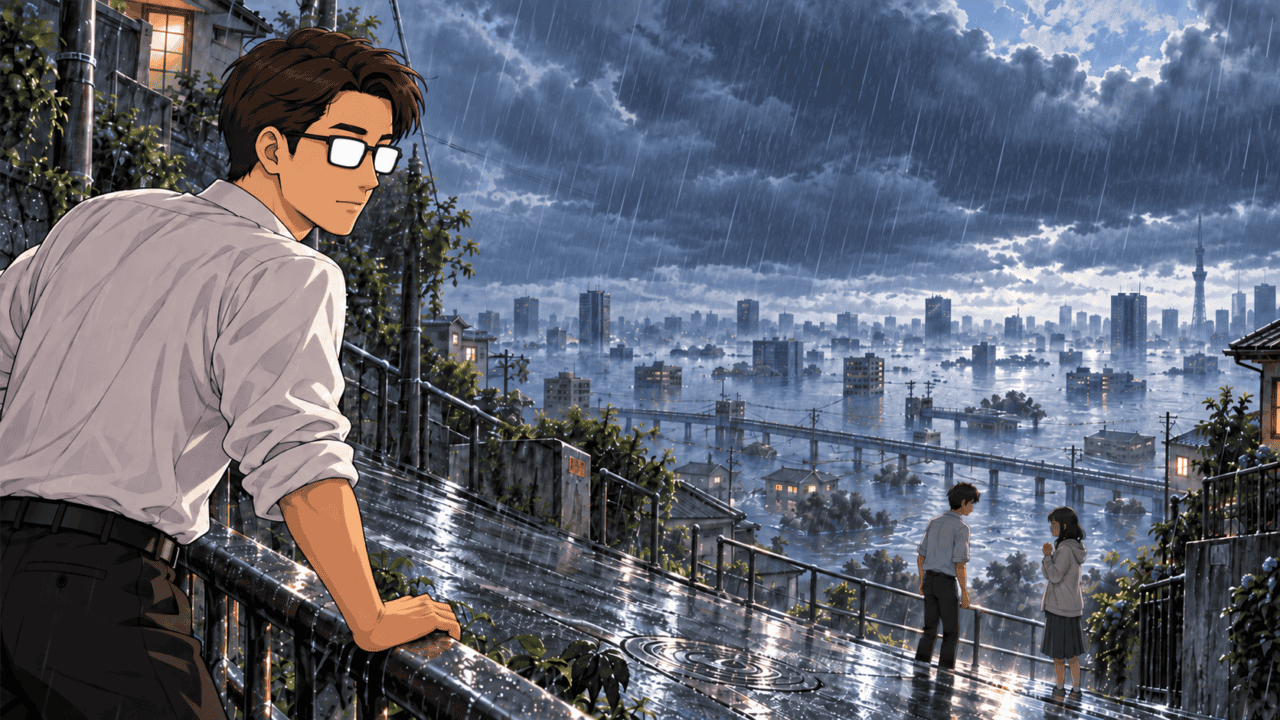
The rain has not stopped since that day, and Tokyo has become a city of water. Still, people live there, beginning a new chapter in its history.
The people Hodaka meets again are kind to him, despite the transformation his actions have brought about.
He wanders through Tokyo, unexpectedly uncertain. What had he done? Had it all been an illusion, something empty?
Then, in the rain, he finds Hina praying to the sky.
He approaches her and tells her:
“Hina… I’m sure… we’re gonna be OK!”
Explore more dialogue from the film in Weathering with You quotes in Japanese and English.
Weathering with You: Themes and Interpretation
The ending, Hina’s power, and Hodaka’s wound offer different ways into the film’s themes.
Youthful Desires and Adult Intervention
Throughout Weathering with You, I see a conflict between the young person’s urgent demand to be allowed to live independently and adults—or society—who cannot leave children alone.
At a certain age, especially when many restrictions demand restraint, a desire for a world of one’s own—or a world for just two people—can burst out in response. Hodaka and Hina’s struggle to escape adult rules and live together embodies that desire.
The police, child-welfare workers, and Suga try to protect them according to law, social norms, or goodwill. Yet that intervention also blocks their freedom and choices, pushing them into a corner.
Even with a flooded Tokyo before them, the two affirm that they will be okay. I read this ending as Shinkai’s determination to affirm youthful desire and choice through fiction, placing a personal bond above social correctness or the world’s harmony. Could this conflict between youthful desires and adult intervention be the central theme driving the story toward its divisive conclusion?
What Are the Weather Maiden’s Powers and Role?
In my reading, Hina’s power is more than an ability to bring sunshine. The weather maiden originally mediated between people and the sky; her ability to call lightning supports that possibility. As humans came to demand only clear weather and lost their dialogue with nature, her role may have changed into that of a sacrifice offered to keep the weather in balance.
Hina’s power is central to the film. It is mostly used to clear rainy skies, but that cannot be the whole of it: on at least one occasion, her prayer calls down lightning.
What, then, can a weather maiden really do, and what sort of figure is she? I develop my own interpretation in the article linked below.
Read the fuller interpretation here:
Weathering with You: The Weather Maiden and the Joy of Falling
What Does “We’re Gonna Be OK” Mean?
I read Hodaka’s assurance as an affirmation grounded in knowing he saved Hina through his own choice. Rather than simply feeling guilty for changing the world, he accepts his decision and resolves to live here. It can also be read as encouragement from Shinkai: if even these two can affirm a choice that changed the world, the audience can affirm its own decisions.
Weathering with You fits the broad framework of sekai-kei: the girl in front of the boy matters more than the world’s fate, and their personal problems are directly connected to the world’s problems. (Other works often discussed in that context include Evangelion and Saikano.)
Yet the extreme self-affirmation of the final line seems to depart from that framework. At least, this is what strikes me about Weathering with You: the two insist that they will be okay.
Why end on that extreme affirmation? I discuss my answer in more detail in the following article.
Read the discussion of the ending here:
What Does “We’re Gonna Be OK” Mean?
Why Show the Wound on Hodaka’s Cheek?
In this interpretation, Hodaka’s cheek wound is more than a sign of desperation. At first he follows his own rules, his sense of justice and his desires. After seeing Hina’s sacrifice, he begins running truly for another person. The wound makes that inner change visible, much as nakedness does in Run, Melos!
Near the end, Hodaka cuts his left cheek while running to save Hina. It looks painfully sore, but he keeps going. Why include it? The plot could proceed in exactly the same way without that wound.
I think it has a deeper purpose. In the linked article, I compare it with the nakedness of Melos in Osamu Dazai’s Run, Melos!, reading both as signs of a change in what drives a person.
Read the literary comparison here:
Hodaka’s Cheek Wound and Run, Melos!
How did you understand the final line, the wound, and the film’s ending?
Your Take: Hodaka’s Choice
The ending connects Hodaka and Hina’s future with a Tokyo transformed by rain. Where do you stand on Hodaka’s choice?
Poll results
How do you feel about Hodaka’s choice to bring Hina back?
- I support his choice to bring Hina back.0%
- I can’t support his choice, given the cost to others.0%
- I understand him, but I still feel conflicted.0%
- I see the ending differently.0%
- I’m not sure.0%


Reader Comments
Have a thought or interpretation? Leave a comment