
The Rebuild of Evangelion series ended on March 8, 2021. It felt like the end of Evangelion: 3.0+1.0 Thrice Upon a Time was also the end of the series as a whole—at least, I doubt we will see another Eva film directed by Hideaki Anno. As with Makoto Shinkai’s Weathering with You, I knew avoiding spoilers would be impossible, so I decided to go on the morning of opening day. Happily, I managed it.
I felt something stirring in me throughout the film, and plenty of scenes moved me deeply, but I just about managed not to cry.
It was on the way home that the tears came. As I thought about the Evangelion series and how long it had taken us to reach this day, I suddenly found myself crying.
For me, it was that kind of good film.
These are hurried notes, but I want to set down a few personal thoughts while the experience is still fresh.
Warning: Massive spoilers for the entire series ahead.
*This is a translated version. The original (Japanese) is available here.
- Gendo Ikari’s Confession
In Evangelion: 3.0+1.0, Gendo finally puts his weakness, his attachment to Yui, and his fear of Shinji into words. There is something important about hearing him acknowledge what we had long suspected. - A Satisfying Conclusion, Unlike the Zeta Gundam Films
The film offers the salvation that The End of Evangelion could not, bringing the story to a close in an ordinary world. Its structure resembles the Mobile Suit Zeta Gundam: A New Translation trilogy, but Evangelion succeeds, I think, because it actually concludes the series. - Mari Makinami’s Role
I read the ending as pairing Rei with Kaworu and Asuka with Kensuke, while Mari becomes Shinji’s new partner. Her arrival gives the story a way to take a new step. - The Repeat Sign “:||” and Trying Again
To me, “:||” suggests both Shinji’s repeated attempts to remake the world and Anno’s long process of trial and error. The final world without Evangelions feels like the director saying, “I’m not doing Eva anymore.”
On this pageContents
Thoughts on Evangelion: 3.0+1.0
Gendo Ikari Finally Spills It
One highlight of Evangelion: 3.0+1.0 has to be Gendo Ikari’s monologue. Shinji has spent the series exposing his inner life to us. This time, even Gendo cannot get away: he finally spills it.
Here is what Gendo finally admits:
- He has spent his life shutting himself away rather than connecting with other people.
- Meeting Yui made his world rosy.
- Losing her therefore left him in utter despair.
- He ran away from Shinji, telling himself it was for Shinji’s sake.
- In truth, he was afraid of Shinji.
- Thinking about it, all he needed to do was hug Shinji and cry, “Mom’s gone, and Dad doesn’t know what to do!”
Perhaps opening up for the first time was embarrassing. But relax, Gendo: we all knew that already.
Still, it was good to hear it from Gendo himself. Shinji’s revelations about his inner life had, in a sense, been Gendo’s revelations too. His attachment to Yui is what sets him apart, but he could have said something to Shinji. You took quite a detour, Gendo.
A Zeta Gundam Movie Ending That Works
Near the climax, Shinji and Gendo get into a father-son fight inside their Evas. (The shifting scenes vaguely reminded me of the ending of Urusei Yatsura 2: Beautiful Dreamer.) Gendo finally realizes that what he wanted was not to reunite with Yui but to say goodbye to her. In effect, he goes, “Oh! Then I don’t need the Human Instrumentality Project!” and stops the operation.
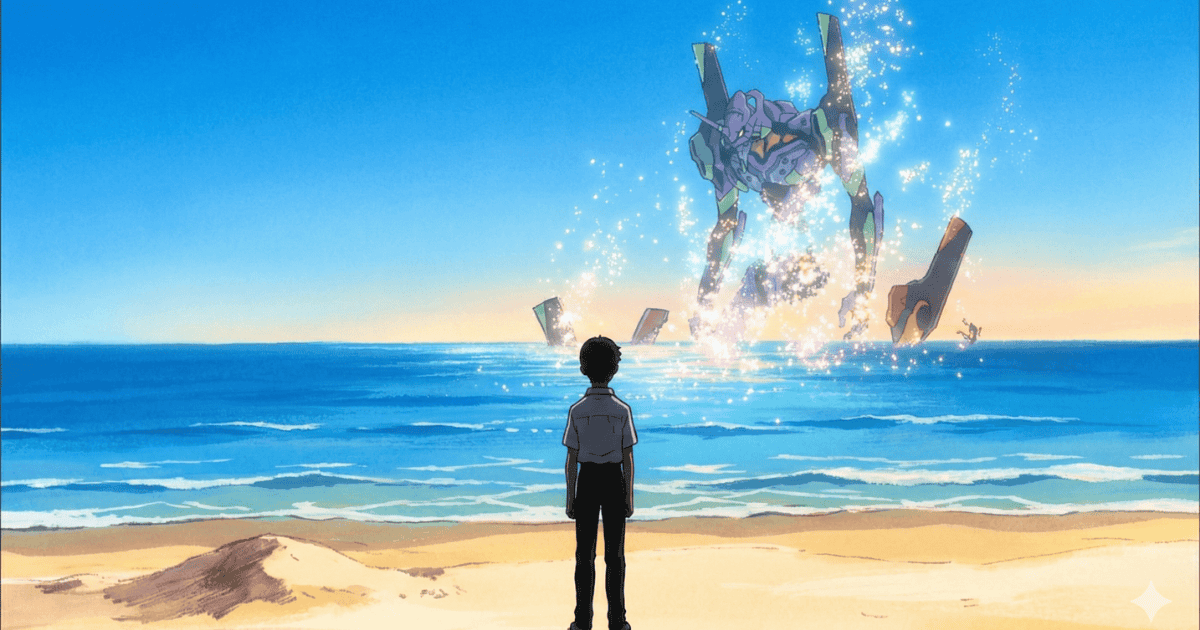
Shinji saves Asuka, Rei, and Kaworu, then creates an ordinary world for a new genesis: a messy world where people are separate and friction remains, but the people who matter to you are there. (This part reminded me of the ending of JoJo’s Bizarre Adventure Part 6.)
It feels like the world Shinji almost reached at the end of The End of Evangelion, and “the ending we wanted for him back then.”
Perhaps this resembles the ending of the Mobile Suit Zeta Gundam: A New Translation films.
As you know, the TV version of Zeta Gundam ends with Kamille losing his mind. The films instead leave him embracing Fa in space. That was surely the ending we had wanted when we watched the TV series.
Yet the Zeta Gundam film ending still leaves me dissatisfied, because parts of it do not fit what comes afterward.
Do I have the same dissatisfaction with Evangelion: 3.0+1.0? Not at all. My reaction was, “You did it, Shinji!” and “Thank you, Director Anno!”
The two works have these things in common for me:
- I was dissatisfied with the original ending but found a way to accept it.
- I am satisfied with the new ending itself.
The problem, I think, is that the Zeta Gundam films cannot conclude the Gundam series. If they had been its finale, perhaps I would have said, “You did it, Kamille!” and “Thank you, Director Tomino!”
Whatever the comparison, the ending of Evangelion: 3.0+1.0 was wonderful. A long, long, long battle was finally over. You did it, Shinji.
Why Mari Makinami Was There
Mari Makinami Illustrious remained a mystery almost to the very end of the Rebuild series. The photograph made it seem all but certain that she had known Gendo and Fuyutsuki for a long time. But I still could not understand why the story needed this new character. Then, at the very end, it dawned on me:
So that was it! I had not thought of that possibility. I read the ending as bringing Asuka together with Kensuke, with whom she had grown close during the missing fourteen years, and Rei together with Kaworu.
Some people may be dissatisfied with those pairings, but I liked them.
What Does the Repeat Sign “:||” Mean?
The repeat sign “:||” in the title of Evangelion: 3.0+1.0 looked so suggestive that it inspired all kinds of interpretations. The film never explicitly resolves it, but I suspect it means something like this:
Shinji has remade the world again and again to reach the ending we saw. I think the sign also reflects the many rounds of trial and error Director Anno went through to get there.
Since Shinji creates a world without Evangelions, perhaps Anno is also telling us, “I’ve done this much. That’s enough, right? I’m not doing Eva anymore.”
It feels a little sad, but all we can really say is “Congratulations.”
Final Thoughts
These are impressions after a single viewing. I am sure I have missed details, and my thinking may change later. Even so, I want to keep a record of how it felt to see the conclusion of Evangelion for the first time.
As for “:||,” perhaps the Evangelion series will continue without Anno. Or perhaps, since the repeat sign is attached to the theatrical title, something else will happen on TV.
I do not know where the series will go from here. But I feel that, for us, Evangelion: 3.0+1.0 Thrice Upon a Time will remain the conclusion of Evangelion.




Reader Comments